Friday, October 5, 2007

On Mercantilism


Mercantilism was the theory that gathering the limited supply of wealth in the world is vital to the survival of a nation; thus mercantilists insisted on very strict government control of trade and commerce. Well, if that's the case then the Stamp Act, Tea Tax, and all other impositions by the British government on trade in the Colonies make sense. The same taxes et alia were imposed in Britain to almost 3 times the amount they were in the colonies, yet Britain didn't revolt. Why not? B/c the colonists had discovered how wealthy they could become if the government left them the hell alone. So our entire Revolution owes a big tip of the hat to the laissez-faire economics that runs in opposition to mercantilism.


Moreover, in our century (20th) FDR tried the same trick as King George; the New Deal laid a heavy series of taxes and controls on big commerce and trade and consolidated American votes in Washington with the excuse that they were "looking out for the little guy." They weren't. It was mercantilism under another form. And the damage that FDR did to the economy and the government didn't even begin to be undone until Reaganomics in the 1980s.

Monday, September 24, 2007

In praise of garbage

I ought to write a book (I ought to write several books) and title it "In Praise of Garbage". Reflecting on the Federalist papers leads me to believe that our national penchant for just mindless junk is actually a very fine thing. Oh, don't get me wrong, I still think that filling the heads of the young with a lot of mindless garbage can be a bad thing if that's all there is. I still have valuable RAM taken up with the words of Oingo Boingo songs, Oscar Meyer weiner ditties, baseball stats of the Chi White Sox in 1980s and trivia about Star Wars. But Hamilton claims in Federalist 10 that one of the ways to remove the deadly threat of factions is to make the populace share similar values. He dismisses this as impossible since people by nature are different and will choose different things. But what if something has occurred that Hamilton could not foresee? In our time, the last 100 years we have seen the development of the automobile and road system allowing people to travel far and spread out in a mass Exodus throughout the nation; we have seen the rise of movies, TV, and radio, and now internet and video games allowing people across the nation to share the same entertainments; we have seen the rise of professional sports allowing people throughout the nation to have similar loves of divergent activity; we have seen the mass market of foodstuffs, toys, clothing, and gear allowing people to collect cheaply a vast array of similar junk; we have seen the rise of the shopping mall, the waterpark, the drivein movie theater and all the other pasttimes that people enjoy in their leisure time; we have seen the evolution of the five day work week, the summer vacation, and the watercooler allowing people to make a good living and gripe about it to boot; we have seen the proliferation of various foodstuffs of all ethnic and bland variety (KFC and Bucca di Beppo in the same block) allowing people to eat good food from various backgrounds.

Much of this might be dismissed as the work of the devil which only serves to corrupt our sensibilities, make us hedonistic bread heads, and lead us into a callous Americanistic boorishness not shared by our more elite neighbors on the other side of the swimming pool. True, true, true.

But think of it... where else on earth do people from so vast a geographical distance get together to share a love of Hummells? where else on earth do thousands of screaming fans go to watch the Twinkies beat the tar out of the White Sox and then go home amicably? where else on earth can people on either East or Left coast talk jovially about the latest episode of Survivor? Garbage brings us together.

I know, there's alot more that brings us together, but no one seems to give credit to this amazing American phenomenon of the production of garbage. No other country does it on so vast a scale. No other country seems to share so various and so similar tastes. And no other country enjoys the relative peace and amity that America enjoys. Even when we hate the opposition we don't actually go out and flay them.

In the Middle East to solve a problem means open carnage in the streets, murder, mayhem, yelling, screaming and riots. But then, the Middle East has never had a professional sports league like the Giants. Is there a connection? I think that indeed there is and if/when I write my book I will give a big hats off to whomever first said, "that'd sell to the American people."

Wednesday, September 5, 2007

Alexander Wilder and the Greek Gods

This excerpt from Alexander Wilder struck me as quite significant:

The worship of these subordinate beings constituted the idolatry charged upon the ancients, an imputation not deserved by the philosophers who recognized but one Supreme Being, and professed to understand the hyponia or under-meaning, by which angels, demons and heroes were to be regarded. Epicuras said, "The gods exist, but they are not what the [[hoi polloi]], or common multitude, supposed them to be. He is not an infidel or atheist who denies the existence of the gods whom the multitude worship, but he is such who fastens on these gods the opinions of the multitude."

Aristotle declares: "The divine essence pervades the whole world of nature; what are styled the gods are only the first principles. The myths and stories were devised to make the religious systems intelligible and attractive to the people, who otherwise would not give them any regard or veneration." Thus the stories of Jupiter, the siege of Troy, the wanderings of Ulysses, the adventures of Hercules, were but tales and fables, which had a deep under-meaning. "All men yearn after the gods," says Homer. All the old worships indicate the existence of a single theosophy anterior to them. "The key that is to open one must open all; otherwise it cannot be the right key."

~Alexander Wilder


What Aristotle seems to touch on is a fundamental reality of human existence; we perceive metaphysical realities first and foremost through artwork, images, forms. Philosophy and theology express metaphysical truth and make it intelligible, but myths and stories make metaphysical truth intelligible and attractive. Thus we find ourselves "relating" to a song or movie or story, though not to the doctrine of three persons in one god. The "gods", then, are these powers or manifestations of the One God that occur in our world and through us. We still today make heroes of our celebrities. Emulating them and admiring their enviable success, we tacitly wish that we too could be famous and svelt and successful. We still conjure the pagan gods as well each time we covet the luxuries of the shopping mall, or make a deity of alcohol and drugs, or over-romanticize sexual love through porn or adultery. The pagan gods and heroes are still very much with us b/c they are part of a fundamental longing in the human heart. By worshiping them we run the risk of becoming again their slaves and making them, as Augustine said, into demons. But by studying them and pondering what they really embodied, we not only come to understand the unique greatness of Christianity, we also come to know the metaphysical world and ourselves as well.

Monday, August 20, 2007

Beowulf the hero

I read with interest Douglas Wilson’s article on Beowulf in Touchstone magazine. I was surprised, however, that Mr. Wilson did not mention the concept of Ragnarok in regards to the epic poem. Surely the pagan Norse were not unique in their experience of internecine war, treachery, and hopelessness; one has to look only to the strife-ridden court of Constantinople to prove this. But the Norse were unique in their concept of Ragnarok as an inevitable end of everything that exists (gods included). As J.R.R. Tolkien has pointed out in his masterful article “The Monsters and the Critics” the heroic strength to face despair and grapple manfully with it rather than backing down is the greatest contribution that Anglo-Saxon literature has given to Western culture. This concept must have permeated the world view of the Anglo-Saxon poet and influenced the nature of his work.
When the Anglo-Saxons sharing this world view of inevitable ruin were converted to Christianity they must have seen in the person of Christ a savior who fit this view of heroism. Such an interpretation is born out by two examples, namely “The Dream of the Rood” which refers to Christ’s victory over death in terms of bravery in battle and entrance into the Lord’s mead hall.

That Son was victory-fast in that great venture,
with might and good-speed when he with many,
vast host of souls, came to God's kingdom,
One-Wielder Almighty: bliss to the angels
and all the saints--those who in heaven
dwelt long in glory--when their Wielder came,
Almighty God, where his homeland was.

Se sunu wæs sigorfæst on þam siðfate,
mihtig ond spedig, þa he mid manigeo com,
gasta weorode, on godes rice,
anwealda ælmihtig, englum to blisse
ond eallum ðam halgum þam þe on heofonum ær
wunedon on wuldre, þa heora wealdend cwom,
ælmihtig god, þær his eðel wæs.

The second example is a vignette concerning the conversion of King Edwin in “Bede’s Ecclesiastical History”, Bk II, Ch XIII. After the priest, Coifi, gives a speech supporting Christianity and calling for conversion, one unnamed theign casts his lot in favor of conversion and uses the famous image of a sparrow flying through a mead hall, saying,

"The present life of man, O king, seems to me, in comparison of that time which is unknown to us, like to the swift flight of a sparrow through the room wherein you sit at supper in winter, with your commanders and ministers, and a good fire in the midst, whilst the storms of rain and snow prevail abroad; the sparrow, I say, flying in at one door, and immediately out at another, whilst he is within, is safe from the wintry storm; but after a short space of fair weather, he immediately vanishes out of your sight, into the dark winter from which he had emerged. So this life of man appears for a short space, but of what went before, or what is to follow, we are utterly ignorant. If, therefore, this new doctrine contains something more certain, it seems justly to deserve to be followed."

The darkness surrounding the mead hall, with all its uncertainty and menace, is a parallel to Ragnarok, in the face of which every man is made weak. Beowulf proposes that facing this darkness is what makes a man heroic. Rather than crying out for something radically different than paganism it seems that the poet is actually encouraging his audience to embrace an image of heroism also exhibited in the heroism of Christ. As such, it tells a much more universal and human story.

Tuesday, August 14, 2007

Demons


And just in case you thought those stories about demons were a bunch of hooey....

Monday, August 13, 2007

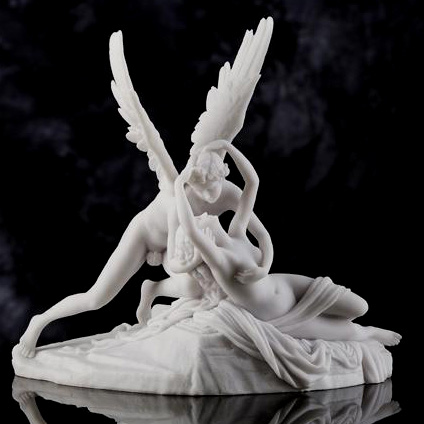
On Eros


A recent exchange with a graduate.


Dear Abecedarius,

Far be it from me to convert to paganism, but the Greeks' insight is starting to make it sound attractive.

Greeks had (as far as I know) two versions of the deityEros:


  1. Eros was not only erotic love and beauty but also the personification of the creative force, one of the primordial gods.


  2. The other version has Eros the god of romantic love, son of Aphrodite and Ares, and being a chaotic, mischievous force.

To some degree, Greek Polytheism seems to be the attempt to reconcile the unity of goodness and its many, often conflicting, manifestations. Zeus is a powerful god who in a sense stands for unity and goodness, but when the question is asked "From where comes evil?" we get comical images of the apathetic Zeus sleeping around. It's almost as if the Greeks knew goodness was one and was powerful, and that there was evil, and having no way to reconcile these two ideas, they made a farce of it by manifesting different goods in different gods so that they could conflict.

This is where the two versions of Eros come in. In the first sense, erotic infatuations are the most providential of human affairs, originating in being qua being himself more directly than any other passion; in the other sense, erotic infatuations are some divine anomaly (as many objectivist biologists like to think today) that are the result of a rebellious, chaotic and mischievous force, thus making erotic infatuations outside of divine providence. Both ideas seem to be common today, and both seem problematic.

On one end, an idol is made of Eros, and the items of worship range from modern innundation of Harlequin novels, to various television shows, to unhealthy obsessions that control lives, particularily high school girls. Eros is trusted as if he were God Himself, and current infatuations are taken to be THE infatuation. When Eros breaks one's trust, one can only experience the most nihilistic heartbreak.

On the other end, Eros is killed in the name of stoicism. There can be no romance, but mere sexual drive. Eros becomes a passion to overcome. In the Platonic sense, Eros is an appetitive passion, and the virtuous man controls and exercises temperance with regards to his romantic appetite. The problem with this scenario is that Eros seemingly cannot be controlled; it is by nature chaotic. One cannot chose whom one falls in love with, but can only choose whether to trust providence and pursue the beloved, or to trust his own wits, betray Eros, and pick a more suitable spouse outside Eros's counsel.

I suppose my entire email boils down to one question: Can one fall in love with the wrong person, and what are the ramifications of this?

Sincerely,

Alfred P. Student


~~~~~~~~~


Al,
You just jumped right in there, dintcha?

First, we have to consider that no idea, including ideas about the divine, ever occurs in a vacuum. We have to look at the historical progression of ideas to get a sense of what we are dealing with in the modern world.

Yes, the ancients did see the force of Eros as positive and negative; but they saw all divine forces as such. Man was a pawn in the plan of the gods, subject to the whimsy that changed on a drachma. So Eros was both the beautiful force of attraction to the good, and it was the destructive force that played gin rummy on human lives. What were they talking about? Most probably they were describing that force that drives us to love this or that thing/person beyond our control. For the ancients, to disobey such a force caused ruin and, since life was short, one took what pleasure one could when one could. Carpe diem, said the Latins. Not everyone did this of course (Hector) but all reckoned that this was a force to have to deal with. Euripides’ “Bacchae” is really dealing with just this force of wild abandon and desire; ecstasy. I really believe that the ancients did see these forces as stemming from a central force or being, but they didn’t talk that way. Probably b/c humans must dissect in order to understand anything, so we break the power down to its constituent parts. Even Zeus himself was not the final force or power; he was merely the ruling Olympian god; law and order imposed on others (all of his sexual escapades are actually impositions of law, not eros gone willy nilly; they are rapes, not consensual powwows). This concept of various divisions of one force goes back to Neolithic (Stonehenge and Egyptians) times. Such gods were very real in that they really were thought to walk the earth but they bespoke of a dark and violent force to the world. Originally depicted as snakes, they later morph into animals and protean elemental forces. I don’t think that such a sense of terrifying snakiness has ever left us. We are still, as humans, quite pagan in our outlook on life. (so you can’t convert, you already are!) But history has added nuance to our paganism.

The first nuance was the change during Homer & later Plato’s time. Homer first starts to speak of the gods in a critical way. Not so much to poke holes in the whole polytheistic thing (I don’t think he was thinking that far ahead) but to show that these forces lent themselves to humor and tragedy. He was a radical in his era, but he also made a living by embodying the zeitgeist of the Ionian age. This same criticism is later picked up by the Athenians who see the gods not as gods external to us but as representations of forces within man. For Plato, the gods were a language for talking about those things we experience as humans. Nevertheless, the golden era philosophers seem to have believed that there really was a force of some sort to which man conformed (both physically and spiritually). This force is difficult to speak of directly so we speak of it through a mirror, or shield, which is polytheism. We anthropomorphize in order to understand. But in anthropomorphism a major change takes place. The snakiness disappears. No longer are the gods forces that control us, but they begin to become forces which we participate in (since they are manlike and not “Kadosh: otherness” as the Jews called them). Suddenly the gods become incarnate in man form and are thought to be understood not as beings that walked about the earth, but as forces which we control. No longer is Eros a destructive, whimsical force giving pleasure here or there, but becomes an expression of that longing which every man feels within him for some unknown beauty; the unknown Areopagite god. This unknown god is so beautiful that a man must control himself in order to see him, and sacrifice all else that he has for this richness. So a shift in teleology occurs; nuance is added to our pagan thought.

The next additional nuance comes from the merging of Jewish and Greek ideas. The Jews, who initially also saw the forces as serpents stemming from one serpent, began to conceive of the force as anthropomorphic; Yahweh was a man with hands, feet, breath, eyes, even a backside (which he shows to Moses). Moreover, he was a manlike being who loved his little creatures, instead of merely using them. This is a significant change. If the forces are within us, then the fact that the force loves us gives a teleology to the forces within us which is radically different than previous. This is why I love the mythology and religion of the Jews. God loved us, not only in a sexual way (as the Greek gods did) but in a deeply moving type of love that was beyond even eros. Eros becomes caught up in a greater love of self and other which is what Yahweh displays to his little shepherd idiots. We begin to get an insight through the Jewish faith into a being who loves on many levels; and thus we get an insight into the fact that our loves (whatever those mysterious movements in the soul are) have a greater telos than mere gain or pleasure. The Jews stressed family life as the greatest institution on earth. Man and woman were made to get married (not just to exchange bodily fluids) and within marriage sexual love was the highest expression of love (witness the book of Tobit wherein the demon seeks to block, not the marriage, but the sexual consummation of marriage). Thus for the Jews, women were honored above all else and the having of children was “arrows within your quiver.” Wealth became measured by how much one loved one’s god, one’s family and, by extension, one’s neighbors.

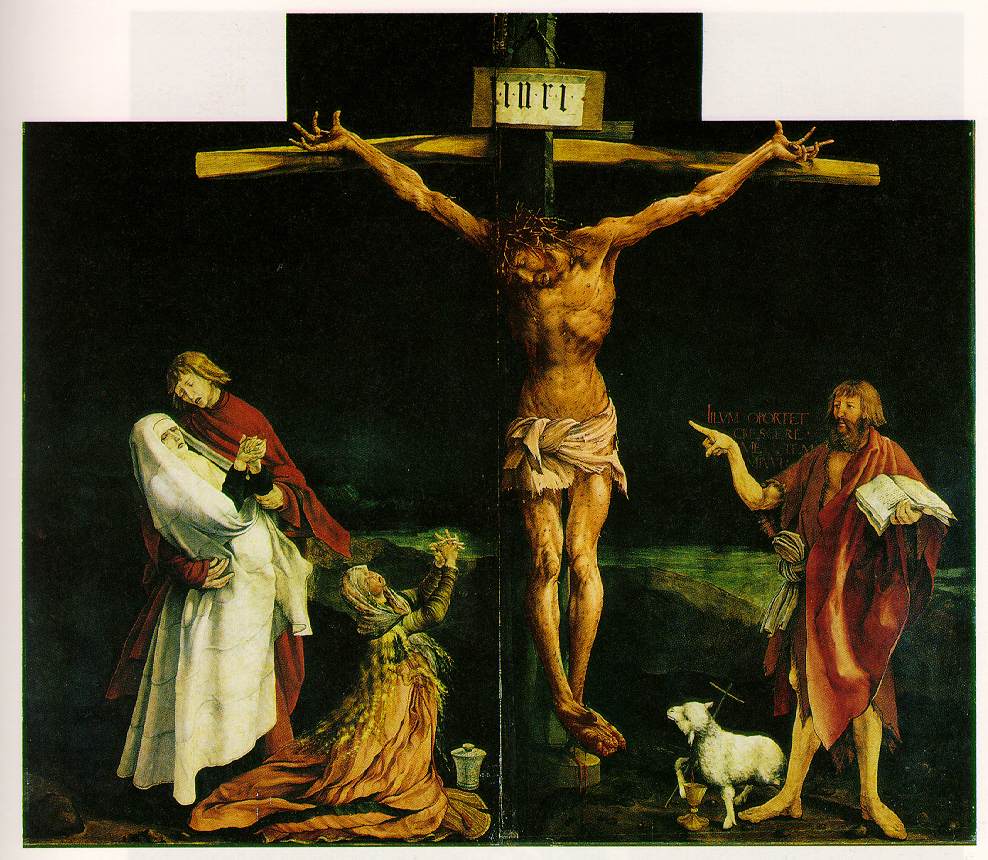
When the Jewish beliefs merged with the golden era Greek philosophy a new concept came into existence which again gave nuance to our paganism. The nuance was a merging of the Jewish concept of love & marriage (esp. as a symbol of God’s love) with the Greek idea of longing and self-control for a greater good. “No greater love hath a man than that he lay down his life for a friend.” In Christ we have the union of the concept of marriage and sex and birth with the concept of self-sacrifice, denial, suffering, resurrection. The Jewish aspect proclaims that “God so loved the world” and that Christ attended the wedding feast at Cana, and that “out of his side flowed blood and water.” The Greek aspect proclaims that “…he gave his only begotten son” and that Christ “suffered and died so that we might have life” and that on the third day he rose from the dead. The belief for men shifts in this nuance from being merely a concept to being an embodied individual; there really was a Christ, he really did bless marriage and friendship, he really did suffer and die and rise again. Thus our belief in the Incarnation changes our concept of ourselves. Not that if he could do it so can we (because that implies that success is merely a force of will) but rather that the focus of the divine force within us is to endure suffering and failure for the sake of the love of others not yet seen. Marriage and sex become a “total gift of self” (to borrow the words of JP2) and even Eros is subordinated to understanding, nobility & honor, and self sacrifice for the good of something greater. That’s one heck of a nuance.

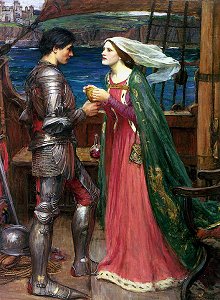
The final nuance, IMO, is that given to the West by the Medievals. The code of chivalry exalts women to the status of quasi-divine creatures. I don’t think this is a new exaltation; I think that men have always had a tendency to do this. But the Medievals gave voice to what this experience is like and in the romances suggested that such a natural exaltation is symbolic of man’s longing for something greater than himself. The knights, ladies, monsters, love affairs, duels, and quests that populate the Medieval romances are themselves a landscape of the human heart wherein man learns how best to focus his own natural desires. Sure we can sympathize with another man on a cross, but my own desire for a woman, esp. one made unattainable by marriage to another, eats at me and conflicts with that image of self-sacrifice embodied by the figure of Christ. How can I be a good Christian when I so desire her? How can my natural drive to procreate with this divine-like being be reconciled with the purity and chastity which Christianity urges me to cultivate? This is the big question of the romances the answer to which gives the final nuance to our paganism. Lancelot’s desire for Guinevere never fades. In fact his perpetual desire for her destroys everything that he has ever believed in; ruins his wife, strips him of all honor, wrecks the court of Camelot, takes the life of Arthur, prevents Lancelot from achieving the Grail, and reduces him to a starving heap of a man. Yet he does not stop loving her. If she is the image of longing which Eros produces that does not bode well for any of us. When does Eros let us go? The answer, I think, is never. But what Lancelot does is remarkable. He chooses to apply himself to an honorable course of life. He chooses to enter the monastery when Guinevere enters the convent. He chooses to do penance for the love that has brought so many to ruin. This choice is the answer to those big questions of desire; we choose honor even if it makes us suffer and die. By doing so, we are not driven about by Eros but have a choice to remain constant to a way of life we know to be right. In so doing we become the greatest of chivalric persons.

Taken altogether, I don’t know if I answered your question. Bluntly, can you fall in love with the wrong person? Sure. Are you driven by love to have to act on that love? Absolutely not. Our “falling in love” comes and goes; Eros still shoots arrows. And in our blackest moments we all of us are pagans. But what the history of thought has shown us is that those black moments do not have to last. Ultimately, our sexual desire and, moreover, the desire of our heart (b/c the two are not entirely separable) will always be for different people. But we are free to choose that person who is right for us (I mean by “right” honorable, financially secure, emotionally stable, supportive of us, and attractive), commit to them, and remain faithful despite the tidal changes of the heart.

Eros is a force, like all the pagan gods, which, if worshipped like a god becomes a demon. He does not command us, we command him. And in the name of honor, self-sacrifice, goodness and happiness, in the name of Jesus Christ, we order him down to his proper place.

Hope this all helps.
Friday, August 10, 2007

Monday, July 23, 2007

Tristan & Isolde

The lovely AbecedariusRegina and I watched the new version of "Tristan & Isolde" a few nights ago.
This new version is directed by Kevin Reynolds stars James Franco and Sophia Myles. Most of the critics hated the movie, but I'm afraid that in years of reading the Arthurian stories (Mabinogion, Gawain, Yvain, Cretien de Troyes and Malory and Pyle, et alia) and in years of looking for even one good adaptation of the Arthurian cycle, my standards have grown pretty low. First there was "Camelot" in which the Rogers & Hammerstein music made the whole thing rather silly. Then there was "Excalibur" where the blood, sex, and general Heavy Metaldom ruined the movie. Then there was "First Knight" in which the aging Sean Connery could not save the film from the acting of Richard Gere and the plot and direction of Jerry Zucker which produced a state of unbridled hilarity followed by dull disoriented nausea.

In brief there has never been a really good version of Arthur. There has never been a good version of Arthur. Hell, there's never been an even passible version of Arthur. All are bloody, oversexed, silly, ignoble, or downright laughable; Hollywood actors with perfect teeth flouncing about in poorly constructed armor delivering horrendous bits of ill-constructed English in bad British accents.

Thus it was that I came to the movie expecting little and found Tristan & Isolde somewhat above the crop. Yes the teeth are too perfect and the accents too bad and the costuming the usual dun colored pseudoprimitive garbage we saw in Antoine Fuqua's Fuquaed-up piece of shlock (whose sole redemption was watching Keira Knightly in tight fitting leather!). Nevertheless, though James Franco did little more than brood and bash heads, and though Sophia Myles was a bit on the breathless and whiny side, the movie nevertheless did some justice to this ancient story.

Let's not compare the movie to Tristan und Isolde by Wagner or to Howard Pyle's brilliant retelling of the story or even to the original tale of Beroul b/c the movie certainly does cut so big a wake as those excellent giants. Nevertheless, the plot does move, there are exciting moments and there is some good dialogue.

There were good lines such as

King Mark's address to the other chieftains, "Will you always be little men incapable of seeing what once was and may be again?"

or Tristan's last words to Isolde, "I don't know if life is greater than death. But love was more than either."

or Isolde's attempt to dissuade Tristan saying, "We both know this cannot be, Tristan. We knew it from the start. That doesn't mean it wasn't true, it is."

or her realization of the pain of adulterous love, "Yesterday at the market, I saw a couple holding hands... and I realized we'll never do that. Never anything like it. No picnics or unguarded smiles. No rings. Just... stolen moments that leave too quickly."

or Tristan's response to Isolde's praise of love, "There are other things to live for; duty, honor."

or Mark's pitiful confidence with Tristan, "Is it possible a man blinded by love might not see treachery right in front of him?"

The acting wasn't so atrocious that it burned the eyeballs to watch it. In fact, I thought that Rufus Sewell did a particularly good job in making Mark a likeable, rather pathetic, but ultimately noble man. Sophia Myles made good eye candy and did a passable job as a sweet, somewhat love stricken princess. Even James Franco was at least the brooding, if somewhat unbelievable, image of Tristan.

The story differs from the traditional Tristan & Isolde, adding political intrigue with a bloodthirsty (though not monstrous) king of Ireland, attacks on castles, raids on slavers, and Tristan's visit to Ireland prior to when he visits in the stories. Traditionally, Tristan visits Ireland as emissary for King Mark to win the hand of Isolde. During his stay on the emerald isle he becomes friends with her, and eventually falls in love with her. Some versions, including Wagner, attribute the love to a potion given Isolde by her witch mother for the sake of enticing Mark but which the two inadvertently drink, thus making their passion utterly beyond their control. They refrain from physical consummation of their desire, yet eventually, after the jealousy of Mark and the potential ruin of the court, they do have an interlude. It is a gripping and moving tale exploring the conflicts in man of jealousy, desire & reason, duty vs. love, honor vs. ruin.

The movie has Tristan loving Isolde physically before he ever returns to Cornwall (since Hollywood can't depict true love without making the beast with two backs). In this movie version, the irony is that Tristan wins Isolde in a contest of arms hosted by the duplicitous King of Ireland who seeks to drive a wedge between the chiefs of the English Isles (discount all history here, btw). It's an interesting twist on the tale and actually does work to produce an element of tragic tension. Tristan does refrain for some time (in movie time, of course) from engaging in adultery with Isolde and the movie does lean toward the fact that it is adultery. One does not desire harm to come to Mark and actually sympathizes with the poor one-handed cuckold. Further, the movie explores some of the damage which adultery, even adultery based on honest feelings of love, exacts on other people. Everyone around the adulterous couple notes their flirtation, except the benighted husband. Some try to warn them (Isolde's maid, Tristan's adopted brother) and some use the information to ruin Cornwall (Mark Strong in a great loathsome baddie role). But eventually all are affected.

There is an element of nobility in Tristan and Isolde, the former realizing the damage done by his careless passion and seeking to clear his name pushes Isolde away in a boat and gives his life to defend the keep. There is a hopeful ending to the movie with Cornwall surviving the onslaught of the Irish and the Irish king going down in a great oh shitter battle. And there is redemption for Mark who allows the two lovers to escape his prison and grants Tristan absolution at the end of his life.

The story would have been stronger had we seen the ruin of Cornwall due to this affair, and the cheesy epithet to the movie was completely useless. Perhaps the weakest point of the movie was the lack of thesis; was it about adulterous love? was it about the good power of love? was it about the treachery of jealousy? was it about honor superceding the temporary feeling of love? was it an attempt to tell "the real, historical story" of Tristan and Isolde (an attempt upon which many directors foolishly embark, nota bene Fuqua's upped effort)? Any single concentration on one of these theses would have benefitted the movie.

Yet overall, it was a good tale and good use of the material and is, so far, the best telling of an Arthurian tale to emerge from the Hollywood fleshpots.

Harry Potter

I had a good conversation with Mrs. S last night at our UD alumni blowout about Harry Potter. My feelings are somewhat mixed on the whole series; I admire J.K.Rowling for having "made it" in the literary world and for giving kids something, anything, to read BUT (there's always a big but) I don't much like the series nor do I clap my hands with more vigor for the HP series than I would for Donald Duck comic books (in fact some Donald Duck comics are better than Harry Potter). Kids are reading and enjoying the reading. Great! But that's akin to saying, kids are talking and enjoying the talking. The important matter isn't that they are reading/talking, but rather what they are reading/talking about. I like this article at National Review by Carol Iannone concerning Harry Potter. This line especially sums up the conundrum: because something sells and is popular doesn't mean it's good.
Verbum sapientibus

Tuesday, June 19, 2007

Michael Davis on Plato Nietzsche and Death

Just read an excellent article by Michael Davis in his collection of essays "Wonderlust" published by St. Augustine's Press. The essay entitled "Plato and Nietszche on Death", like most of the essays in the collection, has several penetrating insights. Davis recalls Nietzsche's critique of Platonic thought saying "For Nietzsche the West is in some sense the Christian West, and 'Christianity is Platonism for the people.'" Indeed, the Christian Church burgeons with Platonic imagery so much so that most people (who do not know Plato) hardly notice the influence, taking for granted their own heritage and thinking that Christianity somehow sprang, fully formed from the brow of Judaism.

But, Nietzsche's critique of both Christianity and Platonism is pejorative.

About the sage Nietzsche's Zarathustra has this to say:

His wisdom is: to wake in order to sleep well. And verily if life had no sense, and I had to choose nonsense, then I too would choose this the most sensible form of nonsense.

The contest between Plato and Nietzsche is, according to Nietzsche, a contest between the view that really makes sense of life and "the most sensible form of nonsense," that is, between truth and the most seductive form of error.

Nietzsche held that any such form of mythic illusion was no more than a lie which we tell ourselves in order to not have to face the harsh reality that there is nothing beyond this world. Plato gives false hope to his interlocutors by suggesting that The Good is the Intelligible and the Intelligible is beyond this world. "Nietzsche seems to say that this identification of the good with the intelligible is an example of Platonic cowardice," Davis points out. As a colleague of mine suggested, perhaps it is Nietzsche who is the coward. There is no mathematical proof that the things of religion are true; there is no absolute assurance beyond doubt that when we die we don't just cease to be; crikey, there is no certainty that the person of Christ was really a person. But it seems to take more courage to operate in this world, putting one foot before the next, without that mathematical certainty. To progress in doing good in the midst of a brutal, cruel, merciless world, never knowing if one is really doing the good or if there will be reward or if one is affecting any change at all (or if there is any transcendent being observing our actions) seems to be a much more courageous course of action than saying there is no good beyond this world and consequently doing nothing. It certainly is more consistent than one who says there is good and doesn't do it, and more logical than one who says there is no good but does good anyway. So perhaps the real coward is Nietzsche, even if he is an ubercoward.


More striking in the article are Davis' observations on exactly what Plato was doing in his dialogues. Assuming that Nietzsche was right in his critique and that Plato "does not regard the separate existence and particular immortality of souls even as conditionally true"; assuming that he was crafting a "noble lie", what sort of "lie" is it? (or to make the question more piquant, "what sort of lie is Christianity, being based on Platonic thought?") One of the things that Davis notes is that Plato himself is not present at the death of Socrates; in the Phaedo he is home, sick. Sickness being a little death, Plato is fighting to stay alive. Socrates, by contrast, is eager to die. Davis points out that this detail has great significance for the author of the dialogue himself seems to be advocating life in contrast to death. Yet if we take the characters in the dialogues not at face value (always a good practice for dealing with Plato) but as metaphors for something greater, what then is being portrayed?

Davis suggests that, first, the death scene is an intentional parallel to the Minotaur story of antiquity. In the older story Theseus
...saved fourteen Athenian youths and maidens from the dreaded Minotaur. ...Phaedo gives an enumeration of those present at Socrates' death, and we discover that fourteen youths are present. Like Theseus, Socrates will save these youths from a dreaded monster.
The monster from which Socrates saves his Athenian youths is the dreaded fear of death; not just the cessation of life, but something more. The minotaur is that half man/half bull which breathes ice and devours flesh in the dark; something terrible and cold and inhuman in that maze of the afterlife which devours the mind with despair. As Davis points out, "human beings live better lives when they are not continually haunted by the knowledge of the necessity of their own deaths." Thus the story functions on the level of myth that gives hope to both interlocutors and future generations of readers.

But, Davis suggests, there is still more to the dialogues. Indeed, Socrates is philosophy in the dialogues. As such, the implication is that philosophy seeks death. How could this be? Socrates does himself say that philosopy is a "preparation for death", but a seeking of death? Davis notes that philosophy is the pursuit of the absolute universal; the Good; good, beautiful, true in their universal, pure form. One falls in love with the Good and wants to be one with it.

But to do this a strange thing has to happen; one must lose oneself. Mollusks do not know they are mollusks, but men know that they are men. They register pain & suffering, have doubts & fears, hopes, loves, artistic insights, shame & pride. In short, men have a sense of their individuality, their "selfness". But the individuality of the self gets in the way of philosophy and as such must be rendered inert; abnegated; killed. The self must be put aside if one is going to experience the ecstasy of joining with the One. How, indeed, can the many be united to the One? Wouldn't they have to become the One in some sense? Thus the self must die if it is to live in union with the Good. In this way, Davis says, philosophy is self-destructive.


Before we have some mass Cathar suicide ritual going on here, though, we have to recall that Plato himself is not present at the death; he is alive and trying to stay that way (to paraphrase Jack Gilford). So Plato is not suggesting that physical death ought to be pursued. Rather, the fear of death addresses "what Cebes calls 'the child in us who has such fears'". Davis notes that,
The mortal fear of death naturally gives rise to a longing for immortality as its cure. This longing is not a desire to be different from what we are; it is rather a desire to remain eternally what we already are. It is an attachment to ourselves.
Everyone, from the slacker to the schoolgirl, from the professor to the pundit, abhors change and wants to be in control of the situation they know. No one wants to endure the suffering which death, in a most radical way, imposes. Thus we delude ourselves, surround ourselves with goodies, abuse each other, lord power over one another, and generally act like spoiled children. Such attachment to ourselves the Greeks called hubris, to which could be attributed every rotten excess of human crime and folly. In the Christian sense, pride (hubris) is the root of all sin (separation from God). Hubris is, essentially, an ingratitude for the goodness which we do not deserve. Thus, we have to grow up. Davis suggests that

Only knowledge of our own immortality can destroy the fears of that child in us and, in a rather radical way, force it to grow up.
Those who refuse to grow up avoid facing their own immortality and seek to maximize pleasure. Yet such eternal pleasure is not really possible; "...the complete absence of pain would be possible only given the complete absence of pleasure," as Davis notes, "the natural desire to maximize pleasure, if pushed to its extreme, is a sort of death wish." Yet the same holds true for anyone who longs for an afterlife of eternal pleasure. Since pleasure and pain are yoked together in the individual self, to eradicate one or the other would also eradicate a self to register them. Davis suggests that

...common sense takes as its standard the soul, or life, as it is, and then attempts to imagine what would be the most satisfactory form of such a life. The result is an ideal life, which because it takes its bearings by the extreme... cannot be lived. The ideal verson of life is incompatible with life; it turns out to be a kind of death. This is the tragedy of common sense.
Human life is, at root, tragic because we all long for something which would spell the end of us; we long for our own annihilation; oblivion;
a draught of vintage! that hath been
Cool'd a long age in the deep-delvèd earth

But as Keats noted, to long for such a thing spells our own forlorn doom. "While it is the case," Davis notes, "that the tragedy does not exist for a mollusk, it is also the case that a mollusk does not know that it is a mollusk. The human self seems to be constituted by the conflict between its desire to be what it is and its desire to be other than what it is." So at the very heart of philosophy, represented in Plato by Socrates, is an "awareness of the tragedy of common sense." If we indeed struggle under this crucifying tension of tragedy, why? from whence does it come? what is consciousness that it causes us to weep? and what is man that Thou dost care for him? mortal man that Thou dost love him?

For this reason it is of some importance that the whole question of immortality does not enter Socrates' argument as a means to overcome death. It enters as a means to overcome ignorance.
Man must know who he is; gnothi seauton, as the Greeks urged, if he is ever to grow up. Otherwise we stumble about striking, mocking, spitting at, and crucifying one another. But knowing who we are is hindered by the hubristic self-interest that every person bears with them. Self-concern "gets in the way of our pursuit of wisdom... to see the world as it is and not through the lens of our self-interest requires neutralizing self-interest." And to see with such clarity makes one a better person.


So religion (and the "noble lie" of religion) is not such a lie after all but a perspective shift. Davis concludes,

By asserting the existence of a better life after death (even without absolute mathematical assurance of such existence - my own interpolation here) this life is made better. That is, by providing a vantage point from which to judge the goodness of life, the character of this life can be known more fully.

Monday, June 18, 2007

About the Desire for Power

And now at last it comes. You will give me the Ring freely! In place of the Dark Lord you will set up a Queen. And I shall not be dark, but beautiful and terrible as the Morning and the Night! Fair as the Sea and the Sun and the Snow upon the Mountain! Dreadful as the Storm and the Lightning! Stronger than the foundations of the earth. All shall love me and despair!
~Galadriel

Tuesday, June 5, 2007

The Harmony of Apollo

To prove I'm not the only nut in the forest, here is Steve Bass with "Listening for the Harmonies of Apollo" published in American Arts Quarterly, Volume 18, number 2.

Monday, June 4, 2007

On Arthurian Romance


Had a wonderful get together on Friday last with Dr. BS, Dr. BC, KevinD, MichealO, MichaelT, ChristopherS, Dr. ArturoH. Thanks, lads.


During the course of the confab at said gt, Dr BS raises the question of courtly love/Arthurian Romance/troubadors et alia. What is so great about these stories? Why do we want our young people to read them? Aren’t they, as Catherine of Sienna indicates and Cervantes hints at, extolling vice as virtue? Most of the stories seem centered around adultery and violence… what’s noble about that? Gottfried von Strassbourg, for instance, makes the life of adulterous romance out to be more noble than the life of honorable marriage; Cretien de Troyes lionizes (literally in one story) the adulterous man; even Goethe himself, though not directly praising adultery, praises the tragic life of, say Tristan and Isolde, as more ennobling and admirable than the desultory life of honorable marriage. Is that virtuous? Aren’t the stories warping to the mind as they did to Don Quixote until one goes and tilts with windmills?


Great query, Doc, and I pick up that gauntlet with gusto!


There is much here and I’ll try to attribute to those what gets it the proper acknowl. First one has to consider the historic context. The court of Eleanor of Aquitaine was certainly rife with adulterous peccadilloes (Ellie herself being somewhat, shall we say, less than faithful to her piggish hubbie, Hank Dos). So the point must go to the fact that there was plenty of “boinkin’" in the courts of Medieval France. The troubadours (those pop stars of the day) certainly contributed to the glissando of this activity; they knew where their bread was buttered, after all, and probably the moralizing troubadour didn’t last too long in his profession.


And yet, human nature being what it is, the profligate character of the courts was little different from our own wayward culture. There were those who did then and those who do now just as there were those who refrained from doing then and now. So the songs of the troubadours probably didn’t encourage licention any more or less than Whitney Houston or Britney Spears do today (which they do; the point being it wasn’t more then). But then, as now, the corpus of lit wasn’t confined only to the Whitneys and the Britneys of the day. Simultaneous with Gottfried, Cretien, and the troubadours, were many excellent composers of liturgical music, attesting to the fact that secular and sacred art lived in commune. Additionally among the secular artists, a prolific number of writers on the Arthurian cycle exist, numbering among them; the author of Pearl & Gawain and the Green Knight, the author of the Niebelungenlied, the Song of Roland, William of Malmesbury, Henry of Huntingdon, Geoffrey of MonMouth, Thomas of Britain and his great epic “Tristan”, not to mention Beroul and even Marie de France in Eleanor’s own court. Additionally there was Robert de Boron who treated the characters of Merlin and Perceval quite well. The German authors Eilhart von Oberge and Hartmann von Aue who reworked the stories of Tristan and Eric and Enid (it’s parallel). The prose poet of the French Tristan, Luce de Gat and the French “Perlesvaus” by an anonymous author also treat favorably the stories of tragic love. The Norse, the Dutch, even Hebrew has a “Melech Artu” which is a reworking of this legend and the Welsh have the “Mabinogion” and the “Culhwch and Olwen” stories as well as the Romances, “Owain”, “Geraint and Enid”, & “Peredur, son of Efrawg” and the Greeks have a “Presbys Hippotes”, “Priestly Horsemen” story. Later in history there is Malory, Ludovico Ariosto, and extending into our own generations, Tennyson, Pyle, White, even Steinbeck does a poor treatment of the story. Numerous musical compositions have been created by none other than Purcell, Handel, Wagner, and numerous others including Lerner & Loewe (for what its worth). One of the most popular masses composed during the Renaissance was the “Missa L’homme armee”, the man at arms mass, and churches throughout Europe abound with knightly imagery. Plays, artwork, poetry have been constructed based on the Arthurian cycle in a list too long to name here. J.R.R. Tolkien himself, when considering what subject matter might give frame to his vision, seriously considered reworking the Arthurian cycle. The imagery of the Arthurian cycle permeates today our pop culture, our advertising industry, our current vision of politics, religion, and how to live life. It is, I would argue, the most dominant paradigm the West possesses.


So what is so enduring about a myth which seems to extol adultery? The whole of the Camelot court seems, as Theresa of Avila suggests, rife with knights and ladies not only incapable of controlling themselves but not even trying so to do. Why is the Arthurian legend so enduring?


Primarily, the Arthurian Romance ennobles man’s general tendency toward violence. Historically, the stories channeled the violent tendencies of a dominant warrior class which ruled Europe at the time. Dr. BernardC points out that the Middle Ages consisted of a warrior class holding the land over a large population of peasant/serfs. This class of men were professionally trained killers who frequently practiced their arts on the local serfs. Atrocities were known to happen. The Arthurian stories suggest that such action is base and ignoble. The true knight protects the weak and only fights those who are his equals. This suggestion, which became pervasive due to the treatment of the theme, has far-reaching consequences. Our current idea of the warrior is one who limits his energy only to release it in a torrent of violence upon those who are evil. Indeed the very concept of combating evil seems to have emerged through the Arthurian cycle. Our vision of religion as a battle takes its theme from this (witness the Saint Michael character and the exercises of St Ignatius of Loyola). Our vision of justice owes much to this as well and hence our civil and political thought; bad men need to be fought; moral relativism (an Eastern concept) is itself a lie which undermines the good man. Arthurian Romance created in the West the vision that struggle, violence, and combat were not random perennial events which the poor man must suffer (as the Greeks thought; life was war with occasional peace), but the major activity of the good man on this earth.


Further, the Arthurian Romance elevated the vision of woman. Setting aside for a moment the stories of adultery, women in the romances are continually depicted as noble, worth honoring, beautiful and the basis of every court (this goes back as far as the proto-Arthurian romance of “Beowulf” in the character of Wealtheow). It was one of the maxims of Arthurian chivalry that a man honors a woman, even an adulterous woman. The claim that Guinevere was an adulteress (though true) was only spoken of openly by the bastard churl, Mordred. Even the weak and bumbling Gawain, who refuses to defend the pyre of Guinevere because of the death of his brothers, will not openly speak of her affair. Women, even adulterous women, are to be honored and their reputation preserved. Moreover, women are perpetually the source of knightly action. Whether the knight set out on the quest to honor his mistress, or to serve his queen, or to protect his wife, or even to be with his lover, he was always motivated by some woman somewhere. Homosexual love never occurs in the Arthurian legends and motivations due to greed, revenge, hubris, desire for more camels or cows or the lust to conquer are non-existent. All motivations in Arthurian Romance involve a woman; Mark’s jealousy of Tristan begins due to Isolde (though some claim that he also has intentions on Tristan as Saul might have had for David), Launcelot’s madness occurs because of the tension between Guinevere and Elaine, Merlin’s imprisonment is due to his love for Elaine the enchantress (not the same Elaine but a girl synonymous with the Lady of the Lake). This honoring of women is simultaneous with the amazing and odd rise of the cult of Mary throughout Europe. This cult in the Church has its origins in England but spread throughout all of Christendom. Thus we even now refer to Mary as “Mother of the Church” the “Virgin of Virgins” the “Star of the Sea” and other noble epithetic titles. Our vision of women as important to society comes from the Arthurian legends; our love of romance, our sense of chivalry toward women (and thus the counter, rampant feminism and the current misogyny of our culture) and even women’s suffrage are all beholden to these cycles (there has been no feminist movement in the Middle East, after all).


Third, the Arthurian Romances ennobled the vision of society and government through the stories of Camelot and the Grail Quest. In the writings of those authors who treat these particular themes with gravity Camelot becomes the paragon of human society; the subordinating of individual human desires in order to graft together divergent powers and interests and create a working community capable of greatness. Interestingly enough, the Camelot story is inseparable from the Grail Quest; what can the well-formed society achieve? Finding the Grail, of course! Ever since the Arthurian stories, our society in the West has sought exactly this. We seek in our politics, our art, our commercialism, our daily activity, the Grail; that “ever-receding Ausonian shore” as Virgil put it when describing Rome. All our longings hint at something beyond this world consisting of happiness, greatness, completion. As my father, Dr Rollin Lasseter, puts it in one of his poems,

It is not so, we know it, despite snow,
These infinites you postulate
Beyond the reach of breath.
Mass is but mother of sorrows loaned
The void that we might suffocate.


This longing accounts for the sense of dissatisfaction which the West endures; the “god-shaped hole” to borrow the words of Bono. It also accounts for the perpetual self-critique to which the West subjects itself. Why haven’t we achieved the Grail? What have we done wrong? Was it our fault? What could we do better? What might we change? What exactly is the Grail? “What is the Secret,” asks Willy Loman. These are questions that no Easterner has ever asked (not that Eastern philosophy at its best doesn’t ask profound question, just not these). The West is perpetually reinventing itself because it constantly seeks this elusive Grail of perfection. The Grail represents that vision of perfection which can be conceived through mathematics, theology, philosophy, art & music, yet which only the truly good man (Galahad) can accomplish. Strangely, in all the stories of the Grail Quest, Galahad’s accomplishment doesn’t involve a trophy (he gets no Stanley Cup to take home, no shining Oscar to put on the mantel) but only a knowledge of himself, a gnothi seauton, and a love of that beauty to which he joins himself. The Grail, then, is phi, Christ, the perfect jazz riff, the zone on the basketball court, the ecstatic moment during “Long-Distance Runaround”, the grace of Peggy Fleming, the fluidity of Tiger Woods’ putt, the elegance of Wedgewood China, the S-curve in the statue of Our Lady of Perpetual Help, the beauty and power of the Pastoral Symphony, et alia (oh, I’m not equating Christ to Wedgewood China; work with me, people!) Over and over again people in the West launch into the Grail Quest with hope springing eternal that this time we might achieve the quest, this time we might find the Questing Beast, this time we might discover Avalon. Camelot, the perfect society, exists in order to accomplish this very difficult, fragile, excellent task; Camelot exists in order to form a more perfect union, that “government of the people, by the people, for the people, shall not perish from the earth”, that “all men, yes, black men as well as white men, (should) be guaranteed the unalienable rights of life, liberty and the pursuit of happiness.” Inexorably wound up with the formation of Camelot is the engagement in the Grail Quest.


Unfortunately for all humanity, also wound up with the formation of Camelot is the Affair of Lancelot and Guinevere. It is in this context that the existence of adultery in the Arthurian cycles really becomes comprehensible. Maugre those troubadours and poets who merely used adultery to entertain and titillate, adultery was in the cycles the one major source of all ruination. Tristan & Isolde fall to ruin only when they finally consummate there implacable love for each other. Elaine commits suicide only when Lancelot returns to adultery with Guinevere (a prefigurement of the later Camelot ruin). Merlin is ruined by adultery as is Uther Pendragon as is Gawain as is Arthur himself (whose adulterous/incestuous affair with his half-sister, Morgana le Fay, becomes the proximate cause of Camelot’s destruction). Adultery is not simply the fun, frivolous flaunting of Christian principles, it evades those principles in order to undermine the very root of human existence. What the adulterous complications in the Arthurian cycle point out is that fundamentally every human being is deeply flawed, and thus deeply in need of redemption. All humans struggle with the fomes (as Thomas called them); those powerful tugs on the human heart that seek to lead us toward things lesser than God. These fomes Augustine called “the gods” (and indeed he was probably more accurate than he thought since most of the Greeks and Romans thought of them as such, too); powers that when worshipped as gods become demons. We see these powers in our own culture; sex, violence, power, rebellion, sex, revenge, sloth, money, avarice, sex, sex, and sex. Indeed of these powers the most powerful, the unbridled sexual urge, Venus or Aphrodite or Astarte or Ishtar, causes ruin more often than any other. Failure in this realm leads to drug use, self-abuse, avarice, power grabbing, viciousness and all the other maladies of Pandora’s box (no pun intended there, no way…). Man seeks beauty, and is drawn, inexplicably, erotically toward beauty. But when that beauty is thwarted we fall to the worst forms of bestiality and vice ever conceived. So the adultery in the Arthurian stories becomes metaphor of this failed attraction toward that which is most loved and most unattainable. It embodies a tension in man between what he desires and what he knows he ought to desire. God, after all, is already married. Who are we to love Him? Who are we to presume that the Queen would look kindly upon us in our pathetic lowliness and bumbling incompetence? And when we don’t gain that ecstasy of heaven and settle for second best (the mistress, the job, fame) what disaster do we reek on ourselves and others? We end, as Lancelot does, running around the Grail Chapel, weeping because we cannot find the door in. Pathetic. Miserable. Imminently human. Thus the Grail/Camelot/Affair story embodies what we in the West see as The Human Story; misery, pain, longing for love, ruining things by our ineptitude, and seemingly unable to stop it all.


Yet the Arthurian Cycle doesn’t quit there. Perhaps this is the greatest element of the stories in the West. Greeks saw life as tragedy and ruin. The East sees things as destiny and karma. The Arthurian Cycle suggests that there is a form of redemption even after our failure. We still believe in goodness despite suffering blow upon blow upon blow. As my father writes in one of his poems,

Why still, beset by enemies the heart upholds,
To hear within that abstract horde, grown cold,
Persistent rumbles of the Night she praised,
The flashes lighting wide the Western skies
And then
The long-locked thunder of the Cross?

Christianity infuses this vision of the Arthurian cycle, certainly, but is also owing to it for the marvelous concrete figure which the stories give to the concept of salvation. After Camelot is annihilated, the knights all dead or scattered, the court at Carlisle a blackened hulk, the women homeless, childless, or master-less, two things happen. First, Arthur, with his dying breath commits his sword, Excalibur, back to the Lady of the Lake. He thus fulfills the promise which eventually made him king and relinquishes the symbol of earthly power and intellect granted to him to complete his task of the Grail. To borrow Tolkien’s wording, he gives up the ring. Consequently, Arthur, like Galadriel, refuses the power of a god, diminishes into the West, and remains Arturus Magnus. Because of this last act of heroism on his part he is taken to the undying lands of Avalon by the spirits of the magical world of Faerie. Even Arthur, in his incompetence as king/husband/father and his failure to perceive his wife’s infidelity transpiring in his own court, redeems himself by a last valiant act of humanity.


Second, both Lancelot and Guinevere, realizing too late the severe consequence of their ill-conceived affair, try to make amends for what they have done. She first enters a convent and denies Lancelot all access to her person. It is agony for her, but she knows it is necessary if she is to find any modicum of happiness. At last, sick and delirious from starvation she calls him one last time, tells him that she no longer loves him but loves Arthur, the “love of her girlhood” and then dies. He, driven to grief by her loss, enters a monastery where he finishes his days in acts of penitence, charity and prayer, “weeping out his last days” as Malory puts it. The ending of these two great figures reminds me of Sebastian Flyte, dying miserably on the steps of the monastery in “Brideshead Revisited.” Yet there is some salvation for these broken and wayward figures. Even losers can find redemption. As Kierkegaard put it, we “work out our salvation in fear and trembling.” I don’t think this is an encomium of such a life as the ideal, as Goethe might have it, but rather a recognition that in our worst moments as humans there might yet be some glimmer of hope. Hope seems, then, a distinctly Western ideal. Westerners do not habitually throw themselves on their swords, barring the ever honorable Romans; hari-kari is not our way. Rather, the underdog, the Rocky (be he III, IV, or MCM), the William Holden, the Cinderella Man, the Shane, becomes our model. Though tragic in its own right, the story of Lancelot and Guinevere (and its parallels in Tristan & Isolde, et alia) is really a story of redemption. Every man fails, inevitably; Finnsburgh burns, Beowulf dies, Peter betrays Christ, Frodo refuses the quest. What a man does with that failure afterwards determines his character as a churl or as a Chevalier au Lion.

Dedicatum cordi meo, Beth. Grazie, carissima bella.

Monday, May 21, 2007

Contact, Aquinas, Aristotle, and Faith

My lovely partner in the conspiracy and I saw the movie “Contact” the other night with Jodie Foster and Matthew McConaughey (yes I know it came out in 1997 and I’m behind the times; so what?). It was a fairly decent movie. Jodie Foster was excellent to watch, as usual, John Hurt was creepy, James Woods, Tom Skerritt, and William Fichtner all gave solid performances. The movie had some hokey things to it; beginning the movie with the young Jodie Foster character and showing elements from her childhood seemed a bit superfluous; the early sex scene between Foster and McConaughey was unnecessary and, though I know Hollywood knows no other way to show love, ruined the romantic tension later in the flick; the treatment of religious zealotry was absurd (Christian suicide bombers? Um, how many of those are there?), but overall these things could be ignored. What was intriguing about the movie was its central theme of faith versus skepticism.

The story was written by Carl Sagan, leading astronomer, physicist, atheist, so I doubt he was so generous to religion as the director, Robert Zemeckis, seems to have been in the movie. But the addition of the character of Palmer Joss, played by McConaughey, seems to have really put the zip into the story. Jodie Foster plays Ellie Arroway, a young (gorgeous, they’re always gorgeous) scientist working on SETI, the search for extra-terrestrial intelligence, after her father died. She is skeptical about religious belief and faith, preferring to look at the world as a “scientist” who sees only those things which can be empirically proven and thinking that religion is a form of mass self-delusion. The McConaughey character, however, challenges these assumptions with some pretty powerful refutations. Instead of philosophizing her to death he says “did you love your father? Prove it!” That seems a pretty powerful argument. Well, anyway, a message from intelligent lifeforms is received on earth, they build a big machine to travel through a wormhole, Ellie goes through the wormhole and sees another world (several other worlds, actually) and makes contact with other intelligences in the universe. She is overcome by the experience and weeps for the beauty of it. Unfortunately, when she returns, no one seems to believe her as she apparently never seemed to have left this world despite her protestations that she was gone for eighteen hours. All she can do is plead with others to accept the vision she has been given on faith. Thus Ellie is suddenly put in the position of being the religious visionary whom no one believes. Only McConaughey, out of love for her, believes her story.

Whether Sagan wanted to create a story about religious experience, or whether he wanted to create a scientific alternative to religious experience is unclear. But the idea that generations of people have mass-deluded themselves in order to escape being so alone is an interesting take on the religious experience. Even more interesting is that the McConaughey character refuses to accept this facile explanation of the mystic vision, partly because it is the belief of the majority of the race and partly because he simply knows, without doubt, that God is.

Here for me was the interesting point; there are two ways of looking at creation. Either one sees order & pattern, or one sees no order or pattern; either providence or chaos. If chaos, then the chaos cannot be limited only to some areas but must extend to all areas. Language, thought, emotions, experience, all of it is mere meaningless chaos. But if this is the case then even discussion about the issue is impossible and one can never find out if the truth is chaos or order. Aquinas speaks to this in the Summa Contra Gentiles;

THERE is then a twofold sort of truth in things divine for the wise man to study: one that can be attained by rational enquiry, another that transcends all the industry of reason. … our cognitive faculty has different aptitudes for the knowledge of divine things. To the declaration therefore of the first sort of truth we must proceed by demonstrative reasons that may serve to convince the adversary. But because such reasons are not forthcoming for truth of the second sort, our aim ought not to be to convince the adversary by reasons, but to refute his reasonings against the truth … alleging the authority of Scripture confirmed from heaven by miracles.


The Being we call “God” is order itself. To deny God is to deny order, pattern, reasoning and discussion itself. Thus, no amount of reasoning can succeed in persuading. Rather a transcendent from of truth, a metatruth has to take place in which the individual accepts certain fundamental principles such as “reason and argument are about something and lead to something.” Aquinas addresses this in his Summa Thelogica introduction when he says;

As other sciences do not argue in proof of their principles, but argue from their principles to demonstrate other truths in these sciences: so this doctrine does not argue in proof of its principles, which are the articles of faith, but from them it goes on to prove something else…

Thus mathematics does not begin by arguing whether a “one” or a “two” exist; nor does it argue whether addition and subtraction are valid procedures. Euclid himself begins his Elements with certain definitions:

Definition 1.
A point is that which has no part.
Definition 2.
A line is breadthless length.
Definition 3.
The ends of a line are points.
Etc.
Were he to prove whether “point” is a valid concept, or “partness” is indeterminate, or were he to excurse upon what the “that” is the Elements would never see completion. Every system of thought assumes some basic principles and proceeds from those principles to “demonstrate other truths in these sciences.” Thus to deny that there is an order & pattern, to deny that there is an orderer & patterner, a “kinoun akineton” as Aristotle calls it in the Metaphysics, is to completely end the conversation; emasculating oneself and preventing any success in discovering whether any of this yackity-yack connects to something real.

If, on the other hand, there is an order & pattern one has to then ask whether that pattern repeats. Is it consistent? Is the pattern transferable from one thing to the next in the physical world? In what way does the pattern connect to something beyond this world? What does the pattern say about the patterner? Such inquiry leads not to being stymied but to true wisdom; as Aquinas notes,
...they are called 'wise' who put things in their right order and control them well.
Wisdom consists in taking that first foolish step and accepting on faith that which cannot be immediately proven empirically; an experience, a relationship, The Forms (ala Plato), or the Neteru (ala the Egyptians). One accepts on faith that these things are, and then one can see them. The Psalm says “the fool in his heart has said ‘there is no God.’” This isn’t in reference to some cosmic fool wandering around in some Nietzschean state of denial, but rather to the fact that denial of such existence makes one foolish, incapable of seeing the Neteru.

As truth is a correspondence to reality, one seeks not truth but the reality to which it corresponds. But one cannot find that reality if one has previously denied its existence. Thus to really comprehend truth, acceptance of what seems outrageous, impossible, ludicrous to the rational mind, this very thing becomes necessary. With such acceptance one gains the wisdom that transcends reason. With denial one remains only a rational fool.

Wednesday, May 16, 2007

Plato's Theory of Forms

The idea of the Forms, the eidoi in Greek, is perhaps one of the most hotly debated ideas in the corpus of Plato’s work. Plato himself never seems to have concretely defined what he meant in his theory of Forms and the doctrine most often is interpreted as some attempt to account of the multiplicity of the created world. But in this passage in the Republic Bk VI Socrates seems to intimate that he is not setting down so much a doctrine of philosophic thought as a description of a relationship, or proportion. Describing the intelligible section of the divided line he says:

There are two subdivisions, in the lower of which the soul
uses the figures given by the former division as images; the enquiry can only be hypothetical, and instead of going upwards to a principle descends to the other end; in the higher of the two, the soul passes out of hypotheses, and goes up to a principle which is above hypotheses, making no use of images as in the former case, but proceeding only in and through the ideas themselves.

Socrates here is describing not so much a set doctrine but a relationship to the good which resembles something akin to love. When the soul first sets out to find the Good it examines the multiplicity of mathematical objects that govern the created world and hesitantly assumes certain principles on faith (such as that these mathematical objects are connected, that they are created by a Being that has reality, that there is an order to it all). Yet as the soul moves closer to loving the good it sees not multiplicity but unity and no longer questions the principles which initially led it to pursue the good. Discussing this idea Socrates says of mathematicians that


… although they make use of the visible forms and reason about them, they are thinking not of these, but of the ideals which they resemble; not of the figures which they draw, but of the absolute square and the absolute diameter, and so on --the forms which they draw or make, and which have shadows and reflections in water of their own, are converted by them into images, but they are really seeking to behold the things themselves, which can only be seen with the eye of the mind…

These Forms (the Neteru of the Egyptians) are not so much a thing or set of things to be attained but rather a relationship of harmonious union: the nomad soul drawn erotically toward the God, or conversely, the good intellect of God as it relates to His creations. Conceiving of them as terms or objects (i.e. goodness, truth, beauty, chairness or couchness) only limits them, as though to say that the closeness of lovers can be captured in a sentence or word or image. The minute one tries to define the Neteru one misconceives them and becomes like an outside voyeur attempting to comprehend the intimacy between lovers.

Plato’s consequent refusal to define the Forms seems understandable in this respect. Indeed the esoteric definitions of the Neteru become merely a guide to try and understand what can only be fully understood by direct experience on the part of the individual. The relationship of mathematical objects to Forms is one of unity increasing and multiplicity decreasing even as the soul ascends to love of the Good; the lover and the beloved are one. Descending from this, unity decreases and multiplicity increases until one diminishes to this specific math object governing this specific physical thing. Then descending into the realm of physical things, multiplicity (and consequent decrease in unity and infinity) increases again ending in the images we construct to comprehend those things. Yet all these multifarious objects are merely stepping stones, means to an end which is unity with the Good. As Socrates himself says:

…when I speak of the other division of the intelligible, you
will understand me to speak of that other sort of knowledge which reason herself attains by the power of dialectic, using the hypotheses not as first principles, but only as hypotheses --that is to say, as steps and points of departure into a world which is above hypotheses, in order that she may soar beyond them to the first principle of the whole; and clinging to this and then to that which depends on this, by successive steps she descends again without the aid of any sensible object, from ideas, through ideas, and in ideas she ends.

But the discussion is not one of a philosophic doctrine as it is a discussion of the soul’s longing for oneness with the Good; this thing is God and is not God. Deus ubi est? In the discussion there is an implied unbroken chain of being back to the Good itself so that all things are drawn to the God and God becomes all in all. The soul reaches a point where it no longer hypothesizes whether it is loved, nor does it any longer need signs and wonders to prove that it loves the Good or that the Good reciprocates that love. It passes out of the realm of hypothesis into a realm of knowing “which is above hypothesis”; a realm in which the soul knows that it is loved.

Friday, May 4, 2007

The Naked and the Nude

~ by Robert Graves

For me, the naked and the nude
(By lexicographers construed
As synonyms that should express
The same deficiency of dress
Or shelter) stand as wide apart
As love from lies, or truth from art.

Lovers without reproach will gaze
On bodies naked and ablaze;
The Hippocratic eye will see
In nakedness, anatomy;
And naked shines the Goddess when
She mounts her lion among men.

The nude are bold, the nude are sly
To hold each treasonable eye.
While draping by a showman's trick
Their dishabille in rhetoric,
They grin a mock-religious grin
Of scorn at those of naked skin.

The naked, therefore, who compete
Against the nude may know defeat;
Yet when they both together tread
The briary pastures of the dead,
By Gorgons with long whips pursued,
How naked go the sometimes nude!

There be dragons!