Monday, September 21, 2009

A bit of Isopsephia


The Tetragrammaton, YHVH, was the most powerful name of Almighty God to the Jews.

It occurs 5,410 times in the Bible, being divided among the books as follows: Genesis 153 times, Exodus 364, Leviticus 285, Numbers 387, Deuteronomy 230 (total in Torah 1,419); Joshua 170, Judges 158, Samuel 423, Kings 467, Isaiah 367, Jeremiah 555, Ezekiel 211, Minor Prophets 345 (total in Prophets 2,696); Psalms 645, Proverbs 87, Job 31, Ruth 16, Lamentations 32, Daniel 7, Ezra-Nehemiah 31, Chronicles 446 (total in Hagiographa 1,295).

So sacred was it that Jews would not utter it aloud after a certain era and substituted the name "Adonai" and "Jehovah" instead:
The true name of God was uttered only during worship in the Temple, in which the people were alone; and in the course of the services on the Day of Atonement the high priest pronounced the Sacred Name ten times.


A Jewish audience, familiar with that four letter formula would have recognized it when it showed up in literary isopsephia, the use of letters corresponding to numbers corresponding to concepts in religious literature.

Thus when the title of Christ, in three languages, shows up above the head of the crucified lord such an audience would immediately make the logical connection that this was the most powerful Elohim himself. In English the phrase above Christ's head is "Jesus the Nazarene King of the Jews" - in Latin "Iesus Nazarenus Rex Iudaeorum" (INRI) - in Greek "ησος Ναζωραος Bασιλες τν ουδαίων" (HNBO) - in Hebrew "Yeshua` HaNotsri U'Melech HaYehudim" (YHUH, or YHVH). Certainly, if nothing else, the Evangelists wished their audience to recognize the allusion.

The question then arises, if by the time of the crucifixion the utterance of the tetragrammaton was forbidden, wouldn't the Jewish crowd have recognized it and been incensed (in a bad way)? Wouldn't they riot against the Romans for committing such a blasphemy?

Matthew records no response from the Jews:

And sitting down they watched him there; And set up over his head his accusation written, THIS IS JESUS THE KING OF THE JEWS. Then were there two thieves crucified with him, one on the right hand, and another on the left.

Nor does Mark:

And it was the third hour, and they crucified him. And the superscription of his accusation was written over, THE KING OF THE JEWS. And with him they crucify two thieves; the one on his right hand, and the other on his left.

Nor does Luke:

And saying, If thou be the king of the Jews, save thyself. And a superscription also was written over him in letters of Greek, and Latin, and Hebrew, THIS IS THE KING OF THE JEWS. And one of the malefactors which were hanged railed on him, saying, If thou be Christ, save thyself and us.

Only John, the Greek-inspired isopsephiaist, recounts any response from the crowd to this action:

Where they crucified him, and two other with him, on either side one, and Jesus in the midst. And Pilate wrote a title, and put it on the cross. And the writing was JESUS OF NAZARETH THE KING OF THE JEWS. This title then read many of the Jews: for the place where Jesus was crucified was nigh to the city: and it was written in Hebrew, and Greek, and Latin. Then said the chief priests of the Jews to Pilate, "Write not, The King of the Jews; but that he said, I am King of the Jews." Pilate answered, "What I have written I have written."

The response of "take that down - you should not have written it" seems mild in comparison to the severity of the blasphemy. Additionally, John is a later writer, c. 90-100 and was writing for Greeks and lapsed Jews. So the response of his gospels was, probably, his own addition since it doesn't appear in the other three earlier works. Moreover, look at Pilate's response in this gospel; "What I have written I have written," in Greek "απεκριθη ο πιλατος ο γεγραφα γεγραφα"

A strange formula. Christ himself, though, was the LOGOS, the word made flesh. Does "written" here have another meaning? Written versus spoken word? Set down permanently on paper or wood like a man nailed to a cross? The living word of the LOGOS speech vs. the (soon to be) dead word of writing? (very Platonic that) We have to write it down if we are to remember it, right? But the minute we do don't we lose the power of life that is in the thought/word/speech? We have only a patient etherized upon a table not Lincoln in full force at Gettysburg. We have three lumps of stone in the morning sun and not three terrifying trolls. So is the whole of the crucifixion somethin of an injunction against mistaking the dead written word for the living reality?
"I have written that I have written." The formula reminds us immediately of another linguistic formula "I am that I am" or YHWH.

Interesting also to note in John that the INRI inscription appears at 19:19 "εγραψεν δε και τιτλον ο πιλατος και εθηκεν επι του σταυρου ην δε γεγραμμενον ιησους ο ναζωραιος ο βασιλευς των ιουδαιων". (emphasis mine - nota bene "grammenon" as in "tetragrammaton") That's no big deal, except it would have been a big deal to John and his audience b/c 19 is 18+1 or 6+6+6+1 or 6661. Again, no big deal until we realize that this "number of the beast" is part of a calculation involving 6 (the number of rational thought) elevated three times (the number of perfection) plus 1 (the number of unity and wholeness) which corresponds to the risen Lord.

My ability with this is very poor, but INRI connected to YHVH would have sparked in the mind's of John (and the other writers) and his audience a connection that was surely unavoidable. How they worked this connection into their writings is a remarkable bit of artistry.

Friday, September 18, 2009

Rome

Why I love this series. Blood, violence, sex, intrigue - naw. The main reason is that the series tells a human story and shows the tragedy of this ancient world not as a history book might but as human beings struggling through the sorrow of life. Here is the battle of Philippi and the noble Brutus and Cassius, who appear very human and very much more attractive than the snot-nosed Octavius and his callous commanders, are at last cut to ribbons in battle.

Enjoy!

Thursday, September 17, 2009

Beowulf performed


I love a great performance of a great work.
Here first is Benjamin Bagby of the group Sequentia performing in Old English accompanying himself with a lyre.


This next is a performance by Julian Glover in modern English with Old English masterfully interwoven. Glover does a really neat thing and performs the story as though it were being told at night around a campfire. That's perfect. Not only do we still do this, telling scary stories around a bonfire, but this surely would have been like the origin of that masterpiece that eventually made it to the Nowell Codex. Sir John Gielgud introduces the work:


Friday, September 11, 2009

Eight Years Ago Today

Bernard Lewis makes an excellent point about the war against terrorism. We think it is a war to stop attacks from the last 50 years. Al-Qaeda, however, conceives of the war as a continuation of what began 1500 years ago!

Wednesday, September 2, 2009

Tolkien : His Genius


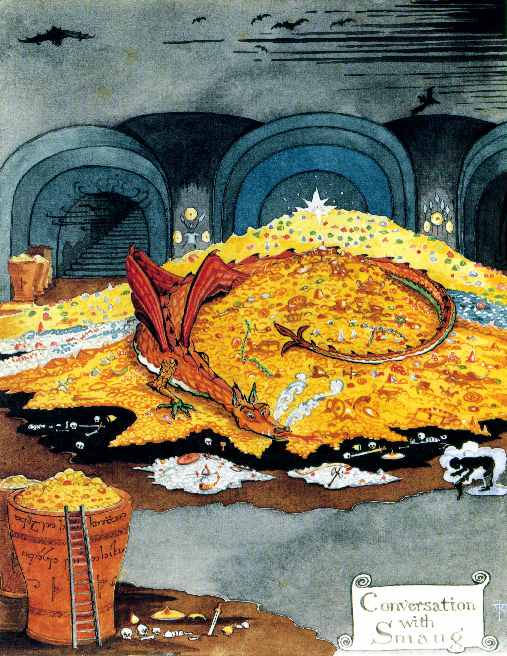
The genius of J.R.R. Tolkien seems often overlooked when referring to his "children's story" of The Hobbit. The story, however, reveals powerful depth of thought and construction. Tolkien was very familiar with dragons and dragon imagery saying of his own youth that he once sought to encounter a dragon; "I desired dragons with a profound desire." After the Somme he undoubtedly lost such a desire. However, Tolkien seems to intimate in his work that the encounter with a dragon is actually an encounter with oneself; the anagogical level of self-reflection that reveals a man to himself.

The dragon imagery dominates the work of The Hobbit. Tolkien frequently drew dragon images and designs and incorporated the imagery even into his map of the geography of Middle Earth. In this map the dragon tail curls from out of Hobbiton (under Bilbo's doorstep) running north into Ered Luin and the Forodwaith; the spine of the dragon consists of the Misty Mountains running south to Rohan and the spike of Orthanc tower where the "dragon rider" (Saruman) would sit; the neck of the dragon, the White Mountains, runs East to the head composed of the mountain range around Mordor (Ered Lithui & Ephel Duath), and the incessantly burning fires of Orodruin are the eye of the dragon. The ranges of Ered Mithruin and Ered Nimrais are the splayed left back leg and right front leg respectively.

Tolkien was drawing on an ancient tradition of Anglo-Saxon artwork that depicted coiling, spirallic dragons doubling in upon themselves in a series of twists and turns. These images were, in turn, an artistic depiction of the solar spiral which can be mapped using a simple gnomon with a magnifying glass on it. The pattern that emerges from spring equinox to fall is one of a double spiral - the dragon. Since most Anglo-Saxon cultures reveal sun worship as an essential component of their religion, this comes as no surprise. As early as neolithic architecture we find solar imagery dominating the artistic imagination of the British Isles. The dragon of Anglo-Saxon art was the solar path, or mirrored in it at least.

But Tolkien seems to employ the imagery to an even greater level. His dragon imagery embodies the action of self-reflection that emerges in serious intellectual inquiry. The essential questions of "Who am I?" "What am I about?" "What am I capable of?" lie at the heart of the spiritual quest to know ourselves. Consequently, the pattern of the Hobbit, which is itself a spiritual journey of self-discovery, displays this mirror doubling in its imagery.

The episode with the trolls is mirrored in the episode with the spiders. The trolls are a comic representation of the Trinity who threaten to "consume" the dwarves and hobbit even as divinity "consumes" the spirit. They, or more accurately, William's purse, ask the question "'Ere! Oo are yoo?" In this encounter Bilbo is defined by who he is and in his flusteration cannot answer correctly. Consequently his response accidentally becomes a riddle prompting the trolls to ask the followup question "what's a burrahobbit?" This is the divine question - "what is man?" = the question of the sphinx and of the psalmist and of any pilgrim setting out on the mystical journey. The encounter with the trolls is like that first terrifying encounter with the other/god in the dark. Yet when dawn comes, the threatening protean images have become manageable and still; turned to stone. From this encounter Bilbo gains strength and knowledge as a burglar, but also acquires his blade, Sting; a small sword but powerful - emblematic of the keenness of intellect and inquiry.

Similarly, the multitudinous spiders are divine, otherworldly creatures of nightmare and darkness. They attack the dwarves and the hobbit in the darkness of Mirkwood when the company tries to seek help from the elusive wood elves and wrap them in the eternal shroud of webbing to be "consumed" later. But Bilbo's encounter with the Trolls has prepared him for this meeting and he saves the dwarves with the help of Sting. The spiders ask "what is it?" in reference to Sting. Here Bilbo is not defined by who he is but what he does. As such he helps the dwarves escape after a great battle with the spiders.

The visiting of the beneficent high elves in Rivendell in which Thorin and company are the voluntary guests of Elrond is mirrored by the "visiting" of the hostile wood elves in Mirkwood in which the company are involuntary guests of Thranduil. Rivendell is a place of joy and light, rest after their encounter with the trolls. The wood elves are a place of darkness and treacherously alluring bounty which imprisons the company. Both are representative of the capacity for creative thought; the first in its benevolent form of comedy, the second in its malevolent form of tragedy. Bilbo leaves from the first riding on ponies and escapes from the second riding on barrels; a fact that later will confuse Smaug and help to save Bilbo.


The episode of intruding on the home of the goblins parallels the episode of intruding on the home of Beorn. The former, an image of depravity in the dark, involves the kidnapping of the dwarves and Bilbo while the latter, an image of solitary abundance in the open country, involves the necessary invasion of Beorn's privacy. Though they have kidnapped the group, the goblins claim they have been intruded upon "sitting on our front porch" and Thorin and company must assume a suppliant posture before the great goblin king. Ultimately they are saved from their imminent death by Gandalf. Though they don't want to intrude on Beorn, the company must if they are to continue their journey. Again they are saved by Gandalf who encourages Thorin and company to assume a suppliant posture with the giant skin-changer. Both episodes involve dwarves barging in on the home of a stranger and consequently echo the initial chapter of "Unexpected Party" and the latter chapter of "On the Doorstep". Bilbo, who fades in the goblin and Beorn section, is mimicked by the goblin king (whose front porch he has intruded upon) and by Beorn (who is the big man to Bilbo's little man).

At the heart of the story, and in the very bowels of the dragon lies Gollum. Gollumis an interesting doppleganger of Bilbo. Once hobbit, or hobbit-like, he lives in a hole in the ground, eats alot, loves riddles, and has one very great treasure; the ring of power. Bilbo's meeting with him, and the pity invoked therefrom, forces the hobbit to face what he too might become. Solitary, miserable, imprisoned and tortured by his own mind, gollum is a "non-living man" - a manikin or "golem". He aquires from Gollum, then, insight, reflection, the power to be self-critical and examine his own heart through the cyclic thought that goes round and round (or "there and back again"). This power, limited to certain individuals, allows them to slip from the vision of the rest of the world, escape the slavery that normalcy and daily existence impose on most people, and become the outsider - the catcher in the rye. It is a power that can lead one to be able to create law, art, music, myth or fashion the norms that govern society. In short, it is the power that leads to autonomy; "self-law". But the power is dangerous b/c it also can give delusions of grandeur which exceed the proper realm of the wielder making him think he is a dragon rather than a man. In doing so, the wielder does not really become a dragon but an "unman", a golem, wrestling with himself in a schizophrenic slavery to the one ring that rules them all.

Pathetic.

This sort of pathos is just what Bilbo must feel, confront, and leave behind. It poses an obstacle to his escape from the nightmarish womb of primordial existence in which Gollum dwells. No great leap for a man but a great leap for a hobbit. Nor is the escape without consequence as Bilbo hears behind him "Thief! Thief! Baggins! We hates it. Hates it forever!" Ever after the curse of becoming the manikin/doppleganger will dog Bilbo's domestic bliss (his Baggins side) pursuing him throughout Middle Earth, trying to join again the two halves that share the ring.

Bilbo's character as well has a dual element to it. He is both the domestic sedentary Baggins and the adventurous Took. He has elements of rabbit imagery but also of dragon imagery. He lives in a hole in the ground, likes comfort, likes to eat, has vast stores of treasure stowed away neatly in his hole, likes to blow smoke out of his nose, wears brightly colored clothing, is small and has hairy feet. Throughout the book the rabbit imagery appears again and again (with the trolls, the eagles, Beorn) but so too does the dragon imagery (riddles with Gollum, climbing the tree in Mirkwood, escaping the elves, facing Smaug, stealing the Arkenstone). Indeed, Bilbo's transformation in the novel is from the timid, domestic, rabbit straggling behind the dwarves into the bold, adventurous, dragonlike hero who leads the band in the end. Though Bilbo does not become a dragon in full (the threat of such an end appears only in LOTR when he begins to become like Sauron, the dragon) he nevertheless acquires characteristics that are "dragonlike" - loses his respectability among the hobbits and becomes a loner in Hobbiton, despite his wealth. He moves from grocer (fat, amiable, giving to others what they need in broad daylight; Barliman Butterbur) to "burglar indeed" (lean, solitary, taking from others under cover of darkness) when he steals the Arkenstone.

Moreover, Bilbo's nature seems to mimic the dragon, Smaug, in his propensity for riddles - he outriddles the dragon - his ability to acquire treasure, and his ability to see above all these "earth bound" individuals who live out their mundane lives in the Shire. At one point in Mirkwood, Bilbo climbs a tree and looks out over the vastness of the forest. There in the sunlight he sees thousands of little flying moths and the beauty of the moment strikes him as timeless. He experiences that other world beyond this in an almost angelic moment in which he is superior to the dwarves (little men). This response parallels the dragon's ability to fly above the earth, but without the contempt of a dragon for the small things and for beauty. A dragon, after all, cannot enjoy his own treasure; merely spoils it for others. But Bilbo does end up "soaring" above others. He is dubbed "elf friend" by the king of the wood elves, and proclaimed a prince by Bard. Indeed, he does fit the elvish Mithril armor better than many elf princes before him. Upon his return to Hobbiton he finds the cloddish Hobbits going about their material existence of selling his worldly goods at an auction. Tolkien makes a particular point that many were sorry he was not dead (a typical cloddish response) and that Bilbo had to take great pains to buy back his own silverware.

Ultimately Bilbo's confrontation with Smaug is the thing that allows him to soar even higher than the dragon. Though he acquires dragonish qualities his ability to confront and outriddle even this great terror breaks the dragon spell on him. Smaug asks him who he is and Bilbo, rather than reveal who he is tells what he has done. He hides behind the invisibility of his deeds and thus, when the despairing nature of the wyrm tries to catch him he can escape. What is a burrahobbit? Nothingness? Darkness? What is at the heart of man's existence? If it is nothingness then despair sets in and we become dragons or naught. But Bilbo's response, "I am what I have done" is something of a salvation. We may not be much, but we can do much and much for good. Thus when Bilbo steals the Arkenstone it is in an attempt for peace, not (as is paralleled in the Master of the Laketown) in a desperate attempt to save himself. This use of the treasure to help others allows him, in the end, to accept his smallness not as curse but as blessing. In the end we are admired by elves, men, dwarves, wizards who all like us very much; but are just little fellows in a very large world. And thank goodness for that.


Tuesday, September 1, 2009

Down into the cave


Plato says that it is necessary for the philosopher to descend again into the world of shadows in order to help others. I can't help but think, though, at the beginning of this school year, that though that is certainly true the philosopher must do this for his own sake as well. Perhaps man cannot live "up there" in the ether; the proper study of man is man and the proper realm of man is this realm of shadows and tears and images and thaumatopoioi. Perhaps at the end of all the searching for meaning in the things around us, we discover that there is a nothingness - or a vast, cold, brilliant realm of thin air (too thin for us to breathe) and only after a glimpse or two must we return to our own clime. This is a problem b/c "re-entry", as Walker Percy notes, is very painful. Jewish mysticism counselled against thinking that the nothingness was the end of the journey; there is a something, being itself, beyond that vast pale blue void of the abyss, they said, but crossing that area is outside the parvue of man in this life. Thus the philosopher returns not just for the sake of others, but for his own sake lest he fly too close to the sun, melt his wings, and plummet to the ocean of chaos and death.

Thursday, August 27, 2009

On the Liberal Arts


Our most excellent guidance counselor sent me the link to this article on a downturn in liberal arts education enrollment (a typical phenomena during a recession; people panic and try to get jobs that will pay, only to find themselves becoming destitute and then longing again for the shining city on the hill).


Applications to Colleges Such as St. John's Are Dropping As the Downturn Leads Families to Weigh the Value, And Price, of a Liberal Arts Degree More Carefully.


This article is from today's Washington Post (August 27. 2009):

I certainly understand the struggle of LA education in this sort of environment. Unfortunately, I think that they are fighting a losing battle when they claim that a LA education is “practical” and gives “tools for life”. I don’t know if that is correct and I don’t think it is a selling point. It’s much like University of Dallas trying to field a baseball team to compete with Texas Tech or SMU – ain’t gonna happen.

More to the point, though, I still am unconvinced that the praxis of liberal arts education is that strong. Praxis always speaks to utility, practicality, what are you gonna “do with” that degree in (insert LA field here)? When it comes down to it, LA education is impractical b/c it encourages the mind/soul/nous to pursue beauty, goodness, truth with ardor – not to use verum bonum pulchrum for some practical end. Such pursuit and contemplation ultimately is liberating; makes the freeman out of the slave, b/c it broadens the mind to see vaster vistas than before.

But liberation, though one of the main goals of the education, can’t actually succeed unless the student pursues knowledge with abandonment of any practical return; a certain ecstasy of sorts has to happen.

Therefore, I think LA education is as impractical as love.

Though it isn’t a big selling point to say “we offer an utterly impractical course of study” – ne’theless, if we make the modus operandi for study a praxis we have debased the finest and noblest of pursuits into something base and selfish; just as if we attribute to love a selfish motive, the promise of gain or some irresistible drive of biology we no longer have love, merely a weaker form of power.

Monday, August 3, 2009

An exchange - "Rope" and Dostoevsky

One of my colleagues sent me this note:

Hello colleagues,

I hope you are all having a good summer.

But I also hope one or more of you will be eager to apply your critical thinking and answer some of my questions regarding the following argument for atheism. The argument at the link below was sent to me by an alum – this is an article that is currently influencing his choosing atheism.

http://www.infidels.org/library/modern/raymond_bradley/moral.html

I am hoping one of you will volunteer to read this article and spend 30-60 minutes talking with me about it. I have some ideas about critiquing this argument – but as I am neither a theologian nor philosopher I would like to bounce my thoughts off of one of you and hear your response as well.

Thanks


Me: To misquote Jerry Maguire, Mr. Bradley lost me with "hello." In this opening paragraph he states:

First: there is ample precedent for what I am doing. Socrates, for example, examined the religious beliefs of his contemporaries--especially the belief that we ought to do what the gods command--and showed them to be both ill-founded and conceptually confused.

-no, he didn't. What he did was to shake the pharisaical complacency and self-righteousness of his contemporaries in order to deepen their understanding of their religious world. If we're to call Socrates (and Plato) anything it would not be "irreligious" and it certainly would not be "atheist". Why so many atheists turn to Plato for solace is utterly beyond me.

I wish to follow in his footsteps though not to share in his fate. A glass of wine, not of poison, would be my preferred reward. (coward)

FURTHER, he misunderstands the Dostoyevsky argument when he says:

"If there is no God, all things are permitted." So said one of Dostoyevsky's characters in Crime and Punishment. He was claiming that if God does not exist, then moral values would be a purely subjective matter to be determined by the whims of individuals or by counting heads in the social groups to which they belong; or perhaps even that moral values would be totally illusory and moral nihilism would prevail. In short--the argument goes--if there are objective moral truths, then God must exist.

No. That's not it at all. The argument Dostoyevsky is making is that if we abandon the reality of God (or even of gods) then there are no restrictions upon our actions and being a murderer is as valid as being a saint.

The actual passage is in Book 11, chapter 4 of Brothers K and consists of an exchange btwn Smerdyakov and Ivan Karamazov recounted by the increasingly insane Ivan to his brother, Alyosha. Here is the text:

"But what will become of men then?’ I asked him, ‘without God and immortal life? All things are lawful then, they can do what they like?’ ‘Didn’t you know?’ he said laughing, ‘a clever man can do what he likes,’ he said. ‘A clever man knows his way about, but you’ve put your foot in it, committing a murder, and now you are rotting in prison.’

Smerdyakov has just murdered a man and claims that Ivan is complicit in the murder b/c it was he that told Smerdyakov that men can do what they will w/o God. (See Hitchcock's "Rope") So in Dostoevsky's portrayal, the original idea professed by Ivan becomes the catalyst which justifies the murderous Smerdyakov in his actions!!!! It isn't a proof of the existence of God, it is a proof of the murderousness of human nature without God.

I never cease to be amazed by the ignorance of history that would claim that religion has been the cause of all our agony rather than that religion has been the one bulwark against the tide of war, famine, suffering and cruelty that inundates our miserable little race. That just isn't so, and Dostoevsky, on the eve of one of the bloodiest centuries in all of human history, was crying out against the abandonment of the one thing that might stem the blood dimmed tide and preserve the ceremony of innocence.

Finally, though, I dismiss the argument in the following way. I don't have time to read and refute all these arguments, I've read them before, thought them before, experienced each of them before. But if there is to be any argument about anything we have to first agree that argument, reason, logic, are fitted to a reality that exists. When we argue we argue about something. When we use language it is language about something. If nothing else, when we say "God" we mean this correspondence. Belief in the reality of that which we argue about allows argument itself. Belief in the reality to which language has correspondence allows language itself. Mr. Bradley argues there is no God.

If we agree with that argument then Mr. Bradley is no more right than Mr. Chesterton or Mr. Lewis or Mr. Pascal or Mr. Saint John and the only principle upon which we can rest any discussion is the triumph of my will over his or his will over mine.

I choose my will ... which dictates that his argument is trash.

End of discussion.


Here's "Rope":


Friday, July 31, 2009

Value, Meaning and the Economic Crisis

A great article by Frederick Turner in the American Arts Quarterly. Spot on about the connection between images and ideas as well as the nature of sacrifice.

Wednesday, July 22, 2009

A discussion on teaching

A former student of mine, interested in going into teaching, asked the following questions. Here are my answers.

************************************
He asks: As for advice,anything you can send my way would be great. I'm not even sure what questions to ask.

Respondeo ad eum: well, let me ask a few questions then:
1. what subject(s) are you teaching?
2. what age group?
3. where are you going to be teaching?


************************************
He asks: I guess my first question is what do you do differently from other teachers that makes you more successful or helps your students succeed to a greater degree?

Respondeo ad eum: first, I don't really follow any of that education classes BS like rubrics and week planners and teaching to different styles of learning. Partly b/c I'm no good at it, partly b/c it doesn't really seem to help in the long run. I little planning, yes, clear & simple expectations for student achievement, yes, organizing activities other than purely lecture, yes. I have a colleague who thinks that piling on oodles of terms and reading and lab work will help students love and learn the subject. Not true. An appropriate amount of work (with constant readjustment to what is reasonable) but not piles of backbreaking labor.

second, constant interpretation of texts, clarification, explaining things so that students can understand the material. discussion of the material. working through in discussion why the arguments are important.

third, I give only a few major terms that need to be known and repeat them, and repeat them, and repeat them. Other minor terms are thrown about during lectures and discussions, but the major terms (10 or so) are reiterated during the course of the year.

finally, I never pander to students. I've always treated students as though they were bright enough to understand the importance of what was put before them and important enough to put before them the best and most powerful stuff.

************************
He asks: Is it your passion for the subject, a passion for your students succeeding, both?

Respondeo ad eum: Both, really. I love what I teach and love whom I teach. The subject matter must be interesting to me or I can't teach it. Consequently if I have to teach something that I am not familiar with I always try to find the angle, the point of interest, something in it that I find remarkable - never teach something b/c you have to - always teach it because you have come to want to. I'm always being told "you have to love these students more" but as one of my colleagues pointed out we can only love our students to the degree that they are in our classrooms. Genuine interest in their success is important, though never to the point of sacrificing the curriculum - they need to know this stuff & to not teach it is actually doing them a disservice. But I know many teachers who love their subject matter and can't stand the students they teach; even going so far as to say that the students are idiots or that it's their fault they can't learn. Though it is sometimes their fault, if they don't understand the material I ought to make an effort to help and not berate them. Above all, compassion and mercy. I only hold a student's feet to the flames if I think it will help him/her, never just to exert my vindictive desires.

************************
Respondeo ad eum: Lastly, if there is any advice that I would offer gratis, I would quote one of my great mentors/teachers who said "we don't try to save every student we teach, but we do try to offer them the tools to handle salvation when it comes to them." I think that, bottom line, this is what I do (or try to do). Teaching is not about just conveying information (b/c YouTube alone would be good for that), nor is it about simply giving skills (b/c that would be found in a tech school), nor is it about saving the souls of your students (thank God, b/c I would suck at that royally!). Ultimately teaching is about training students to be able to handle the difficult choices, decisions, thoughts that will come to them. I hold this mantra for every discipline whether it be science, math, language, philosophy, history, or mechanics. I really do think (and here I will wax philosophic so you can stop reading now if you so desire) that the gristmill of life is such a crushing thing that without some ability to handle it, to think through the weirdness of our human condition and mature into rational adults, we will be destroyed; even if we go on living physically, our minds and spirits get ruined - darkened - fall into a sort of malaise of despair or monotonous repetition which is hellish. The true job of the teacher is to try and provide the ability to see order, structure, pattern and beauty in the world by means of rational thought and contemplation; the constant questioning of "why is this so?" or "what is the pattern?" or "how does this fit?" In short, teaching is a revelation that there is an order to things, a Logos, and that the Logos is beautiful.
Very Platonic of me, I know, but there it is.


************************
He asks: P.S.- In class yesterday we discussed the poem "Stopping By Woods on a Snowy Evening" by Robert Frost. I could't help but notice some similarities with the story of Dante's Inferno. Is this just me or do you see what I am referring to?

Respondeo ad eum: It's just you. No, seriously, I just finished teaching this and found some excellent material on this poem and on "Road Not Taken" which I will gladly share with you when YouTube is working again. I wrote several essays on the blog (ScribbleBibble) regarding different Frost poems. The connection btwn "Woods" and "Inferno" is very strong - woods, cold, darkness, despair, the longing for sleep - but did Frost intend that? Is there evidence that he was referring to that work or is it just similarly used natural symbolism (which, after all, is a bit limited as it only means what it is and not what we say it is).

Tuesday, July 21, 2009

The convergence of the three

Three things happened that converged into this idea; a dream, a Biblical reading, Mary Wollstonecraft's mother.


The dream -
I came into a Gothic style church and Father J and several other priests were preparing to say Mass. Father J was excited to see me b/c now there would be good singing. But instead of Mass there was a heated debate going on about the nature of scripture; was it the direct word of God? was it not the direct word of God? Did God even exists? I interjected myself in good teaching fashion and proclaimed that the people there had it all wrong. The truth of the work did not lie in its direct descent from a divine being or not, but rather that the work inspired such vivid reactions and debate amongst those who read it. No one, after all, has such debates over Judy Blume books or over Dr. Seuss. The bible inspires such debates because it encourages readers to seek for the truth, and because truth is important to them they discuss the merits of the work with passion. If they were striving for unity, such unity would be found in that they all wished to find the good, the true, and the beautiful - nor would they sacrifice their pursuit of these three things for the sake of just getting along. The bible creates unity either by instilling in its readers a desire to know the real or by fanning that desire that already existed in them.

In the Song of Solomon Chapter 3 one reads that

By night on my bed I sought him whom my soul loveth:
I sought him, but I found him not.
I said,
I will rise now, and go about the city;
In the streets and in the broad ways I will seek him whom my soul loveth:
I sought him, but I found him not.

The watchmen that go about the city found me;
To whom I said, Saw ye him whom my soul loveth?

It was but a little that I passed from them,
When I found him whom my soul loveth:
I held him, and would not let him go,
Until I had brought him into my mother's house,
And into the chamber of her that conceived me.

I adjure you, O daughters of Jerusalem,
By the roes, or by the hinds of the field,
That ye stir not up, nor awake my love,
Until he please.

Who is this that cometh up from the wilderness
Like pillars of smoke,
Perfumed with myrrh and frankincense,
With all powders of the merchant?

Behold, it is the litter of Solomon;

Wollstonecraft in Vindication writes:
In the world few people act from principle; present feelings, and early habits, are the grand springs: but how would the former be deadened, and the latter rendered iron corroding fetters, if the world were shew2n to young people just as it is; when no knowledge of mankind or their own hearts, slowly obtained by experience, rendered them forbearing? Their fellow creatures would not then be viewed as frail beings; like themselves, condemned to struggle with human infirmities, and sometimes displaying the light, and sometimes the dark side of their character; extorting alternate feelings of love and disgust; but guarded against as beasts of prey, till every enlarged social feeling, in a word, - humanity, was eradicated.


Somethings cannot be revealed to some people. Perhaps the whole of our iconography exists in order to bring us to a farther shore of knowing who we are. As rational creatures we understand things by creating an image in our minds of the thing to be considered; we imagine things to understand them. As they correspond to the reality being considered they are more or less "true".

A. image -----(degree of truth)------> B. reality

The point of the faith life is to unite image and reality as closely and honestly as possible such that we are able to love that which is lovable. The metaphor for this is a marriage union between man and woman. Image unites with reality so that the mask and the masker are the same and the dancer and the dance are one.

But our problem is manifold. First, we can't handle a great deal of reality, so we have to cloak the reality in layers of imagery. As people mature in their spiritual life they are able to comprehend more beyond the initial image; not losing the initial image (though that is a risk and often seems to result in loss of faith completely), but rather a looking beyond, like Bilbo looking out over Mirkwood.


Second, we have a tendency to cling to our images - to concretize them and insist that the image, not the thing imaged, is the real. Problematic, esp. when we then try to impose these (artificial) concretizations upon others, insisting they live and think the same way as we.

Third, b/c we are so good at self-delusion we frequently construct an image which we know to be wrong - willfully avoiding the images that work in favor of the images that will allow us to get our way; we manipulate images to enforce the dominance of our will over others. This is necromancy.

All this on the natural lacuna, the abyss that occurs as a consequence of the distance between images and reality. Images always fall short of reality and thus need to be abandoned at some point. EVERY image must be abandoned if we are to truly understand either image or reality. This "dark night of the soul" or negative vision, is, it seems, a necessary part of the whole spiritual exercise but probably also the hardest as it is the most terrifying and difficult to accomplish. Those who are afraid of it shy away and retreat to their concrete images, become literalists and doctrinalists, and never enter again the realm of questioning and darkness. Those who are untrained to go through this experience come to think that every image is bogus and all faith is a lie; they cease to question what faith even means (or what terms like "soul", "God" "heaven" or "hell" could mean). Thus they fall into atheism, ridicule or critique of all faith. Rather than trying to comprehend what faith actually seeks to accomplish, namely coming to love that which is lovable, which

cometh up from the wilderness
Like pillars of smoke,
Perfumed with myrrh and frankincense


as one would love a man or a woman; self and other; image and reality joined in a union; the members of these two camps become law-driven or lawless, the Hammerites or the Trickster's Pagans.

Note to self: Read more Ratzinger


Thursday, July 16, 2009

Be Still and know that I am God


“An inconceivable beauty you speak of,” he said, “if it is the source of knowledge and truth, and yet itself surpasses them in beauty. For you surely cannot mean that it is pleasure.”
“Hush,” said I...
- Republic Bk IV: 509a

αὐτὸ δ᾽ ὑπὲρ ταῦτα κάλλει ἐστίν: οὐ γὰρ δήπου σύ γε ἡδονὴν αὐτὸ λέγεις.

εὐφήμει, ἦν δ᾽ ἐγώ:

Socrates' response to Glaucon is commonly read to mean "shut up" or "don't blaspheme" for Glaucon, in the midst of the discussion of The Good has misunderstood and suggested that this "inconceivable beauty" (hyper tauta kallei) is nothing more than pleasure. His knuckleheaded response is understandable, though, given his character; pleasure IS all he knows.

Socrates' response, however, is surprising. He is normally very tolerant of the obtuse incomprehension of his interlocutors. The severity of his response seems to indicate that he takes this matter very seriously. Indeed to reduce this greatest of visions to something so base and transitory is itself akin to blasphemous speech. IF all our vision of greatness is only another form of pleasure, being good only in that it pleases us, then not only does the whole native hue of resolution get sicklied o'er with the pale cast of thought, but our very standard for what is good or evil becomes a subjective gratification of what appeals to us. Consequently The Good becomes theft, power, sloth, rapine, murder or any other host of evils dared by Gyges. Indeed, to subjectify this concept of The Good is to verify the rightness of what Gyges in Book 2 does. He is right in rapine and murder, Hugh Hefner is right in polygamy, Karl Miewis is right in cannibalism, Pol Pot is right in genocide, and no one can tell anyone else anything certain of what is good, true or noble.

But the command "euphemei" in Greek has another connotation besides "hush" - literally it translates as "use words of good omen" or "abstain from evil words" and comes from the combination of "eu" (good) and "phemei", meaning a voice of unknown or prophetic origin. ("euphemism" in English is a direct derivative) So what Socrates says to Glaucon isn't just "shut up" or "be silent", it is "prophecy well". He is commanding Glaucon at this critical moment to become a prophet of The Good - to allow the truth that inspires to speak through him, rather than let his own vision clouded by desire ruin the greatness of the conversation (and of the work). So one could extract from this command something of the prophetic calling of Glaucon by Socrates.

Nevertheless, the common use of the imperative (according to Liddell & Scott) is normally "hush!" or "be still!". Such a command at this moment rings harmoniously with the command in Psalm 46.10 "Be still, and know that I am God: I will be exalted among the heathen, I will be exalted in the earth." This too is a command from the speaker (God) to the interlocutor (us) to "hush!" in the midst of all our babble.

I can't help but think that in both texts, Republic and Bible, the hush is something more akin to a formula. How does one know God? How does one become a prophet? Is it in argument? Conversation (as Socrates seems to ironically proclaim)? Being busy with good works? Reading voluminously? - what both the Psalm and Socrates indicate is that the only way to know God is in the midst of stillness. What is sin but constant noise and business, hurriedness, worry, the cacophony of the world., the imperative to buy, the injunction to neither stand nor lie nor sit.

"O figliuol", disse, "qual di questa greggia

s'arresta punto, giace poi cent'anni

sanz'arrostarsi quando 'l foco il feggia."

In such a din there is no way to know God any more than it is possible to know the Good of which Socrates speaks.

The evening prayer of John Henry Cardinal Newman has stuck with me since my youth. Newman writes

May the Lord support us all the day long,
Till the shades lengthen and the evening comes
and the busy world is hushed,
and the fever of life is over,
and our work is done.

Then in his mercy may he give us
a safe lodging
and a holy rest,
and peace at last.

True insight comes in silence, not in fever, and what we long for, safe lodging, holy rest, peace at the last, seem to come not through the busy machinations of the world's materialism and pleasure, but only at silent reflection and meditation on the fact that God is Good. So mote it be (or in the vernacular: Amen).


Saturday, July 11, 2009

On consciousness and the God

Here's what I'm currently deliberating - the belief in evil (with which I agree) uncoupled from a belief in a, as you say, "beneficent supernatural god". We both may doubt the existence of god, but how then do we account for evil? If we say that evil is merely one man hurting another then we have agreed to a standard based on the importance of the individual. But where does that standard come from? Doesn't it assume that there is an individual to be honored and doesn't such belief in an individual importance mean that I believe in a thing, invisible to the eyes (call it consciousness, soul, nous, mind, whatever) which manifests through outer actions and the working of the human mind through writing and speech and art (as I am doing now)? Then - and here is the sticking point - how important is that individual nous; likened to a divinity? Not to use this observation to prove the existence of god b/c I don't know if such "proof" is either valid or necessary; but what if The God is a way not of viewing some magnificent power that dominates over us, but a way rather of viewing some odd phenomenon in us which is otherwise hard to justify or explain - namely, consciousness. Regardless of knowing that there is a god, our belief, or willed assent, that there is a god allows us better to make sense of this weirdness with which we are afflicted. Perhaps The god is rational thought itself - Logos; denial of which ruins the possibility of discussion. Perhaps The god is consciousness - nous; denial of which ruins the possibility of honoring the importance of the individual. And maybe the only way to give assent in order to engage in rational thought, discussion, honor is to acknowledge that The god is other than and greater than us.

Friday, July 10, 2009

The Sophist's Dictionary


(with apologies to Ambrose Bierce):

comfort = the root of all existence; too little of which stimulates change, too much of which kills spending

country = an illusion that helps placate the masses by encouraging them to think they share some common bond and are not isolated and lonely targets; a good excuse for going to war with another group of people in order to increase profit margins

family = a temporary convenience until something better from Argentina comes along

freedom = a limited set of choices calculated to encourage the maximum amount of spending among the people by seeming to be limitless; proportional to one's spending power (see Maxim's maxim); just some people talking; another word for nothing left to lose

God = a tool for self aggrandizement

happiness = a euphoria induced by the release of chemicals within the body brought on by an abundance of porn, fast food, violent video games/movies, and/or loud music; an excellent stimulant to freedom (see above); a warm gun.

illusion = a term marketed to the masses to encourage them to think that they must buy certain products in order to be liberated from it.

love = that without which no product can be moved; love must be fanned until it burns focused until it flames, controlled until it consumes; chemicals released into the body that convince one that everything will be okay; easily simulated by chocolate, steak, or 1-900 phone calls.

Maxim's maxim = F1+P1 = S1,
Let F1 = greater sense of freedom
Let P1 = more spending power
Let S1 = more spending

religion = a fine thing taken in moderation; a useful set of actions and words to gain money, advance a career, or promote one's latest album

soul, consciousness, nous, individuality = nice sentiments easily compromised; a delusion common among the buying public of their own self-worth and/or importance.

thought = the enemy of success; the prompter of hesitation; the impediment to ruin; the foil to excess; the confounder of profits; the parent of self-control; the disperser of illusion; the destruction of empires; the breeder of emancipation; the catalyst of action

Tuesday, July 7, 2009

Comment on "that video"

One of the viewers at YouTube left this comment on my video.

ideas are great. beliefs are dangerous. if they are set up to be followed beyond all logic and reason, then beliefs are bad.
I agree wholeheartedly with the sentiment, though not with the syntax. As I point out in the fourth video, we humans tend to construct our mythology in order to understand ourselves, but then quickly we concretize the mythology and lose the thing trying to be understood. The next step, then, is to impose that concretized mythology in a mindless, dictatorial fascism upon those around us. Rather than trying to bring others to greater understanding or trying to find what is best for others through love for them, we try to force others to abide by the actions and outer signs which are but manifestations of the understanding we are trying to achieve. Consequently, we tend very quickly to a dangerous form of totalitarianism which kills logic and reason; whether that totalitarianism is Buddhist, Hindu, Muslim, Christian, Jewish, Atheist, Deist, or Theist is inconsequential. As a race we have a tendency to "lose the forest for the trees" or "throw the baby out with the bathwater" or "make a club and beat each other on the head with it." This, I think, is utterly antithetical to the life of holiness.

But, that being said, what the commentator is suggesting is that there is a difference between ideas and beliefs - the two are diametrically opposed - the first is good, the second is bad, since the first corresponds to logic and the second to superstition. This needs addressing.

First, the Greek language had a better handle on this then we do. Plato distinguishes not between ideas and beliefs but between knowledge and opinion. Opinion is subject to error, but knowledge is not. Opinion does not have a basis in reason, knowledge does. Opinion is what the multitude possess, knowledge is what a true philosopher possesses. Opinion is closer to sleep walking, knowledge to being awake. Opinion is like being dead, or non-existence, knowledge is life and full existence. Yet between the two is something like
a correct judgment which does not yet have full confirmation of its reality. From the Symposium:

For true opinions, as long as they remain, are a fine thing and all they do is good, but they are not willing to remain long, and they escape from a man’s mind, so that they are not worth much until one ties them down by (giving) an account of the reason why. [...] After they are tied down, in the first place they become knowledge, and then they remain in place. That is why knowledge is prized higher than correct opinion, and knowledge differs from correct opinion in being tied down. 98a
True opinions have to be transformed into knowledge if they are going to be reliable and fly away. How does one do this? Plato suggested it was through a form of katharsis, or emotional purging prompted by a traumatic experience, that releases one from the illusions of this world that lead to complacency and routine. But since we cannot go through such traumatic experience regularly we have to compensate with images, rituals, stories, and habits designed to prompt this cathartic experience.

Second, when the commentator above refers to belief I assume he means the ignorant, pigheaded, unquestioning belief that takes as concrete the images and rituals of religion as the end goal (telos) of that religion. But indeed, that's my point. The images and rituals of religion - any religion - exist to prompt the kathartic experience in man so that he asks the questions necessary to achieve knowledge and not rely anymore on opinion. Plato suggests that the images which prompt this katharsis, the icons (eikones), are merely shadows of the actual forms, ideas (eidos), which they represent. If one is to mature in religion he has to move beyond thinking that the eikons are the eidoi; the shadows are not the reality. If one does not do so, then to stare into that abyss is to see only one's own reflection, and to fall in love with that reflection (selfishness) and be transformed into something non-human; like Narcissus. As Simone Weil points out, the true life of holiness is a life of enquiry into the nature of things. Only by such enquiry, peering into the abyss, do we actually come to knowledge and move away from the complacent comfort of opinion.

Third, however, as the Cave metaphor shows, the movement beyond the eikones does not prompt their utter abandonment. One cannot throw out the rituals, images or shadows, but has to realize that they are not the end goal. Nor does insult or denigration of these rituals and images by those who are "in the know" (gnosis) actually help anyone else to move from opinion to knowledge. Rather it does damage to the mind, or soul, or nous. It is, as I say in the third video, a bit like telling in graphic detail to a 5 year old what rape is; they aren't helped by such description, merely terrified. Instead we tell them "Red Riding Hood". The story is about rape (or other forms of demonic violation) but children are able to understand the horror without actually seeing it. This is a bit like challenging the Medusa using a mirroring shield. Mythology, religion, is a mirroring shield to allow us to experience the katharsis that leads to knowledge without being turned to stone by the horror of it.

Consequently, it would seem, there are people of fanaticism on both the side of "belief" and the side of "knowledge"; those who are professed believers in Christianity (or another religion) frequently seem to think it their job to beat down non-believers, skeptics, and critics, insult them, or try to convert them using rigorous logic and quotations from the Bible. But non-believers also seem compelled to insult religion, ridicule believers, and convert to non-belief those who are part of a religion. I don't know the cause of such strange desires; perhaps childhood trauma, perhaps sexual license, perhaps weakness or laziness of thought. Whatever the case such actions seem little to correspond with what might be considered a life of holiness. Benedict XVI in his address to Regensburg made this very clear when he said that religion cannot be spread by the sword; metaphorically or literally. Religious understanding (or more accurately spiritual understanding) is a deeply personal experience; namely b/c one is confronting that greatest of abyssals that we are alone in the universe - but to understand this and convey it to others we have to have recourse to the images and rituals we use to express this experience.

The life of knowing is not diametrically opposed to the life of believing, in this sense, any more than the life of ideas is opposed to the life of icons. Indeed, the two are actually complementary. We must come to understand and to love and this is done through images and mythology that prompt catharsis away from ourselves and toward the reality which the images embody.

To concretize the images does damage to the understanding which they embody; but so too does insulting or denying the images. Thus, it seems, we are left only with the course which Plato embodies in his great myth; we go down into the shadows to learn what they have to tell us and thus escape, repeatedly, from our own little cave of confinement.

I plan to make more videos b/c I'm not done mumbling yet.

Saturday, July 4, 2009

July 4th - Independence


Honoring all the men and women, including many of the signers of the below document, who gave their lives for this unique ideal. If we love our country we not only must critique the bad, we must also extol the good; and there is much good about this great nation. I never cease to be amazed at the remarkable quality of the ideal that led to our founding. So below I post again the Declaration of Independence. To hold certain truths to be self-evident, to claim that men are endowed with certain unalienable rights, and to boldly assert that governments exist to secure those rights is, in itself, a monumental shift in human history. Happy July 4th!

Documents of Freedom

Interactive Constitution

British PEM Daniel Hannan on the greatness of America:


The Declaration of Independence: A Transcription


IN CONGRESS, July 4, 1776.

The unanimous Declaration of the thirteen united States of America,

When in the Course of human events, it becomes necessary for one people to dissolve the political bands which have connected them with another, and to assume among the powers of the earth, the separate and equal station to which the Laws of Nature and of Nature's God entitle them, a decent respect to the opinions of mankind requires that they should declare the causes which impel them to the separation.

We hold these truths to be self-evident, that all men are created equal, that they are endowed by their Creator with certain unalienable Rights, that among these are Life, Liberty and the pursuit of Happiness.--That to secure these rights, Governments are instituted among Men, deriving their just powers from the consent of the governed, --That whenever any Form of Government becomes destructive of these ends, it is the Right of the People to alter or to abolish it, and to institute new Government, laying its foundation on such principles and organizing its powers in such form, as to them shall seem most likely to effect their Safety and Happiness. Prudence, indeed, will dictate that Governments long established should not be changed for light and transient causes; and accordingly all experience hath shewn, that mankind are more disposed to suffer, while evils are sufferable, than to right themselves by abolishing the forms to which they are accustomed. But when a long train of abuses and usurpations, pursuing invariably the same Object evinces a design to reduce them under absolute Despotism, it is their right, it is their duty, to throw off such Government, and to provide new Guards for their future security.--Such has been the patient sufferance of these Colonies; and such is now the necessity which constrains them to alter their former Systems of Government. The history of the present King of Great Britain is a history of repeated injuries and usurpations, all having in direct object the establishment of an absolute Tyranny over these States. To prove this, let Facts be submitted to a candid world.

He has refused his Assent to Laws, the most wholesome and necessary for the public good.
He has forbidden his Governors to pass Laws of immediate and pressing importance, unless suspended in their operation till his Assent should be obtained; and when so suspended, he has utterly neglected to attend to them.
He has refused to pass other Laws for the accommodation of large districts of people, unless those people would relinquish the right of Representation in the Legislature, a right inestimable to them and formidable to tyrants only.
He has called together legislative bodies at places unusual, uncomfortable, and distant from the depository of their public Records, for the sole purpose of fatiguing them into compliance with his measures.
He has dissolved Representative Houses repeatedly, for opposing with manly firmness his invasions on the rights of the people.
He has refused for a long time, after such dissolutions, to cause others to be elected; whereby the Legislative powers, incapable of Annihilation, have returned to the People at large for their exercise; the State remaining in the mean time exposed to all the dangers of invasion from without, and convulsions within.
He has endeavoured to prevent the population of these States; for that purpose obstructing the Laws for Naturalization of Foreigners; refusing to pass others to encourage their migrations hither, and raising the conditions of new Appropriations of Lands.
He has obstructed the Administration of Justice, by refusing his Assent to Laws for establishing Judiciary powers.
He has made Judges dependent on his Will alone, for the tenure of their offices, and the amount and payment of their salaries.
He has erected a multitude of New Offices, and sent hither swarms of Officers to harrass our people, and eat out their substance.
He has kept among us, in times of peace, Standing Armies without the Consent of our legislatures.
He has affected to render the Military independent of and superior to the Civil power.
He has combined with others to subject us to a jurisdiction foreign to our constitution, and unacknowledged by our laws; giving his Assent to their Acts of pretended Legislation:
For Quartering large bodies of armed troops among us:
For protecting them, by a mock Trial, from punishment for any Murders which they should commit on the Inhabitants of these States:
For cutting off our Trade with all parts of the world:
For imposing Taxes on us without our Consent:
For depriving us in many cases, of the benefits of Trial by Jury:
For transporting us beyond Seas to be tried for pretended offences
For abolishing the free System of English Laws in a neighbouring Province, establishing therein an Arbitrary government, and enlarging its Boundaries so as to render it at once an example and fit instrument for introducing the same absolute rule into these Colonies:
For taking away our Charters, abolishing our most valuable Laws, and altering fundamentally the Forms of our Governments:
For suspending our own Legislatures, and declaring themselves invested with power to legislate for us in all cases whatsoever.
He has abdicated Government here, by declaring us out of his Protection and waging War against us.
He has plundered our seas, ravaged our Coasts, burnt our towns, and destroyed the lives of our people.
He is at this time transporting large Armies of foreign Mercenaries to compleat the works of death, desolation and tyranny, already begun with circumstances of Cruelty & perfidy scarcely paralleled in the most barbarous ages, and totally unworthy the Head of a civilized nation.
He has constrained our fellow Citizens taken Captive on the high Seas to bear Arms against their Country, to become the executioners of their friends and Brethren, or to fall themselves by their Hands.
He has excited domestic insurrections amongst us, and has endeavoured to bring on the inhabitants of our frontiers, the merciless Indian Savages, whose known rule of warfare, is an undistinguished destruction of all ages, sexes and conditions.

In every stage of these Oppressions We have Petitioned for Redress in the most humble terms: Our repeated Petitions have been answered only by repeated injury. A Prince whose character is thus marked by every act which may define a Tyrant, is unfit to be the ruler of a free people.

Nor have We been wanting in attentions to our Brittish brethren. We have warned them from time to time of attempts by their legislature to extend an unwarrantable jurisdiction over us. We have reminded them of the circumstances of our emigration and settlement here. We have appealed to their native justice and magnanimity, and we have conjured them by the ties of our common kindred to disavow these usurpations, which, would inevitably interrupt our connections and correspondence. They too have been deaf to the voice of justice and of consanguinity. We must, therefore, acquiesce in the necessity, which denounces our Separation, and hold them, as we hold the rest of mankind, Enemies in War, in Peace Friends.

We, therefore, the Representatives of the united States of America, in General Congress, Assembled, appealing to the Supreme Judge of the world for the rectitude of our intentions, do, in the Name, and by Authority of the good People of these Colonies, solemnly publish and declare, That these United Colonies are, and of Right ought to be Free and Independent States; that they are Absolved from all Allegiance to the British Crown, and that all political connection between them and the State of Great Britain, is and ought to be totally dissolved; and that as Free and Independent States, they have full Power to levy War, conclude Peace, contract Alliances, establish Commerce, and to do all other Acts and Things which Independent States may of right do. And for the support of this Declaration, with a firm reliance on the protection of divine Providence, we mutually pledge to each other our Lives, our Fortunes and our sacred Honor.

Wednesday, July 1, 2009

John Donne: The Broken Heart

Just reading this again. What a great poem. What a great poet.

And why, he asks in his odd way, looking under his brows like a bull, do we only know that we love something once it has been crushed or wounded or lost?

What a screwed up race we are.

Sunday, June 28, 2009

Pablatum

...or why reading is better than watching tv or (gasp) internet.

For some time I've debated the efficacy of reading versus watching movies, tv, or browsing the internet. Most of the argument has been against the nature of the medium, not just the content. But it occurred to me today that there is a difference in freedom. With movies there are certainly many and you can choose what you wish to view; but you are always subject to the interpretation of the movie maker. There is little to counter the viewpoint put forth by the movie so if Jose Cameron suggests that the Titanic sank in such and such a way - it's truth; unless you check it. Moreover, with things like tv you watch what they want you to watch. You may have a gabillion channels on your satellitecabledirectinternet tv, but seriously, are you going to find something original and unique? Not likely. Most of it will be canned by someone else's opinion of what you want to watch; Ted Turner colorizing the old black and whites for instance. Ditto with internet - you see the profile others want you to see. With books, it is true that you are reading the opinion or view of the author (that's inevitable) but you can pick up another book and cross reference things, find out things that others might not know, browse through a bookstore and find gems overlooked by the hoi poloi... sort of like using a dictionary instead of those new-fangled dictionaryinakeyboard thingummies. In the former while browsing for zebra I might discover a hundred other words exciting and unknown. One might argue that while browsing blockbuster you might do the same - true, but the medium still is limited to what the director offers. Moreover, book people are normally the types to move from one to the next to the next book instead of reading one and considering it the gospel uber alles. There is a certain freedom of thought provided by such agility which seems lacking in tv only, or movie only, or internet only people. Indeed, one can't always believe what they read, but then most of what is on tv or internet is mere pablatum.

There be dragons!