Showing posts with label poetry. Show all posts

Tuesday, June 6, 2023

Romeo & Juliet & Larry & Paolo & Francesca & Gianciotto


I came across two terms the other day that were very interesting to the discussion of Romeo & Juliet.


Free indirect speech 
style of third-person narration which uses some of the characteristics of third-person along with the essence of first-person direct speech; it is also referred to as free indirect discoursefree indirect style, or, in Frenchdiscours indirect libre.

This one I heard about in a podcast on Jane Austen (for dudes) which can be found here:

This one my daughter clued me into as a term used throughout the internet by the youngsters:
The process by which a single trait from a character is overstated and brandished to the point that it becomes the character's only trait. Flanderization is almost always for the worst and tends to draw viewers away from the the medium that the character represents.

Thinking of our discussion the other night I thought, "Is it possible that Shakespeare himself was exercising an early form of free indirect speech?"  He doesn't have a narrator (obviously) but he has a chorus - one which frames our thinking about the play twice.  The chorus tells us that the two households are "alike in dignity" (leading us to believe that they are dignified and not a bunch of thugs and hotheads); chorus tells us that there is an uncleanness due to an "ancient grudge" (very classical tragedy-like); chorus introduces the oxymoron "fatal loins"; and chorus suggests that the love btwn the two youths is "star-crossed" - meaning fated for death from the beginning - but also suggesting that it ain't their fault!  It has nothing to do with their character or their choices.  Just la merda succede, I guess.  Chorus also suggests that the "death-mark'd love" and the "children's end" heal the division btwn the two houses and removes their parents "continuance (of) rage".


But does it?  If the setting is medieval Italy so beset with civil strife that Dante called it 

Ah slavish Italy! thou inn of grief,
Vessel without a pilot in loud storm,
Lady no longer of fair provinces,
But brothel-house impure!
- Purg VI

and Machiavelli wrote that Italy was

... without head, without order, beaten, despoiled, torn, overrun; and to have endured every kind of desolation... left as without life, waits for him who shall yet heal her wounds and put an end to the ravaging and plundering of Lombardy, to the swindling and taxing of the kingdom and of Tuscany, and cleanse those sores that for long have festered. 
- Prince XXVI

And if the character of the two heads of families proved itself to be incapable of change, would they have ceased from their constant disputes and rivalries?  The historical fact of the matter is that most of the disputes in wartorn medieval Italy were ancient clan strifes that lined up behind the two factions of the Guelphs and Ghibellines.  

The year 1198 saw the beginning of two such political parties–the Guelphs and Ghibellines. (The Montecchis were Ghibellines; the Capuletis were Guelphs.)

Perhaps the Capulets and Montagues are no different possessing an "ancient strife" that now finds its form in support of the Pope vs. the HRE (Holy Roman Emperor); the spiritual power vs. the secular; realists vs. nominalists.  IDK - but it seems unlikely such strife will cease b/c of two bratty kids offing themselves.


For Florence and her allies, the Battle of Montaperti turned into a disaster. The Guelphs began to flee, and the Ghibellines, made crazy by their success, killed without restraint, including enemies who were ready to surrender. The Arbia Creek became red with Florentine blood. When night fell, 10,000 men lay dead in the field and 4,000 were missing.

But back to my theme.  The second time chorus shows up is in the prologue to act II (why not the other acts, I wonder?).  Here chorus leads us to believe that "old desire" (for strife et alia) is in its death-bed and that "young affection" (so sweet) longs to inherit the rule; love trumps hate, amirite?  But hold on!  Chorus tells us that the beauty which seemed so sweet before, causing groaning and "I would die for her" is now not being just to poor Sappio.  Sure, he loves again and has love requited (which is a nice way of saying he got the girl) but he is "bewitched by the charm of looks" and if she were to "steal love's sweet bait from fearful hooks" he would have to complain to his foes.  Bummer.  Both of them are forced to remain secretive by the cultural strife btwn their families - as they should have accounted before they got hitched.  But it's okay b/c "passion lends them power, time means" to confront their harsh problems with real sweetness.  Flowers in gun muzzles and all that.  


It is this read which seems to have appealed to the Romantics who praised Romeo & Juliet and equally praised the characters of Paolo & Francesca when Dante's works re-emerged in the 19th century:


Perhaps a confirmation of this complexity of character (an anti-Flanderization, if you will) could be in the connection to Dante's characters, Paolo & Francesca:

Although no version of Francesca's story is known to exist before Dante, Giovanni Boccaccio--a generation or two after Dante--provides a "historical" account of the events behind Francesca's presentation that would not be out of place among the sensational novellas of his prose masterpiece, The Decameron. Even if there is more fiction than fact in Boccaccio's account, it certainly helps explain Dante-character's emotional response to Francesca's story by presenting her in a sympathetic light. Francesca, according to Boccaccio, was blatantly tricked into marrying Gianciotto, who was disfigured and uncouth, when the handsome and elegant Paolo was sent in his brother's place to settle the nuptial contract. Angered at finding herself wed the following day to Gianciotto, Francesca made no attempt to restrain her affections for Paolo and the two in fact soon became lovers. Informed of this liaison, Gianciotto one day caught them together in Francesca's bedroom (unaware that Paolo got stuck in his attempt to escape down a ladder, she let Gianciotto in the room); when Gianciotto lunged at Paolo with a sword, Francesca stepped between the two men and was killed instead, much to the dismay of her husband, who then promptly finished off Paolo as well.


I suggest, however, that humans are more complicated than the Romantics thought; our motives and passions and reasons for doing things are sometimes hidden even from ourselves; thinking we know what is best in the face of convention, learning, and religious teaching enmirks an already mirky situation.  And I think Shakespeare knew this and embodied it in his play.  What were Francesca's reasons for starting an affair with the good-looking cousin?  Anger at being tricked into marrying the hunchback?  Spite against her family (and his) for the trick?  An attempt to seize control of her situation in the only way she knew how?  This seems eerily similar to possible motives of Juliet that supersede the Flanderized "true love" motive.

It is unclear whether Shakespeare read Dante (the Italian's works were not translated into English until the Romantic era) but he probably had some familiarity with them from other sources, the traffic btwn Italy and England being what it was:

...it seems likely that Shakespeare would have been surrounded by people who were versed in Italian literature and language, due to its popularity. And he'd have been talking to them to get the necessary details for the Italian settings of his plays. Dante's work was certainly known in 17th century England so it seems inconceivable that Shakespeare would not have heard about them, likely in detail, at least in second hand. The limited parallels drawn between Inferno and Much Ado About Nothing in the referenced question and answer require no more than limited knowledge of the Inferno.


It seems likely that the English Bard was reflecting on the same damning thing that got Francesca and Paolo into the second circle of hell; namely the mortal sin of lust.  The Saint Augustine Prayer Book has this interesting entry in the section on examination of conscience:
Lust is the misuse of sex for personal gratification, debasing it from the holy purpose for which God has given it to us.
Then in the various forms of lust are listed:
Unchastity (obviously)
Immodesty (obviously)
Prudery (not so much obviously but still, fairly obvious)
Cruelty.  Deliberate infliction of pain, mental or physical.  Tormenting of animals.  (say what?)
In this sense lust and violence are closely united; Venus and Mars are lovers.  The manifestation of unbridled lust may differ in the sexes or btwn individuals but it primarily stems from hubristic focus on one's own desire to dominate the world like a god:
 
Lust has as its focus gratifying oneself, and it often leads to toxic actions to fulfill one’s desires with no consideration to the consequences. Lust springs forth from selfishness and greed.

According to Baker's Biblical Dictionary, Lust is "a strong craving or desire, often of a sexual nature. Though used relatively infrequently (twenty-nine times) in Scripture, a common theme can be seen running through its occurrences. The word is never used in a positive context; rather, it is always seen in a negative light, relating primarily either to a strong desire for sexual immorality or idolatrous worship."

Shakespeare writes about this unbridled sin twice in his sonnets; 
where he calls lust in action an "​expense of spirit in a waste of shame​"​ and goes on to say that
​... till action, lust
Is perjured, ​​murd'rous, bloody, full of blame,
Savage, extreme, rude, cruel, not to trust,
Enjoyed no sooner but despisèd straight,
Past reason hunted; and, no sooner had
Past reason hated as a swallowed bait
On purpose laid to make the taker mad;
Mad in pursuit and in possession so,
Had, having, and in quest to have, extreme;
A bliss in proof and proved, a very woe;
Before, a joy proposed; behind, a dream...


and again in 
where he describes his lustful love as "a fever"
...longing still
For that which longer nurseth the disease,
Feeding on that which doth preserve the ill,
Th’ uncertain sickly appetite to please.
My reason, the physician to my love,
Angry that his prescriptions are not kept,
Hath left me, and I desperate now approve
Desire is death, which physic did except.
Past cure I am, now reason is past care,
And frantic-mad with evermore unrest;
My thoughts and my discourse as madmen’s are,
At random from the truth vainly expressed:
    For I have sworn thee fair, and thought thee bright,
    Who art as black as hell, as dark as night.

Neither sonnet speaks to glowingly about this sin and it stands to reason that the Bard would embody this "murd'rous, bloody, full of blame, / Savage, extreme, rude, cruel, not to trust" disease which threatens to engulf the soul in something "as black as hell" and "as dark as night" in actual characters within a play.  

Dante himself had distinguished btwn the two seemingly identical movements of the soul praising one and condemning the other despite both being indicated by the same Italian word "amor":
    • working from ideas already present in his moral canzone Doglia mi reca, in Inferno 5 Dante insists that reason and love not only can coexist but must coexist: a passion that is antithetical to reason, that is not the product of a free will, cannot be called love
    • the word amore: in Inferno 2, “amore”, rightly construed, is aligned with reason, and leads to salvation: “amor mi mosse, che mi fa parlare” (Inf. 2.72). In Inferno 5, “amore”, wrongly construed, leads to death: “Amor condusse noi ad una morte” (Inf. 5.106). The latter passion is not love, according to Dante’s understanding of love. But it is the same word “amore” in both instances, so it is up to us to learn to construe and understand correctly. In his moral canzone Doglia mi reca, Dante had already indicated the need to apply an alert hermeneusis, explaining that some call by the word ‘‘love’’ what is in reality mere bestial appetite: “chiamando amore appetito di fera” (143).
    • https://digitaldante.columbia.edu/dante/divine-comedy/inferno/inferno-5/
Again, it seems likely to me that the English Bard would have at least heard rumor of Dante's thinking even if by alternate sources.  The characters of his play, therefore, seem highly tuned toward this sort of destructive "amor ad una morte" rather than the "l’amor che move il sole e l’altre stelle".  Even if Romeo's form of lust (womanish, mindless, wreckless, simpering behavior) differs from Juliet's (manlike, spiteful, cruel, bitter, manipulative, engulfing) both share in the extreme and violent end that drives them inevitably, tragically toward their own useless and pointless self-destruction.


There was, fascinatingly enough, a Romeo & Juliet (& Larry); or Paolo & Francesca ( & Gianciotto) trifecta much closer to Shakespeare's time which was so notorious in Europe that it seems unlikely he would NOT know of it.   This was the story of Carlos Gesualdo;
One fateful night in October 1590, Gesualdo discovered her in flagrante with the Duke of Andria, Don Fabrizio Carafa (he was wearing Maria’s silk nightgown at the time). Gesualdo immediately set about slaughtering the pair, slashing their limbs with his sword, mutilating their sexual organs, and puncturing their skulls with the bullets of his gun. He then allegedly murdered the baby boy who may or may not have been his or Don Fabrizio’s child by swinging him to death in his castle courtyard.

The murderous duke composed most glorious and beautiful music.  


But he was, nevertheless, a murderer of the worst degree.  What motives led him to slaughter his wife, her lover, and their little boy?  What motives led her to engage in the affair in the first place?  What motives led Don Fabrizio Carafa to wear women's night clothes?  What motives led Romeo to seek solace in the arms of a willing woman?  What motives drove Juliet to avoid and condemn her own family?  What drove her to deny her father and refuse her name?

Whatever the answers might be, Shakespeare isn't writing a sweet but tragic romance (as the Romantics of the 19th century would lead us to believe).  Instead he wrote a tragedy wherein the motives, though obscure, emerge from the character of the  individuals.  The experience of this tragedy might bring to us a little suffering, and that suffering might bring some momdicum of wisdom if we pay attention.  "Character is fate" quipped Heraclitus (ἦθος ἀνθρώπῳ δαίμων) and if we are to learn anything from the tragic fate of these "star-crossed lovers" possessed of an "amor ad una morte" it is that we too might fall into the same character deficiencies that lead to their tragic implosion.


Friday, November 13, 2009

Friday the 13th Post


Sonnet #29

When, in disgust with Fortune and men's eyes,
I all alone berate my aching pate,
And trouble deaf woodwork with my bootless cries,
And look upon myself and curse my fate.
When this one's a clod and this one's a dope,
A scalawag, a nincompoop, a tart,
When pimps are praised and whores are full of hope,
And all high thought is edifice and art,
Then in these thoughts my mind as black as night,
I bang my fist and rail against the grey,
(though silently for fear might children fright;
Or solid men in coats might take me away)
What good is rage the only wealth it brings;
Destruction, sorrow, cabbages and kings.


I rewrote it some.

Wednesday, November 11, 2009

Sonnet 116 (a blog for Ben)

116

  1. Let me not to the marriage of true minds
  2. Admit impediments, love is not love
  3. Which alters when it alteration finds,
  4. Or bends with the remover to remove.
  5. O no, it is an ever-fixed mark
  6. That looks on tempests and is never shaken;
  7. It is the star to every wand'ring bark,
  8. Whose worth's unknown, although his height be taken.
  9. Love's not Time's fool, though rosy lips and cheeks
  10. Within his bending sickle's compass come,
  11. Love alters not with his brief hours and weeks,
  12. But bears it out even to the edge of doom:
  13. If this be error and upon me proved,
  14. I never writ, nor no man ever loved.

(William Shakespeare)

I agree that one reading of the poem is an honest analysis of true love. Unfortunately, I have never found a passage of Shakespeare that is entirely honest; he is always wearing a mask and always has something up his sleeve. Consequently, this poem, which seems like a straightforward proclamation of the steadfastness of love probably is too good to be true. He does the same thing in Romeo & Juliet, offering what looks like a great romance but loaded with problems that indicate the opposite of real love. Here there are numerous ambiguities, subtle references, and structural alterations that indicate if nothing else a difficulty in the poem.

First, the English sonnet normally has in the third quatrain a complication of the subject introduced in the first two quatrains. What is the complication? There is none (apparently) - not even in the last bit of the poem. The normal indicator of complication "but" is in the 12th line at the end of the third quatrain. If the turn exists at the beginnig of the third quatrain then our complication of the discourse is that Love is not Time's fool - which means what? The Fool was subordinate to the King so that Love is the King and Time is the fool (instead of the other way around). But Shakespeare who wrote this poem also wrote "King Lear" - a tragic play in which the King, Lear, is imprisoned by his daughters for being foolish in his actions and the Fool is seen as far more free and wise than the king. Moreover, during the play King and Fool trade places and so represent the same thing in different postures. If this is so (and to an audience familiar with Lear it seems to be an intentional comparison) is the comparison supposed to be between the foolishness of Love and the kingliness of Time? Does Time rule over us? Is Love a foolish thing (b/c it certainly does make men foolish as Mercutio says and Iago attests)? Or are Love and Time the same thing?

Second, there is a frequent ambiguity to the use of pronouns; the "it" in lines 2,4&6 seemingly references to "love". But then what is the antecedent of "his" in line 7,9&10 ? The Star? Love? Time? If the "his" in 7 refers to the Polar Star then the worth of the star is unknown but his height is taken; meaning, we can measure the thing empirically but don't actually know what it is worth. Thus the Pole Star's attributes are identical to Love's and the "his" could reference either. If the "his" in 10 refers to "Time" that makes sense - but the ambiguity suggests that the sickle belongs to Love. Same with the "his" in 11 which seems to refer to Time since "brief hours and weeks" is the auspice of Time. But Love too is brief so the line could mean that Love does change in the short time we know of it on earth. This ambiguity is particularly pointed in the 12th line where the antecedent of "it" is completely obscure. What is born out to the edge of doom? Love? Time? It?

Finally, Shakespeare is a master of the language. Nowhere else in his corpus of works is there ever so seemingly straightforward and honest a proclamation. Also, nowhere else are there so many ambiguities, vagueries, mistakes and errors. Consequently, the last couplet can be read in two different ways.

If this be error and upon me proved,

What is the "this" to which he refers? The proclamation of love? The construct of the poem prior? the language itself? If it is the proclamation of love he has suggested hitherto that love doesn't ever change; that it is constant; that it looks upon the tumult of human life from a remote and aloof position similar to a star looking down upon earth. But this isn't right about love and Shakespeare knew it. Human love isn't constant as he proved in "Much Ado About Nothing" and "The Merchant of Venice" and "Romeo & Juliet" and "Othello" and numerous other works. Moreover, if he is referring to Love as a god or The God he seems to be describe an aloof and impersonal god that remains utterly unmoved by the sorrows and passions of human existence. But his whole religion of Incarnation, redemption, suffering and resurrection speaks contrary to this. Even if he is correct in assessing human love and divine love as unchanging and inflexible he would be well aware of the maxim that living things alter and change and dead things don't. Consequently the love he is describing isn't truly living but dead. Is he in error here? Is this the "this" to which he refers in line 13? If the "this" is the construct of the poem, it has already been shown that structurally the poem doesn't follow the normal modus operandi of a sonnet. There is no apparent complication, there is no consistent poetic conceit, there are numerous switches in the rhythmic pattern during the poem. So the poem is itself somewhat in error. The language is intentionally ambiguous and hard to fathom; it too is in error. The "this" is, consequently, proven to be in error.

Given this proof, the line "I never writ, nor no man ever loved" adopts a knew meaning. Is "I never writ" an excuse? An escape? A Thomistic "burn it; it's all straw" statement? And has anyone ever really loved? Do we really know what love is? Do we really want to know what love is? Or do we only think we know what love is and desire love as long as it makes us feel good and gives us pleasure? Complicated. Brilliant.

Tuesday, May 26, 2009

Frost's "A Time to Talk"

Here's the poem:

When a friend calls to me from the road
And slows his horse to a meaning walk,
I don't stand still and look around
On all the hills I haven't hoed,
And shout from where I am, 'What is it?'
No, not as there is a time to talk.
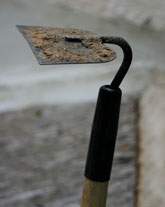
I thrust my hoe in the mellow ground,
Blade-end up and five feet tall,
And plod: I go up to the stone wall
For a friendly visit.

Most of my students see this as a poem about friendship, as, on a cursitory read, it appears so to be. Another happy little bucolic pastorale by that friendly grandfather figure, Robert Frost.

But there are certain nuances/difficulties in the poem. The title is a reference to Ecclesiastes 3:7 which reads

To every thing there is a season, and a time to every purpose under the heaven...A time to rend, and a time to sew; a time to keep silence, and a time to talk

The passage goes on to ask

What profit hath he that worketh in that wherein he laboureth? I have seen the travail, which God hath given to the sons of men to be exercised in it. He hath made every thing beautiful in his time: also he hath set the world in their heart, so that no man can find out the work that God maketh from the beginning to the end. I know that there is no good in them, but for a man to rejoice, and to do good in his life.

Moreover

...that which befalleth the sons of men befalleth beasts; even one thing befalleth them: as the one dieth, so dieth the other; yea, they have all one breath; so that a man hath no preeminence above a beast: for all is vanity.
All go unto one place; all are of the dust, and all turn to dust again.


Now Frost was no Pious Percy, quite the opposite, but his command of the scriptures and his use of them in other places is obvious; "Provide, Provide" or "Never Again Would Bird Song be the Same" or "The Road Not Taken". Consequently, it seems safe to assume that here again he is making a reference to this passage in Ecclesiastes reminding us all that we are dust and to dust we shall return.

In the first line of the poem we are introduced to the first person speaker who claims that "a friend" is calling to him from "the road". The friend represents anyone with whom the speaker has familiarity - but we learn in the second line that he sits astride a horse, symbol of power and royalty. There is a vague resemblance, then, to the horsemen of the Apocalypse in this nameless friend on the road. Also important is that the friend does not call for a friendly chat, but merely calls to the speaker at first; we assume a friendly parley because of the speaker's last lines "I go up to the stone wall / For a friendly visit" but that is witness only to the speaker's perspective. The friend on the horse merely calls to him and in that call is a sense of command which obliges the speaker to cease his work.

The speaker is obviously in medias res, hoeing a field with several more still to work; he makes note of "all the hills I haven't hoed" and yet prides himself in not continuing his work. In fact, the sense of self-satisfaction in the speaker is remarkable. There is no overwhelming sense of filial love for the neighbor, nor is there a sense of interest in what is to be told to him - he seems almost reticent to have to lose the time in the field in order to hear what, apparently, is meaningless talk. Instead, the speaker seems duty bound as he "plods" toward the friend for the friendly visit. The repetition of the word "friend" at the end of the poem echoes the word's use at the beginning and connotes a sense almost of irony or impatience in the duty-bound speaker. Again, he isn't going up to the road out of love, but out of duty, congratulating himself on the way.

The identity of the speaker and the identity of the friend become more clear with the revelation of a few ambiguities in the poem. First the fact that the friend is working in the field refers again to a scriptural passage, Matthew 20, in which Jesus relates a parable about the laborers in the vineyard;

The kingdom of heaven is like a landowner who went out early in the morning to hire men to work in his vineyard. He agreed to pay them a denarius for the day and sent them into his vineyard.
"About the third hour he went out and saw others standing in the marketplace doing nothing. He told them, 'You also go and work in my vineyard, and I will pay you whatever is right.' So they went.
"He went out again about the sixth hour and the ninth hour and did the same thing. About the eleventh hour he went out and found still others standing around. He asked them, 'Why have you been standing here all day long doing nothing?'
" 'Because no one has hired us,' they answered.
"He said to them, 'You also go and work in my vineyard.'
"When evening came, the owner of the vineyard said to his foreman, 'Call the workers and pay them their wages, beginning with the last ones hired and going on to the first.'
"The workers who were hired about the eleventh hour came and each received a denarius. So when those came who were hired first, they expected to receive more. But each one of them also received a denarius. When they received it, they began to grumble against the landowner. 'These men who were hired last worked only one hour,' they said, 'and you have made them equal to us who have borne the burden of the work and the heat of the day.'
"But he answered one of them, 'Friend, I am not being unfair to you. Didn't you agree to work for a denarius? Take your pay and go. I want to give the man who was hired last the same as I gave you. Don't I have the right to do what I want with my own money? Or are you envious because I am generous?'
"So the last will be first, and the first will be last."


In Frost's poem, the friend on the horse is in a position to the speaker is the master would be to the servants; coming to bring news of other laborers, perhaps, or of some other significance. Moreover, the speaker's sanctimonious self-righteousness makes him akin to the indignant early workers. What might the reaction of such an attitude be to being told that more workers were going to arrive for the same pay?

Second, the speaker claims that he "thrust (his) hoe in the mellow ground, Blade-end up and five feet tall". This is a seemingly innocuous image, except that to do so would be to cover the handle in dirt. Why not lay the tool on the ground? Indeed, with the blade end sticking up the tool thrust into the ground bears a striking resemblance to a grave marker; the shaft the body, the blade the head of a man. Moreover, the ground is described with the adjective "mellow" - this seems a direct contrast to the idea of ground being rough and needing toil. The speaker seems almost to find the earth pleasant, passive, yielding easily to the hoe; he has mastered it. Finally, The speaker makes a specific point that the thrust-in hoe is five feet tall", a little less than the height of a man. Thus with the cessation of work there is the hint of death.

Third, the stone wall to which the speaker approaches separates the field from the road. Traditionally, the image of a wall represents the barrier between two worlds; life and death, sleeping and waking. Frost himself uses the image in another poem "Mending Wall", a commentary about the isolation of each person from the other and in which he claims that "Good fences make good neighbors". Understandably the wall is made of stone; as stones rose in the field they would be set to the sides and built into a wall. But the quality of stone is also used in tombs and the coldness of stone resembles the permanence of death. The speaker calling to him from the other side of the wall, then, seems to be calling him not to friendship but to either temporary or permanent cessation from his work.

As yet the speaker is still separated from that other world by the stone wall, but his plodding indicates that, though he is older he is still reluctant to enter into "friendly visit" with the possibility of permanent cessation in death. His attitude of self-congratulation at his neighborliness is belied by the reluctance with which he gives up his important work in the field and accepts what the "friend" on horseback has to offer. Frost's poem, then, is not one of the importance of friendship, but of the importance of clarity in our attitude toward the necessities that intrude on our own little world of important work. The smaller "deaths" that intrude into our world of work offer us the opportunity to prepare for that greater death that eventually arrives on the road to call us for a "friendly visit".

Friday, May 4, 2007

The Naked and the Nude

~ by Robert Graves

For me, the naked and the nude
(By lexicographers construed
As synonyms that should express
The same deficiency of dress
Or shelter) stand as wide apart
As love from lies, or truth from art.

Lovers without reproach will gaze
On bodies naked and ablaze;
The Hippocratic eye will see
In nakedness, anatomy;
And naked shines the Goddess when
She mounts her lion among men.

The nude are bold, the nude are sly
To hold each treasonable eye.
While draping by a showman's trick
Their dishabille in rhetoric,
They grin a mock-religious grin
Of scorn at those of naked skin.

The naked, therefore, who compete
Against the nude may know defeat;
Yet when they both together tread
The briary pastures of the dead,
By Gorgons with long whips pursued,
How naked go the sometimes nude!

There be dragons!