Facile the descent to where no birds live;
Night and day the dark gates of the Unchanged;
But to recover the stair and ascend toward the sweet light,
This is the work, this the labor.
- Aeneid 6.124
“An inconceivable beauty you speak of,” he said, “if it is the source of knowledge and truth, and yet itself surpasses them in beauty. For you surely cannot mean that it is pleasure.” “Hush,” said I... - Republic Bk IV: 509a
Socrates' response to Glaucon is commonly read to mean "shut up" or "don't blaspheme" for Glaucon, in the midst of the discussion of The Good has misunderstood and suggested that this "inconceivable beauty" (hyper tauta kallei) is nothing more than pleasure. His knuckleheaded response is understandable, though, given his character; pleasure IS all he knows.
Socrates' response, however, is surprising. He is normally very tolerant of the obtuse incomprehension of his interlocutors. The severity of his response seems to indicate that he takes this matter very seriously. Indeed to reduce this greatest of visions to something so base and transitory is itself akin to blasphemous speech. IF all our vision of greatness is only another form of pleasure, being good only in that it pleases us, then not only does the whole native hue of resolution get sicklied o'er with the pale cast of thought, but our very standard for what is good or evil becomes a subjective gratification of what appeals to us. Consequently The Good becomes theft, power, sloth, rapine, murder or any other host of evils dared by Gyges. Indeed, to subjectify this concept of The Good is to verify the rightness of what Gyges in Book 2 does. He is right in rapine and murder, Hugh Hefner is right in polygamy, Karl Miewis is right in cannibalism, Pol Pot is right in genocide, and no one can tell anyone else anything certain of what is good, true or noble.
But the command "euphemei" in Greek has another connotation besides "hush" - literally it translates as "use words of good omen" or "abstain from evil words" and comes from the combination of "eu" (good) and "phemei", meaning a voice of unknown or prophetic origin. ("euphemism" in English is a direct derivative) So what Socrates says to Glaucon isn't just "shut up" or "be silent", it is "prophecy well". He is commanding Glaucon at this critical moment to become a prophet of The Good - to allow the truth that inspires to speak through him, rather than let his own vision clouded by desire ruin the greatness of the conversation (and of the work). So one could extract from this command something of the prophetic calling of Glaucon by Socrates.
Nevertheless, the common use of the imperative (according to Liddell & Scott) is normally "hush!" or "be still!". Such a command at this moment rings harmoniously with the command in Psalm 46.10 "Be still, and know that I am God: I will be exalted among the heathen, I will be exalted in the earth." This too is a command from the speaker (God) to the interlocutor (us) to "hush!" in the midst of all our babble.
I can't help but think that in both texts, Republic and Bible, the hush is something more akin to a formula. How does one know God? How does one become a prophet? Is it in argument? Conversation (as Socrates seems to ironically proclaim)? Being busy with good works? Reading voluminously? - what both the Psalm and Socrates indicate is that the only way to know God is in the midst of stillness. What is sin but constant noise and business, hurriedness, worry, the cacophony of the world., the imperative to buy, the injunction to neither stand nor lie nor sit.
In such a din there is no way to know God any more than it is possible to know the Good of which Socrates speaks.
The evening prayer of John Henry Cardinal Newman has stuck with me since my youth. Newman writes
May the Lord support us all the day long, Till the shades lengthen and the evening comes and the busy world is hushed, and the fever of life is over, and our work is done.
Then in his mercy may he give us a safe lodging and a holy rest, and peace at last.
True insight comes in silence, not in fever, and what we long for, safe lodging, holy rest, peace at the last, seem to come not through the busy machinations of the world's materialism and pleasure, but only at silent reflection and meditation on the fact that God is Good.So mote it be (or in the vernacular: Amen).
Here's what I'm currently deliberating - the belief in evil (with which I agree) uncoupled from a belief in a, as you say, "beneficent supernatural god". We both may doubt the existence of god, but how then do we account for evil? If we say that evil is merely one man hurting another then we have agreed to a standard based on the importance of the individual. But where does that standard come from? Doesn't it assume that there is an individual to be honored and doesn't such belief in an individual importance mean that I believe in a thing, invisible to the eyes (call it consciousness, soul, nous, mind, whatever) which manifests through outer actions and the working of the human mind through writing and speech and art (as I am doing now)? Then - and here is the sticking point - how important is that individual nous; likened to a divinity? Not to use this observation to prove the existence of god b/c I don't know if such "proof" is either valid or necessary; but what if The God is a way not of viewing some magnificent power that dominates over us, but a way rather of viewing some odd phenomenon in us which is otherwise hard to justify or explain - namely, consciousness. Regardless of knowing that there is a god, our belief, or willed assent, that there is a god allows us better to make sense of this weirdness with which we are afflicted. Perhaps The god is rational thought itself - Logos; denial of which ruins the possibility of discussion. Perhaps The god is consciousness - nous; denial of which ruins the possibility of honoring the importance of the individual. And maybe the only way to give assent in order to engage in rational thought, discussion, honor is to acknowledge that The god is other than and greater than us.
comfort = the root of all existence; too little of which stimulates change, too much of which kills spending
country = an illusion that helps placate the masses by encouraging them to think they share some common bond and are not isolated and lonely targets; a good excuse for going to war with another group of people in order to increase profit margins
family = a temporary convenience until something better from Argentina comes along
freedom = a limited set of choices calculated to encourage the maximum amount of spending among the people by seeming to be limitless; proportional to one's spending power (see Maxim's maxim); just some people talking; another word for nothing left to lose
God = a tool for self aggrandizement
happiness = a euphoria induced by the release of chemicals within the body brought on by an abundance of porn, fast food, violent video games/movies, and/or loud music; an excellent stimulant to freedom (see above); a warm gun.
illusion = a term marketed to the masses to encourage them to think that they must buy certain products in order to be liberated from it.
love = that without which no product can be moved; love must be fanned until it burns focused until it flames, controlled until it consumes; chemicals released into the body that convince one that everything will be okay; easily simulated by chocolate, steak, or 1-900 phone calls.
Maxim's maxim = F1+P1 = S1, Let F1 = greater sense of freedom Let P1 = more spending power Let S1 = more spending
religion = a fine thing taken in moderation; a useful set of actions and words to gain money, advance a career, or promote one's latest album
soul, consciousness, nous, individuality = nice sentiments easily compromised; a delusion common among the buying public of their own self-worth and/or importance.
thought = the enemy of success; the prompter of hesitation; the impediment to ruin; the foil to excess; the confounder of profits; the parent of self-control; the disperser of illusion; the destruction of empires; the breeder of emancipation; the catalyst of action
One of the viewers at YouTube left this comment on my video.
ideas are great. beliefs are dangerous. if they are set up to be followed beyond all logic and reason, then beliefs are bad.
I agree wholeheartedly with the sentiment, though not with the syntax. As I point out in the fourth video, we humans tend to construct our mythology in order to understand ourselves, but then quickly we concretize the mythology and lose the thing trying to be understood. The next step, then, is to impose that concretized mythology in a mindless, dictatorial fascism upon those around us. Rather than trying to bring others to greater understanding or trying to find what is best for others through love for them, we try to force others to abide by the actions and outer signs which are but manifestations of the understanding we are trying to achieve. Consequently, we tend very quickly to a dangerous form of totalitarianism which kills logic and reason; whether that totalitarianism is Buddhist, Hindu, Muslim, Christian, Jewish, Atheist, Deist, or Theist is inconsequential. As a race we have a tendency to "lose the forest for the trees" or "throw the baby out with the bathwater" or "make a club and beat each other on the head with it." This, I think, is utterly antithetical to the life of holiness.
But, that being said, what the commentator is suggesting is that there is a difference between ideas and beliefs - the two are diametrically opposed - the first is good, the second is bad, since the first corresponds to logic and the second to superstition. This needs addressing.
First, the Greek language had a better handle on this then we do. Plato distinguishes not between ideas and beliefs but between knowledge and opinion. Opinion is subject to error, but knowledge is not. Opinion does not have a basis in reason, knowledge does. Opinion is what the multitude possess, knowledge is what a true philosopher possesses. Opinion is closer to sleep walking, knowledge to being awake. Opinion is like being dead, or non-existence, knowledge is life and full existence. Yet between the two is something like a correct judgment which does not yet have full confirmation of its reality. From the Symposium:
For true opinions, as long as they remain, are a fine thing and all they do is good, but they are not willing to remain long, and they escape from a man’s mind, so that they are not worth much until one ties them down by (giving) an account of the reason why. [...] After they are tied down, in the first place they become knowledge, and then they remain in place. That is why knowledge is prized higher than correct opinion, and knowledge differs from correct opinion in being tied down. 98a
True opinions have to be transformed into knowledge if they are going to be reliable and fly away. How does one do this? Plato suggested it was through a form of katharsis, or emotional purging prompted by a traumatic experience, that releases one from the illusions of this world that lead to complacency and routine. But since we cannot go through such traumatic experience regularly we have to compensate with images, rituals, stories, and habits designed to prompt this cathartic experience.
Second, when the commentator above refers to belief I assume he means the ignorant, pigheaded, unquestioning belief that takes as concrete the images and rituals of religion as the end goal (telos) of that religion. But indeed, that's my point. The images and rituals of religion - any religion - exist to prompt the kathartic experience in man so that he asks the questions necessary to achieve knowledge and not rely anymore on opinion. Plato suggests that the images which prompt this katharsis, the icons (eikones), are merely shadows of the actual forms, ideas (eidos), which they represent. If one is to mature in religion he has to move beyond thinking that the eikons are the eidoi; the shadows are not the reality. If one does not do so, then to stare into that abyss is to see only one's own reflection, and to fall in love with that reflection (selfishness) and be transformed into something non-human; like Narcissus. As Simone Weil points out, the true life of holiness is a life of enquiry into the nature of things. Only by such enquiry, peering into the abyss, do we actually come to knowledge and move away from the complacent comfort of opinion.
Third, however, as the Cave metaphor shows, the movement beyond the eikones does not prompt their utter abandonment. One cannot throw out the rituals, images or shadows, but has to realize that they are not the end goal. Nor does insult or denigration of these rituals and images by those who are "in the know" (gnosis) actually help anyone else to move from opinion to knowledge. Rather it does damage to the mind, or soul, or nous. It is, as I say in the third video, a bit like telling in graphic detail to a 5 year old what rape is; they aren't helped by such description, merely terrified. Instead we tell them "Red Riding Hood". The story is about rape (or other forms of demonic violation) but children are able to understand the horror without actually seeing it. This is a bit like challenging the Medusa using a mirroring shield. Mythology, religion, is a mirroring shield to allow us to experience the katharsis that leads to knowledge without being turned to stone by the horror of it.
Consequently, it would seem, there are people of fanaticism on both the side of "belief" and the side of "knowledge"; those who are professed believers in Christianity (or another religion) frequently seem to think it their job to beat down non-believers, skeptics, and critics, insult them, or try to convert them using rigorous logic and quotations from the Bible. But non-believers also seem compelled to insult religion, ridicule believers, and convert to non-belief those who are part of a religion. I don't know the cause of such strange desires; perhaps childhood trauma, perhaps sexual license, perhaps weakness or laziness of thought. Whatever the case such actions seem little to correspond with what might be considered a life of holiness. Benedict XVI in his address to Regensburg made this very clear when he said that religion cannot be spread by the sword; metaphorically or literally. Religious understanding (or more accurately spiritual understanding) is a deeply personal experience; namely b/c one is confronting that greatest of abyssals that we are alone in the universe - but to understand this and convey it to others we have to have recourse to the images and rituals we use to express this experience.
The life of knowing is not diametrically opposed to the life of believing, in this sense, any more than the life of ideas is opposed to the life of icons. Indeed, the two are actually complementary. We must come to understand and to love and this is done through images and mythology that prompt catharsis away from ourselves and toward the reality which the images embody.
To concretize the images does damage to the understanding which they embody; but so too does insulting or denying the images. Thus, it seems, we are left only with the course which Plato embodies in his great myth; we go down into the shadows to learn what they have to tell us and thus escape, repeatedly, from our own little cave of confinement.
I plan to make more videos b/c I'm not done mumbling yet.
Honoring all the men and women, including many of the signers of the below document, who gave their lives for this unique ideal. If we love our country we not only must critique the bad, we must also extol the good; and there is much good about this great nation. I never cease to be amazed at the remarkable quality of the ideal that led to our founding. So below I post again the Declaration of Independence. To hold certain truths to be self-evident, to claim that men are endowed with certain unalienable rights, and to boldly assert that governments exist to secure those rights is, in itself, a monumental shift in human history. Happy July 4th!
British PEM Daniel Hannan on the greatness of America:
The Declaration of Independence: A Transcription
IN CONGRESS, July 4, 1776.
The unanimous Declaration of the thirteen united States of America,
When in the Course of human events, it becomes necessary for one people to dissolve the political bands which have connected them with another, and to assume among the powers of the earth, the separate and equal station to which the Laws of Nature and of Nature's God entitle them, a decent respect to the opinions of mankind requires that they should declare the causes which impel them to the separation.
We hold these truths to be self-evident, that all men are created equal, that they are endowed by their Creator with certain unalienable Rights, that among these are Life, Liberty and the pursuit of Happiness.--That to secure these rights, Governments are instituted among Men, deriving their just powers from the consent of the governed, --That whenever any Form of Government becomes destructive of these ends, it is the Right of the People to alter or to abolish it, and to institute new Government, laying its foundation on such principles and organizing its powers in such form, as to them shall seem most likely to effect their Safety and Happiness. Prudence, indeed, will dictate that Governments long established should not be changed for light and transient causes; and accordingly all experience hath shewn, that mankind are more disposed to suffer, while evils are sufferable, than to right themselves by abolishing the forms to which they are accustomed. But when a long train of abuses and usurpations, pursuing invariably the same Object evinces a design to reduce them under absolute Despotism, it is their right, it is their duty, to throw off such Government, and to provide new Guards for their future security.--Such has been the patient sufferance of these Colonies; and such is now the necessity which constrains them to alter their former Systems of Government. The history of the present King of Great Britain is a history of repeated injuries and usurpations, all having in direct object the establishment of an absolute Tyranny over these States. To prove this, let Facts be submitted to a candid world.
He has refused his Assent to Laws, the most wholesome and necessary for the public good. He has forbidden his Governors to pass Laws of immediate and pressing importance, unless suspended in their operation till his Assent should be obtained; and when so suspended, he has utterly neglected to attend to them. He has refused to pass other Laws for the accommodation of large districts of people, unless those people would relinquish the right of Representation in the Legislature, a right inestimable to them and formidable to tyrants only. He has called together legislative bodies at places unusual, uncomfortable, and distant from the depository of their public Records, for the sole purpose of fatiguing them into compliance with his measures. He has dissolved Representative Houses repeatedly, for opposing with manly firmness his invasions on the rights of the people. He has refused for a long time, after such dissolutions, to cause others to be elected; whereby the Legislative powers, incapable of Annihilation, have returned to the People at large for their exercise; the State remaining in the mean time exposed to all the dangers of invasion from without, and convulsions within. He has endeavoured to prevent the population of these States; for that purpose obstructing the Laws for Naturalization of Foreigners; refusing to pass others to encourage their migrations hither, and raising the conditions of new Appropriations of Lands. He has obstructed the Administration of Justice, by refusing his Assent to Laws for establishing Judiciary powers. He has made Judges dependent on his Will alone, for the tenure of their offices, and the amount and payment of their salaries. He has erected a multitude of New Offices, and sent hither swarms of Officers to harrass our people, and eat out their substance. He has kept among us, in times of peace, Standing Armies without the Consent of our legislatures. He has affected to render the Military independent of and superior to the Civil power. He has combined with others to subject us to a jurisdiction foreign to our constitution, and unacknowledged by our laws; giving his Assent to their Acts of pretended Legislation: For Quartering large bodies of armed troops among us: For protecting them, by a mock Trial, from punishment for any Murders which they should commit on the Inhabitants of these States: For cutting off our Trade with all parts of the world: For imposing Taxes on us without our Consent: For depriving us in many cases, of the benefits of Trial by Jury: For transporting us beyond Seas to be tried for pretended offences For abolishing the free System of English Laws in a neighbouring Province, establishing therein an Arbitrary government, and enlarging its Boundaries so as to render it at once an example and fit instrument for introducing the same absolute rule into these Colonies: For taking away our Charters, abolishing our most valuable Laws, and altering fundamentally the Forms of our Governments: For suspending our own Legislatures, and declaring themselves invested with power to legislate for us in all cases whatsoever. He has abdicated Government here, by declaring us out of his Protection and waging War against us. He has plundered our seas, ravaged our Coasts, burnt our towns, and destroyed the lives of our people. He is at this time transporting large Armies of foreign Mercenaries to compleat the works of death, desolation and tyranny, already begun with circumstances of Cruelty & perfidy scarcely paralleled in the most barbarous ages, and totally unworthy the Head of a civilized nation. He has constrained our fellow Citizens taken Captive on the high Seas to bear Arms against their Country, to become the executioners of their friends and Brethren, or to fall themselves by their Hands. He has excited domestic insurrections amongst us, and has endeavoured to bring on the inhabitants of our frontiers, the merciless Indian Savages, whose known rule of warfare, is an undistinguished destruction of all ages, sexes and conditions.
In every stage of these Oppressions We have Petitioned for Redress in the most humble terms: Our repeated Petitions have been answered only by repeated injury. A Prince whose character is thus marked by every act which may define a Tyrant, is unfit to be the ruler of a free people.
Nor have We been wanting in attentions to our Brittish brethren. We have warned them from time to time of attempts by their legislature to extend an unwarrantable jurisdiction over us. We have reminded them of the circumstances of our emigration and settlement here. We have appealed to their native justice and magnanimity, and we have conjured them by the ties of our common kindred to disavow these usurpations, which, would inevitably interrupt our connections and correspondence. They too have been deaf to the voice of justice and of consanguinity. We must, therefore, acquiesce in the necessity, which denounces our Separation, and hold them, as we hold the rest of mankind, Enemies in War, in Peace Friends.
We, therefore, the Representatives of the united States of America, in General Congress, Assembled, appealing to the Supreme Judge of the world for the rectitude of our intentions, do, in the Name, and by Authority of the good People of these Colonies, solemnly publish and declare, That these United Colonies are, and of Right ought to be Free and Independent States; that they are Absolved from all Allegiance to the British Crown, and that all political connection between them and the State of Great Britain, is and ought to be totally dissolved; and that as Free and Independent States, they have full Power to levy War, conclude Peace, contract Alliances, establish Commerce, and to do all other Acts and Things which Independent States may of right do. And for the support of this Declaration, with a firm reliance on the protection of divine Providence, we mutually pledge to each other our Lives, our Fortunes and our sacred Honor.
Just reading this again. What a great poem. What a great poet.
And why, he asks in his odd way, looking under his brows like a bull, do we only know that we love something once it has been crushed or wounded or lost?
...or why reading is better than watching tv or (gasp) internet.
For some time I've debated the efficacy of reading versus watching movies, tv, or browsing the internet. Most of the argument has been against the nature of the medium, not just the content. But it occurred to me today that there is a difference in freedom. With movies there are certainly many and you can choose what you wish to view; but you are always subject to the interpretation of the movie maker. There is little to counter the viewpoint put forth by the movie so if Jose Cameron suggests that the Titanic sank in such and such a way - it's truth; unless you check it. Moreover, with things like tv you watch what they want you to watch. You may have a gabillion channels on your satellitecabledirectinternet tv, but seriously, are you going to find something original and unique? Not likely. Most of it will be canned by someone else's opinion of what you want to watch; Ted Turner colorizing the old black and whites for instance. Ditto with internet - you see the profile others want you to see. With books, it is true that you are reading the opinion or view of the author (that's inevitable) but you can pick up another book and cross reference things, find out things that others might not know, browse through a bookstore and find gems overlooked by the hoi poloi... sort of like using a dictionary instead of those new-fangled dictionaryinakeyboard thingummies. In the former while browsing for zebra I might discover a hundred other words exciting and unknown. One might argue that while browsing blockbuster you might do the same - true, but the medium still is limited to what the director offers. Moreover, book people are normally the types to move from one to the next to the next book instead of reading one and considering it the gospel uber alles. There is a certain freedom of thought provided by such agility which seems lacking in tv only, or movie only, or internet only people. Indeed, one can't always believe what they read, but then most of what is on tv or internet is mere pablatum.
While grading essays I read an article by Asli Gocer "The Puppet Theater in Plato's Parable of the Cave" which intrigued me. Gocer points out the use of the word "thaumatopoioi" for the puppets in the cave.
Plato writes in Republic Bk 7:
"Picture further the light from a fire burning higher up and at a distance behind them, and between the fire and the prisoners and above them a road along which a low wall has been built, as the exhibitors of puppet-shows have partitions before the men themselves, above which they show the puppets.” “See also, then, men carrying past the wall implements of all kinds that rise above the wall, and human images and shapes of animals as well, wrought in stone and wood and every material, some of these bearers presumably speaking and others silent.”
The word used thaumatapoiois (θαυματοποιοῖς) for the shadow puppets seems the same as the thaumasta (θαυμαστὰ)that draws Gyges into the crevice back in Bk 2;
"after a great deluge of rain and an earthquake the ground opened and a chasm appeared in the place where he was pasturing; and they say that he saw and wondered and went down into the chasm; and the story goes that he beheld other marvels there"
This also seems the same as the later thaumata that Er describes.
Gyges, the Prisoner/pilgrim, Er are the same man in three stages of the alchemical transmogrification effected by the dialectic process.
"All Philosophy begins in wonder" (θαυμαστὰ) Plato states. "All love of wisdom begins in wonder." Whereas the Scriptures proclaim that "Fear of the Lord is the root of all wisdom." Are wonder and fear of the Lord the same thing? Who is the Lord? The Good? Darkness? The Abyss? All of the above?
Wonders draw the man into the darkness; the darkness makes him a prisoner; wonders draw the man up from his state as prisoner into the light of the real; wonders are revealed after passing out of the "cave" through death.
Pythagoreans believed that the soul was merely a balance of perfectly tuned harmonies. With such balance comes the soul and life; loss of such balance kills. The balance of the dialogue (Republic) seems to exist in order to create or "give birth to" (genesis) a soul in the reader/interlocutor; it is a genesis (becoming) towards to on (being).
Yet this is a monologue. Plato assumes the role of Socrates, who is actually remembering his words and the interlocutors' in discussion. This creates several layers of "masking" (thaumatapoiois). Why? To whom? Does he believe it or just use it? Is it real or is it just shadow puppets.
There is, consequently, a balance in the dialogue between the "sleeping" man (Thrasymachus; the minotaur) and the "awakened" man (Odysseus; the sun hero, who chooses the life of the ordinary man in the myth of Er); between the unborn man (Cephalus; the head) and the born man (Er; the man of the air - man of earth); between doxa and gnosis; eikoni and eidoi; the cave and the world of forms.
Yet neither cave, nor world of forms is the really real. The world of forms is no more "real" than the cave as both are in the myth in the narrative in the monologue in the Platonic work itself. The real is in the middle; on the ground outside the cave; in the here, now, and present. Both worlds, (sleeping/waking, prenatal life/adulthood, doxa/gnosis, eikoni/eidoi, shadows/forms) are connected together in the here and now; that's the point. It is the hypostatic union, the philosopher-king, man fully alive is man suffering (the central phrase in the Gospel of John is "Jesus wept"; Jn 11:35) - stretched on the cross of existence that unites horizontal and vertical.
All metaphors must at some point be abandoned, all guiding stars at some point must be relinquished, all ships at some point must be burned if we are to see the new world. The point is, therefore, beyond the point. Not simply to scrutinize the thaumatapoioi that comprise any work of literature, but to see the literature in part and in whole simultaneously and thus to "live dear to one another and to the gods, both while remaining here and when, like conquerors in the games who go round to gather gifts, we receive our reward." Or to borrow from Dante a more poetical way of saying this,
Io ritornai da la santissima onda rifatto sì come piante novelle rinnovellate di novella fronda,
puro e disposto a salire alle stelle
From the most holy water I returned Regenerate, in the manner of new trees That are renewed with a new foliage,
Why does history show again and again people making conscious references to the ancient Greeks and Romans? I tried tapping that in my end of the year lecture at Chesterton Academy. There are many reasons, and in five years my opinion may change, but right now I think the driving force is that Greece and Rome are synonymous with "civilization" (however uncivilized civilization can be).
Respondeo:
It's a good theory. But civilization has been around long before Greece and Rome - Babylon, Persia, the Golden Horde, Aztecia & Cahokia - to name a few. Also civilization has existed simultaneous yet isolated from Greece and Rome: the Han, the Chin, the Chou, the Shogunate, the Ethiopians, the Incas. These all can be considered "civilizations" if the word is taken to mean buildings, government, art and roads and all that. If that is civilization then the Persians greatly surpassed the Greeks and the Golden Horde overwhelmed both Western Rome and Byzantium. I think that Kenneth Clarke had it right that Civilization is more than that.
We have a current posh to think that civilizations are merely whatever "our people" developed; so we prefer Western Civilization b/c... well, we're Westerners. If we were Easterners we'd prefer the great elegance and inventions and governmental certainty of the powerful dynasties in the Orient. Moreover, our preference for Western Civilization, it is said, causes us myopia and prejudice for which we must make constant expiation; apologizing for our white male guilt and innate imperialism.
I think that's all rot.
What makes the preference for Western Civilization is not just that we are Westerners (why, after all, would Easterners prefer WC, after all) but b/c there is something inherently superior proposed by WC that doesn't exist in any other culture.
I would suggest that it is twofold: 1. a vision that law descends not from man but from an unchanging order of the universe (Logos) established by A God and comprehensible to the rational intellect. 2. a supreme emphasis on the importance and rights of the individual person, manifested in an unshakable sense of freedom instead of conformity. a. corollary that women are considered not chattel but equals or superiors to men & that sexuality, or the control/focus thereof through chivalric courtesy is crucial to our vision of this culture.
This manifesto seems to have come from Jewish/Greek/Roman sources - and has been perpetuated primarily through the Christian Church. It is for this reason that I greatly lament the decline of the Church into the small, petty, feel good ridiculousness it seems to exhibit now and simultaneously lament the decline and continued flogging of Western Culture and values in so many of our institutions. Not b/c of prudery - but b/c humans cannot live without culture. "If God did not exist man would have to invent him" says Nietzsche. W/o the institutions of greatness in Western Culture, values, government & law, and the Church we don't just live care free lives of honesty, we actually tend to descend into something much worse, darker, sadder, and more slavish; the tribalism of the neolithic age, the slavery of the satrapies and Persian tyrants, the abysmal internecine warfare and universal conformity of Eastern civilization, the caste system of India.
IF the grand story of Christian salvation, with its complex balance of triumph and humility, divine fatherhood and human brotherhood, is declared dead, it is at once succeeded by less ambiguous, more ruthless andmore easily abused narratives of glorious human progress, social "Darwinism," self-fulfillment, existentialist whim, socialist utopia or nationalist personality cult.
- Frederick Turner, "Epic Arts" in the winter addition 2009 of American Arts Quarterly
These things are horrifying to me and I hope they are only night terrors and not the future Mark Steyn and others predict.
Recently an anonymous student asked me a few questions about the noblest profession. Professing to know something about it, here are my answers.
-What did you specialize in, in your field? A: English Literature. I got my BA in English and went on to get a Masters of English at University of Dallas. They offered a Master of Arts but that required a language component and a longer essay but I lack the chops for doing a language and was tired of writing at the time. I worked on William Butler Yeats for my junior poet and went on to study Arthurian literature for my BA. My Masters of English concentrated on the work of Charles Williams for which I gave a public reading (like a dissertation w/o as much pressure)
-What made you want to become a teacher? A: I’ve always wanted to do so. Perhaps it was at first ego – I like talking and hearing myself talk. I also like leading other people to see things and found that what I had to say really was unique (apparently) and valuable (ostensibly). My father was a teacher and the teaching business was somewhat in my blood, but the more I read the more I found that the knowledge had to be transferred to others; the skill sets, the content, and the interpretation. To me it seemed the most honorable course of action to give myself to the education of other people. When first I began teaching I thought that the mere revelation of my great ideas would be enough to sway people (pure ego that, what what?) but as I have progressed in the field I find it is less about me and more about my students – the works presented remain great maugre their ignorance and stupefaction – about getting them to be able to see something more than the world in front of them. Ultimately, too, I like the thrill. There is a certain thrill in engaging in the world of ideas and in getting other people to look at life more deeply. So perhaps I’m just a thrill addict, I don’t know.
-And if you weren't teaching, what could you see yourself doing? Collecting moss behind my ears and pushing 400 pounds. No, I’d probably be in the publishing business, maybe politics (if I didn’t have such a feeling of dyspepsia and revulsion every time I think about it), or the priesthood; though my wife might object to that last one.
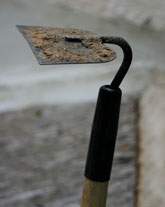
When a friend calls to me from the road And slows his horse to a meaning walk, I don't stand still and look around On all the hills I haven't hoed, And shout from where I am, 'What is it?' No, not as there is a time to talk. I thrust my hoe in the mellow ground, Blade-end up and five feet tall, And plod: I go up to the stone wall For a friendly visit.
Most of my students see this as a poem about friendship, as, on a cursitory read, it appears so to be. Another happy little bucolic pastorale by that friendly grandfather figure, Robert Frost.
But there are certain nuances/difficulties in the poem. The title is a reference to Ecclesiastes 3:7 which reads
To every thing there is a season, and a time to every purpose under the heaven...A time to rend, and a time to sew; a time to keep silence, and a time to talk
The passage goes on to ask
What profit hath he that worketh in that wherein he laboureth? I have seen the travail, which God hath given to the sons of men to be exercised in it. He hath made every thing beautiful in his time: also he hath set the world in their heart, so that no man can find out the work that God maketh from the beginning to the end. I know that there is no good in them, but for a man to rejoice, and to do good in his life.
Moreover
...that which befalleth the sons of men befalleth beasts; even one thing befalleth them: as the one dieth, so dieth the other; yea, they have all one breath; so that a man hath no preeminence above a beast: for all is vanity. All go unto one place; all are of the dust, and all turn to dust again.
Now Frost was no Pious Percy, quite the opposite, but his command of the scriptures and his use of them in other places is obvious; "Provide, Provide" or "Never Again Would Bird Song be the Same" or "The Road Not Taken". Consequently, it seems safe to assume that here again he is making a reference to this passage in Ecclesiastes reminding us all that we are dust and to dust we shall return.
In the first line of the poem we are introduced to the first person speaker who claims that "a friend" is calling to him from "the road". The friend represents anyone with whom the speaker has familiarity - but we learn in the second line that he sits astride a horse, symbol of power and royalty. There is a vague resemblance, then, to the horsemen of the Apocalypse in this nameless friend on the road. Also important is that the friend does not call for a friendly chat, but merely calls to the speaker at first; we assume a friendly parley because of the speaker's last lines "I go up to the stone wall / For a friendly visit" but that is witness only to the speaker's perspective. The friend on the horse merely calls to him and in that call is a sense of command which obliges the speaker to cease his work.
The speaker is obviously in medias res, hoeing a field with several more still to work; he makes note of "all the hills I haven't hoed" and yet prides himself in not continuing his work. In fact, the sense of self-satisfaction in the speaker is remarkable. There is no overwhelming sense of filial love for the neighbor, nor is there a sense of interest in what is to be told to him - he seems almost reticent to have to lose the time in the field in order to hear what, apparently, is meaningless talk. Instead, the speaker seems duty bound as he "plods" toward the friend for the friendly visit. The repetition of the word "friend" at the end of the poem echoes the word's use at the beginning and connotes a sense almost of irony or impatience in the duty-bound speaker. Again, he isn't going up to the road out of love, but out of duty, congratulating himself on the way.
The identity of the speaker and the identity of the friend become more clear with the revelation of a few ambiguities in the poem. First the fact that the friend is working in the field refers again to a scriptural passage, Matthew 20, in which Jesus relates a parable about the laborers in the vineyard;
The kingdom of heaven is like a landowner who went out early in the morning to hire men to work in his vineyard. He agreed to pay them a denarius for the day and sent them into his vineyard. "About the third hour he went out and saw others standing in the marketplace doing nothing. He told them, 'You also go and work in my vineyard, and I will pay you whatever is right.' So they went. "He went out again about the sixth hour and the ninth hour and did the same thing. About the eleventh hour he went out and found still others standing around. He asked them, 'Why have you been standing here all day long doing nothing?' " 'Because no one has hired us,' they answered. "He said to them, 'You also go and work in my vineyard.' "When evening came, the owner of the vineyard said to his foreman, 'Call the workers and pay them their wages, beginning with the last ones hired and going on to the first.' "The workers who were hired about the eleventh hour came and each received a denarius. So when those came who were hired first, they expected to receive more. But each one of them also received a denarius. When they received it, they began to grumble against the landowner. 'These men who were hired last worked only one hour,' they said, 'and you have made them equal to us who have borne the burden of the work and the heat of the day.' "But he answered one of them, 'Friend, I am not being unfair to you. Didn't you agree to work for a denarius? Take your pay and go. I want to give the man who was hired last the same as I gave you. Don't I have the right to do what I want with my own money? Or are you envious because I am generous?' "So the last will be first, and the first will be last."
In Frost's poem, the friend on the horse is in a position to the speaker is the master would be to the servants; coming to bring news of other laborers, perhaps, or of some other significance. Moreover, the speaker's sanctimonious self-righteousness makes him akin to the indignant early workers. What might the reaction of such an attitude be to being told that more workers were going to arrive for the same pay?
Second, the speaker claims that he "thrust (his) hoe in the mellow ground, Blade-end up and five feet tall". This is a seemingly innocuous image, except that to do so would be to cover the handle in dirt. Why not lay the tool on the ground? Indeed, with the blade end sticking up the tool thrust into the ground bears a striking resemblance to a grave marker; the shaft the body, the blade the head of a man. Moreover, the ground is described with the adjective "mellow" - this seems a direct contrast to the idea of ground being rough and needing toil. The speaker seems almost to find the earth pleasant, passive, yielding easily to the hoe; he has mastered it. Finally, The speaker makes a specific point that the thrust-in hoe is five feet tall", a little less than the height of a man. Thus with the cessation of work there is the hint of death.
Third, the stone wall to which the speaker approaches separates the field from the road. Traditionally, the image of a wall represents the barrier between two worlds; life and death, sleeping and waking. Frost himself uses the image in another poem "Mending Wall", a commentary about the isolation of each person from the other and in which he claims that "Good fences make good neighbors". Understandably the wall is made of stone; as stones rose in the field they would be set to the sides and built into a wall. But the quality of stone is also used in tombs and the coldness of stone resembles the permanence of death. The speaker calling to him from the other side of the wall, then, seems to be calling him not to friendship but to either temporary or permanent cessation from his work.
As yet the speaker is still separated from that other world by the stone wall, but his plodding indicates that, though he is older he is still reluctant to enter into "friendly visit" with the possibility of permanent cessation in death. His attitude of self-congratulation at his neighborliness is belied by the reluctance with which he gives up his important work in the field and accepts what the "friend" on horseback has to offer. Frost's poem, then, is not one of the importance of friendship, but of the importance of clarity in our attitude toward the necessities that intrude on our own little world of important work. The smaller "deaths" that intrude into our world of work offer us the opportunity to prepare for that greater death that eventually arrives on the road to call us for a "friendly visit".
I was buying some tea in Target yesterday and in the aisle with me were an attractive young mother, her toe headed 4 year old boy in a pair of overalls and a red button-down oxford, and an older employee of Target who was busily “fronting” the products in the aisle. Anyone who has done merchandise sales knows that “fronting” is a pain in the posterior – bring the boxes to the front so that customers can better see/reach them. It is a thankless, endless, tedious job since even as you finish it some yahoo comes along and ruins your work. This elderly lady had obviously been at it for some time since most of the row was fairly neat. Meanwhile the little 4 year old was busily pushing every box within grasp of his grubby little paws back to the back, haphazardly, mindlessly, perpetually. The mom, who was obviously hell bent on getting something for junior, kept up a witty banter of “So, Melchizedek, do you want hot chocolate?” “no” ...push... “with marshmallows?” “no” ...push... “what about Quick? You like Quick?” “no” ...push... “Now stop that, Melchizedek, stop it. Do you want Strawberry Quick? or Vanilla Quick?” “no” ...push... I just wanted to slap them both. Instead I just got my green tea and left.
If the mother were to have slapped the boy's hand and told him "Melchizedek, either you knock it off or I'm ..... (taking you home, calling the manager, bending you over my knee and tanning your behind) then the kid might stand a chance of not growing up thinking old people were stupid employees of Target whose work was meaningless and deserved to be ruined by their so smart and talented ass.
As George Carlin said, "kids these days don't hear those vital words 'Johnny, you failed!'"
Since no one else seems to have this on the net, here is a map of the major myths contained in the 10 books of Plato's Republic. I mapped them on to the golden spiral since the book is about gnomonic growth based on the golden proportion, or PHI. The color parallels indicate a repetitive parallel in the stories in which images in one are answered, paralleled, countered in another; so for instance, the crowd at the banquet is like the mutinous crew and like the many-headed beast; the just man, Er, is a counter to the unjust man, Gyges. The images within the myths also parallel (recycling of gold, earth, darkness/light, rebirth) but I can't fit all that on here.
Two good articles on Henry James' ghost story can be got Here by Edward J. Parkinson and ">Here by Thomas J. Bontley
So, do you think the governess is crazy?
What if she is Miss Jessel? That is, consider the account stops after the death of Miles – but if the account is of a woman already mad couldn’t’ the events themselves be disordered chronologically? Isn’t there evidence of hanky-panky with the master and Miss Jessel? Certes btwn Quint and Jessel – but then Quint seems to be compared to the master (he wears the master’s clothes) Wouldn’t hanky-panky btwn a rich bachelor and a young, poor, naïve governess be a scenario possible in Edwardian England? Wouldn’t it lead to scandal ruining her and not him? Doesn’t Jessel get compared to the governess (if nothing else, she was the prior governess)? Mrs. Grose’s comment early on that the master DID like governesses that were young and pretty The master’s summary dismissal of the governess with the injunction never to contact him seems odd unless there was a love situation Miles and Flora are boy and girl, parallel to Quint and Jessel, also parallel to the governess and the master Miles and Flora seem to be innocence threatened, Quint and Jessel seem to be corruption irredeemable, master and governess seem to be in between
In Book VI, ln 496d, of the Republic Socrates claims that the Just Man in the world will be like “a human being who has fallen in with wild beasts and is neither willing to join them in doing injustice nor sufficient as one man to resist all the savage animals” and as a man who “keeps quiet and minds his own business – as a man in a storm, when dust and rain are blown about by the wind, stands aside under a little wall.”
I was struck today by that image of the little wall. Influenced by Bernard Suzanne's observation that images in one myth in Plato show up in some form in all the myths, I can't help but think that this "little wall" in this passage might also be that "little wall" in the cave in Book VII, ln 514b:
Between the fire and the prisoners there is a road above, along which see a wall, built like the partitions puppet-handlers set in front of the human beings and over which they show the puppets.
The prisoners of the cave crouch behind that wall and, in the midst of the darkness of the storm, engage in - some seeing, some showing - shadow puppets. The Just Man must be among them, crouching behind that wall. Though he is just, justice alone is not sufficient for hope. Spem in alium; hope in OTHER things. The Just Man's erotic longing is for something greater than this world to be true.
That wall, though protecting him from the storm, is also preventing him from moving forward - keeps him in a crouch in his foxhole. As Winters yells to his troop "GET UP! YOU HAVE TO MOVE! IF YOU STAY HERE YOU'RE SITTING DUCKS!" Is it the wall that separates being from non-being? image from reality? life from afterlife? Is the wall death?
His release and travel out would then be a transformation from out the storm of darkness into light for the first time. Childlike, trusting, that those things of which we speak are real. Peter says "For we have not followed cunningly devised fables, when we made known unto you the power and coming of our Lord Jesus Christ, but were eyewitnesses of his majesty." Moreover,
Whereby are given unto us exceeding great and precious promises: that by these ye might be partakers of the divine nature, having escaped the corruption that is in the world through lust. And beside this, giving all diligence, add to your faith virtue; and to virtue knowledge; And to knowledge temperance; and to temperance patience; and to patience godliness; And to godliness brotherly kindness; and to brotherly kindness charity. For if these things be in you, and abound, they make you that ye shall neither be barren nor unfruitful in the knowledge of our Lord Jesus Christ. But he that lacketh these things is blind, and cannot see afar off, and hath forgotten that he was purged from his old sins. Wherefore the rather, brethren, give diligence to make your calling and election sure: for if ye do these things, ye shall never fall: For so an entrance shall be ministered unto you abundantly into the everlasting kingdom of our Lord and Saviour Jesus Christ.