Facile the descent to where no birds live;
Night and day the dark gates of the Unchanged;
But to recover the stair and ascend toward the sweet light,
This is the work, this the labor.
- Aeneid 6.124
While grading essays I read an article by Asli Gocer "The Puppet Theater in Plato's Parable of the Cave" which intrigued me. Gocer points out the use of the word "thaumatopoioi" for the puppets in the cave.
Plato writes in Republic Bk 7:
"Picture further the light from a fire burning higher up and at a distance behind them, and between the fire and the prisoners and above them a road along which a low wall has been built, as the exhibitors of puppet-shows have partitions before the men themselves, above which they show the puppets.” “See also, then, men carrying past the wall implements of all kinds that rise above the wall, and human images and shapes of animals as well, wrought in stone and wood and every material, some of these bearers presumably speaking and others silent.”
The word used thaumatapoiois (θαυματοποιοῖς) for the shadow puppets seems the same as the thaumasta (θαυμαστὰ)that draws Gyges into the crevice back in Bk 2;
"after a great deluge of rain and an earthquake the ground opened and a chasm appeared in the place where he was pasturing; and they say that he saw and wondered and went down into the chasm; and the story goes that he beheld other marvels there"
This also seems the same as the later thaumata that Er describes.
Gyges, the Prisoner/pilgrim, Er are the same man in three stages of the alchemical transmogrification effected by the dialectic process.
"All Philosophy begins in wonder" (θαυμαστὰ) Plato states. "All love of wisdom begins in wonder." Whereas the Scriptures proclaim that "Fear of the Lord is the root of all wisdom." Are wonder and fear of the Lord the same thing? Who is the Lord? The Good? Darkness? The Abyss? All of the above?
Wonders draw the man into the darkness; the darkness makes him a prisoner; wonders draw the man up from his state as prisoner into the light of the real; wonders are revealed after passing out of the "cave" through death.
Pythagoreans believed that the soul was merely a balance of perfectly tuned harmonies. With such balance comes the soul and life; loss of such balance kills. The balance of the dialogue (Republic) seems to exist in order to create or "give birth to" (genesis) a soul in the reader/interlocutor; it is a genesis (becoming) towards to on (being).
Yet this is a monologue. Plato assumes the role of Socrates, who is actually remembering his words and the interlocutors' in discussion. This creates several layers of "masking" (thaumatapoiois). Why? To whom? Does he believe it or just use it? Is it real or is it just shadow puppets.
There is, consequently, a balance in the dialogue between the "sleeping" man (Thrasymachus; the minotaur) and the "awakened" man (Odysseus; the sun hero, who chooses the life of the ordinary man in the myth of Er); between the unborn man (Cephalus; the head) and the born man (Er; the man of the air - man of earth); between doxa and gnosis; eikoni and eidoi; the cave and the world of forms.
Yet neither cave, nor world of forms is the really real. The world of forms is no more "real" than the cave as both are in the myth in the narrative in the monologue in the Platonic work itself. The real is in the middle; on the ground outside the cave; in the here, now, and present. Both worlds, (sleeping/waking, prenatal life/adulthood, doxa/gnosis, eikoni/eidoi, shadows/forms) are connected together in the here and now; that's the point. It is the hypostatic union, the philosopher-king, man fully alive is man suffering (the central phrase in the Gospel of John is "Jesus wept"; Jn 11:35) - stretched on the cross of existence that unites horizontal and vertical.
All metaphors must at some point be abandoned, all guiding stars at some point must be relinquished, all ships at some point must be burned if we are to see the new world. The point is, therefore, beyond the point. Not simply to scrutinize the thaumatapoioi that comprise any work of literature, but to see the literature in part and in whole simultaneously and thus to "live dear to one another and to the gods, both while remaining here and when, like conquerors in the games who go round to gather gifts, we receive our reward." Or to borrow from Dante a more poetical way of saying this,
Io ritornai da la santissima onda rifatto sì come piante novelle rinnovellate di novella fronda,
puro e disposto a salire alle stelle
From the most holy water I returned Regenerate, in the manner of new trees That are renewed with a new foliage,
Why does history show again and again people making conscious references to the ancient Greeks and Romans? I tried tapping that in my end of the year lecture at Chesterton Academy. There are many reasons, and in five years my opinion may change, but right now I think the driving force is that Greece and Rome are synonymous with "civilization" (however uncivilized civilization can be).
Respondeo:
It's a good theory. But civilization has been around long before Greece and Rome - Babylon, Persia, the Golden Horde, Aztecia & Cahokia - to name a few. Also civilization has existed simultaneous yet isolated from Greece and Rome: the Han, the Chin, the Chou, the Shogunate, the Ethiopians, the Incas. These all can be considered "civilizations" if the word is taken to mean buildings, government, art and roads and all that. If that is civilization then the Persians greatly surpassed the Greeks and the Golden Horde overwhelmed both Western Rome and Byzantium. I think that Kenneth Clarke had it right that Civilization is more than that.
We have a current posh to think that civilizations are merely whatever "our people" developed; so we prefer Western Civilization b/c... well, we're Westerners. If we were Easterners we'd prefer the great elegance and inventions and governmental certainty of the powerful dynasties in the Orient. Moreover, our preference for Western Civilization, it is said, causes us myopia and prejudice for which we must make constant expiation; apologizing for our white male guilt and innate imperialism.
I think that's all rot.
What makes the preference for Western Civilization is not just that we are Westerners (why, after all, would Easterners prefer WC, after all) but b/c there is something inherently superior proposed by WC that doesn't exist in any other culture.
I would suggest that it is twofold: 1. a vision that law descends not from man but from an unchanging order of the universe (Logos) established by A God and comprehensible to the rational intellect. 2. a supreme emphasis on the importance and rights of the individual person, manifested in an unshakable sense of freedom instead of conformity. a. corollary that women are considered not chattel but equals or superiors to men & that sexuality, or the control/focus thereof through chivalric courtesy is crucial to our vision of this culture.
This manifesto seems to have come from Jewish/Greek/Roman sources - and has been perpetuated primarily through the Christian Church. It is for this reason that I greatly lament the decline of the Church into the small, petty, feel good ridiculousness it seems to exhibit now and simultaneously lament the decline and continued flogging of Western Culture and values in so many of our institutions. Not b/c of prudery - but b/c humans cannot live without culture. "If God did not exist man would have to invent him" says Nietzsche. W/o the institutions of greatness in Western Culture, values, government & law, and the Church we don't just live care free lives of honesty, we actually tend to descend into something much worse, darker, sadder, and more slavish; the tribalism of the neolithic age, the slavery of the satrapies and Persian tyrants, the abysmal internecine warfare and universal conformity of Eastern civilization, the caste system of India.
IF the grand story of Christian salvation, with its complex balance of triumph and humility, divine fatherhood and human brotherhood, is declared dead, it is at once succeeded by less ambiguous, more ruthless andmore easily abused narratives of glorious human progress, social "Darwinism," self-fulfillment, existentialist whim, socialist utopia or nationalist personality cult.
- Frederick Turner, "Epic Arts" in the winter addition 2009 of American Arts Quarterly
These things are horrifying to me and I hope they are only night terrors and not the future Mark Steyn and others predict.
Recently an anonymous student asked me a few questions about the noblest profession. Professing to know something about it, here are my answers.
-What did you specialize in, in your field? A: English Literature. I got my BA in English and went on to get a Masters of English at University of Dallas. They offered a Master of Arts but that required a language component and a longer essay but I lack the chops for doing a language and was tired of writing at the time. I worked on William Butler Yeats for my junior poet and went on to study Arthurian literature for my BA. My Masters of English concentrated on the work of Charles Williams for which I gave a public reading (like a dissertation w/o as much pressure)
-What made you want to become a teacher? A: I’ve always wanted to do so. Perhaps it was at first ego – I like talking and hearing myself talk. I also like leading other people to see things and found that what I had to say really was unique (apparently) and valuable (ostensibly). My father was a teacher and the teaching business was somewhat in my blood, but the more I read the more I found that the knowledge had to be transferred to others; the skill sets, the content, and the interpretation. To me it seemed the most honorable course of action to give myself to the education of other people. When first I began teaching I thought that the mere revelation of my great ideas would be enough to sway people (pure ego that, what what?) but as I have progressed in the field I find it is less about me and more about my students – the works presented remain great maugre their ignorance and stupefaction – about getting them to be able to see something more than the world in front of them. Ultimately, too, I like the thrill. There is a certain thrill in engaging in the world of ideas and in getting other people to look at life more deeply. So perhaps I’m just a thrill addict, I don’t know.
-And if you weren't teaching, what could you see yourself doing? Collecting moss behind my ears and pushing 400 pounds. No, I’d probably be in the publishing business, maybe politics (if I didn’t have such a feeling of dyspepsia and revulsion every time I think about it), or the priesthood; though my wife might object to that last one.
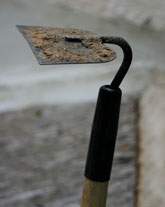
When a friend calls to me from the road And slows his horse to a meaning walk, I don't stand still and look around On all the hills I haven't hoed, And shout from where I am, 'What is it?' No, not as there is a time to talk. I thrust my hoe in the mellow ground, Blade-end up and five feet tall, And plod: I go up to the stone wall For a friendly visit.
Most of my students see this as a poem about friendship, as, on a cursitory read, it appears so to be. Another happy little bucolic pastorale by that friendly grandfather figure, Robert Frost.
But there are certain nuances/difficulties in the poem. The title is a reference to Ecclesiastes 3:7 which reads
To every thing there is a season, and a time to every purpose under the heaven...A time to rend, and a time to sew; a time to keep silence, and a time to talk
The passage goes on to ask
What profit hath he that worketh in that wherein he laboureth? I have seen the travail, which God hath given to the sons of men to be exercised in it. He hath made every thing beautiful in his time: also he hath set the world in their heart, so that no man can find out the work that God maketh from the beginning to the end. I know that there is no good in them, but for a man to rejoice, and to do good in his life.
Moreover
...that which befalleth the sons of men befalleth beasts; even one thing befalleth them: as the one dieth, so dieth the other; yea, they have all one breath; so that a man hath no preeminence above a beast: for all is vanity. All go unto one place; all are of the dust, and all turn to dust again.
Now Frost was no Pious Percy, quite the opposite, but his command of the scriptures and his use of them in other places is obvious; "Provide, Provide" or "Never Again Would Bird Song be the Same" or "The Road Not Taken". Consequently, it seems safe to assume that here again he is making a reference to this passage in Ecclesiastes reminding us all that we are dust and to dust we shall return.
In the first line of the poem we are introduced to the first person speaker who claims that "a friend" is calling to him from "the road". The friend represents anyone with whom the speaker has familiarity - but we learn in the second line that he sits astride a horse, symbol of power and royalty. There is a vague resemblance, then, to the horsemen of the Apocalypse in this nameless friend on the road. Also important is that the friend does not call for a friendly chat, but merely calls to the speaker at first; we assume a friendly parley because of the speaker's last lines "I go up to the stone wall / For a friendly visit" but that is witness only to the speaker's perspective. The friend on the horse merely calls to him and in that call is a sense of command which obliges the speaker to cease his work.
The speaker is obviously in medias res, hoeing a field with several more still to work; he makes note of "all the hills I haven't hoed" and yet prides himself in not continuing his work. In fact, the sense of self-satisfaction in the speaker is remarkable. There is no overwhelming sense of filial love for the neighbor, nor is there a sense of interest in what is to be told to him - he seems almost reticent to have to lose the time in the field in order to hear what, apparently, is meaningless talk. Instead, the speaker seems duty bound as he "plods" toward the friend for the friendly visit. The repetition of the word "friend" at the end of the poem echoes the word's use at the beginning and connotes a sense almost of irony or impatience in the duty-bound speaker. Again, he isn't going up to the road out of love, but out of duty, congratulating himself on the way.
The identity of the speaker and the identity of the friend become more clear with the revelation of a few ambiguities in the poem. First the fact that the friend is working in the field refers again to a scriptural passage, Matthew 20, in which Jesus relates a parable about the laborers in the vineyard;
The kingdom of heaven is like a landowner who went out early in the morning to hire men to work in his vineyard. He agreed to pay them a denarius for the day and sent them into his vineyard. "About the third hour he went out and saw others standing in the marketplace doing nothing. He told them, 'You also go and work in my vineyard, and I will pay you whatever is right.' So they went. "He went out again about the sixth hour and the ninth hour and did the same thing. About the eleventh hour he went out and found still others standing around. He asked them, 'Why have you been standing here all day long doing nothing?' " 'Because no one has hired us,' they answered. "He said to them, 'You also go and work in my vineyard.' "When evening came, the owner of the vineyard said to his foreman, 'Call the workers and pay them their wages, beginning with the last ones hired and going on to the first.' "The workers who were hired about the eleventh hour came and each received a denarius. So when those came who were hired first, they expected to receive more. But each one of them also received a denarius. When they received it, they began to grumble against the landowner. 'These men who were hired last worked only one hour,' they said, 'and you have made them equal to us who have borne the burden of the work and the heat of the day.' "But he answered one of them, 'Friend, I am not being unfair to you. Didn't you agree to work for a denarius? Take your pay and go. I want to give the man who was hired last the same as I gave you. Don't I have the right to do what I want with my own money? Or are you envious because I am generous?' "So the last will be first, and the first will be last."
In Frost's poem, the friend on the horse is in a position to the speaker is the master would be to the servants; coming to bring news of other laborers, perhaps, or of some other significance. Moreover, the speaker's sanctimonious self-righteousness makes him akin to the indignant early workers. What might the reaction of such an attitude be to being told that more workers were going to arrive for the same pay?
Second, the speaker claims that he "thrust (his) hoe in the mellow ground, Blade-end up and five feet tall". This is a seemingly innocuous image, except that to do so would be to cover the handle in dirt. Why not lay the tool on the ground? Indeed, with the blade end sticking up the tool thrust into the ground bears a striking resemblance to a grave marker; the shaft the body, the blade the head of a man. Moreover, the ground is described with the adjective "mellow" - this seems a direct contrast to the idea of ground being rough and needing toil. The speaker seems almost to find the earth pleasant, passive, yielding easily to the hoe; he has mastered it. Finally, The speaker makes a specific point that the thrust-in hoe is five feet tall", a little less than the height of a man. Thus with the cessation of work there is the hint of death.
Third, the stone wall to which the speaker approaches separates the field from the road. Traditionally, the image of a wall represents the barrier between two worlds; life and death, sleeping and waking. Frost himself uses the image in another poem "Mending Wall", a commentary about the isolation of each person from the other and in which he claims that "Good fences make good neighbors". Understandably the wall is made of stone; as stones rose in the field they would be set to the sides and built into a wall. But the quality of stone is also used in tombs and the coldness of stone resembles the permanence of death. The speaker calling to him from the other side of the wall, then, seems to be calling him not to friendship but to either temporary or permanent cessation from his work.
As yet the speaker is still separated from that other world by the stone wall, but his plodding indicates that, though he is older he is still reluctant to enter into "friendly visit" with the possibility of permanent cessation in death. His attitude of self-congratulation at his neighborliness is belied by the reluctance with which he gives up his important work in the field and accepts what the "friend" on horseback has to offer. Frost's poem, then, is not one of the importance of friendship, but of the importance of clarity in our attitude toward the necessities that intrude on our own little world of important work. The smaller "deaths" that intrude into our world of work offer us the opportunity to prepare for that greater death that eventually arrives on the road to call us for a "friendly visit".
I was buying some tea in Target yesterday and in the aisle with me were an attractive young mother, her toe headed 4 year old boy in a pair of overalls and a red button-down oxford, and an older employee of Target who was busily “fronting” the products in the aisle. Anyone who has done merchandise sales knows that “fronting” is a pain in the posterior – bring the boxes to the front so that customers can better see/reach them. It is a thankless, endless, tedious job since even as you finish it some yahoo comes along and ruins your work. This elderly lady had obviously been at it for some time since most of the row was fairly neat. Meanwhile the little 4 year old was busily pushing every box within grasp of his grubby little paws back to the back, haphazardly, mindlessly, perpetually. The mom, who was obviously hell bent on getting something for junior, kept up a witty banter of “So, Melchizedek, do you want hot chocolate?” “no” ...push... “with marshmallows?” “no” ...push... “what about Quick? You like Quick?” “no” ...push... “Now stop that, Melchizedek, stop it. Do you want Strawberry Quick? or Vanilla Quick?” “no” ...push... I just wanted to slap them both. Instead I just got my green tea and left.
If the mother were to have slapped the boy's hand and told him "Melchizedek, either you knock it off or I'm ..... (taking you home, calling the manager, bending you over my knee and tanning your behind) then the kid might stand a chance of not growing up thinking old people were stupid employees of Target whose work was meaningless and deserved to be ruined by their so smart and talented ass.
As George Carlin said, "kids these days don't hear those vital words 'Johnny, you failed!'"
Since no one else seems to have this on the net, here is a map of the major myths contained in the 10 books of Plato's Republic. I mapped them on to the golden spiral since the book is about gnomonic growth based on the golden proportion, or PHI. The color parallels indicate a repetitive parallel in the stories in which images in one are answered, paralleled, countered in another; so for instance, the crowd at the banquet is like the mutinous crew and like the many-headed beast; the just man, Er, is a counter to the unjust man, Gyges. The images within the myths also parallel (recycling of gold, earth, darkness/light, rebirth) but I can't fit all that on here.
Two good articles on Henry James' ghost story can be got Here by Edward J. Parkinson and ">Here by Thomas J. Bontley
So, do you think the governess is crazy?
What if she is Miss Jessel? That is, consider the account stops after the death of Miles – but if the account is of a woman already mad couldn’t’ the events themselves be disordered chronologically? Isn’t there evidence of hanky-panky with the master and Miss Jessel? Certes btwn Quint and Jessel – but then Quint seems to be compared to the master (he wears the master’s clothes) Wouldn’t hanky-panky btwn a rich bachelor and a young, poor, naïve governess be a scenario possible in Edwardian England? Wouldn’t it lead to scandal ruining her and not him? Doesn’t Jessel get compared to the governess (if nothing else, she was the prior governess)? Mrs. Grose’s comment early on that the master DID like governesses that were young and pretty The master’s summary dismissal of the governess with the injunction never to contact him seems odd unless there was a love situation Miles and Flora are boy and girl, parallel to Quint and Jessel, also parallel to the governess and the master Miles and Flora seem to be innocence threatened, Quint and Jessel seem to be corruption irredeemable, master and governess seem to be in between
In Book VI, ln 496d, of the Republic Socrates claims that the Just Man in the world will be like “a human being who has fallen in with wild beasts and is neither willing to join them in doing injustice nor sufficient as one man to resist all the savage animals” and as a man who “keeps quiet and minds his own business – as a man in a storm, when dust and rain are blown about by the wind, stands aside under a little wall.”
I was struck today by that image of the little wall. Influenced by Bernard Suzanne's observation that images in one myth in Plato show up in some form in all the myths, I can't help but think that this "little wall" in this passage might also be that "little wall" in the cave in Book VII, ln 514b:
Between the fire and the prisoners there is a road above, along which see a wall, built like the partitions puppet-handlers set in front of the human beings and over which they show the puppets.
The prisoners of the cave crouch behind that wall and, in the midst of the darkness of the storm, engage in - some seeing, some showing - shadow puppets. The Just Man must be among them, crouching behind that wall. Though he is just, justice alone is not sufficient for hope. Spem in alium; hope in OTHER things. The Just Man's erotic longing is for something greater than this world to be true.
That wall, though protecting him from the storm, is also preventing him from moving forward - keeps him in a crouch in his foxhole. As Winters yells to his troop "GET UP! YOU HAVE TO MOVE! IF YOU STAY HERE YOU'RE SITTING DUCKS!" Is it the wall that separates being from non-being? image from reality? life from afterlife? Is the wall death?
His release and travel out would then be a transformation from out the storm of darkness into light for the first time. Childlike, trusting, that those things of which we speak are real. Peter says "For we have not followed cunningly devised fables, when we made known unto you the power and coming of our Lord Jesus Christ, but were eyewitnesses of his majesty." Moreover,
Whereby are given unto us exceeding great and precious promises: that by these ye might be partakers of the divine nature, having escaped the corruption that is in the world through lust. And beside this, giving all diligence, add to your faith virtue; and to virtue knowledge; And to knowledge temperance; and to temperance patience; and to patience godliness; And to godliness brotherly kindness; and to brotherly kindness charity. For if these things be in you, and abound, they make you that ye shall neither be barren nor unfruitful in the knowledge of our Lord Jesus Christ. But he that lacketh these things is blind, and cannot see afar off, and hath forgotten that he was purged from his old sins. Wherefore the rather, brethren, give diligence to make your calling and election sure: for if ye do these things, ye shall never fall: For so an entrance shall be ministered unto you abundantly into the everlasting kingdom of our Lord and Saviour Jesus Christ.
I was reading Proverbs again today (it's something I do) and noticed at the very beginning (Prov 1:7) that the poet says "The fear of the Lord is the beginning of knowledge." Fear of the Lord. Fear leads to knowledge. This seems similar to Plato's statement that "all philosophy begins in wonder" and certainly reflects the image of Gyges' wondering at the chasm in the ground and going into it, or the philosopher descending into the cave. Are wonder and fear related in this way? Do we both wonder and fear at some dark pit, some chasm? Certainly the ancients said that the world begin in an abyss, and Genesis of course begins with "the deeps" over which the spirit moves. At what are we wondering/fearing? That abyss seems to be internal rather than external - some darkness within us - and has echoes of the lacuna between image and imaged in which the truth resides.
But it occurred to me that Aristotle points out the purpose of tragedy is "to provoke fear and pity." Tragedy provokes fear or awe by revealing the deep pit inside each of us. We are awed by it and wonder "what's down there?" Yet we also have pity b/c we know that this pit is terrifying and dangerous. Caveat - beware - the Cave. Yet what is that caveat within us?
Plato explicitly uses the term "noble dogs" for his guardians who are the meeting point between the nobility of the intellectual rulers and the caninity of the appetitive workers. Man is both noble and canine; spirit and body; divine and mortal. What is the tragedy in that? Unless, of course, the dog knows it is a dog and not a god. By dog! ho kunos!
That certainly is a cave canem.
"We know what we are but we know not what we may become," as Ophelia states. Were we to be merely dogs, ants, goats we would have no knowledge of our dogness, or our antness, or our goatness. But b/c we are aware, b/c we wonder (an action unique to humans) we know that we are dogs and live everyday with our grossness. We are aware of our antness and live with our puny existence. We are aware of our goatness and live with the knowledge that goats become gyros. Before the slaughter we look up at the knife held by our Father and cry out in a mournful wail, a goat song - tragoidos. Tragedy is the cry over our own existence.
And as our dogness seems apparent enough our nobility does not. Show me an ounce of honor, a foot of soul, the weight of love. These things cannot be measured or held in the hand and so seem ephemeral - unreal - lies or illusions. They are mere myths we tell in order to feel better about our own dogness. Were we merely dogs this would be no problem and we could go about rolling in fish or sniffing bottoms or chasing rabbits and be none the wiser. But the dog knows it is a dog and hence the source of our sorrow. "For with much wisdom comes much sorrow; the more knowledge, the more grief." (Ecc 1:18)
We are compelled by wonder (fear) to go down into the cave. There in the dark we encounter the reality of our noble dog existence. Once we are aware of our existence we are compelled by pity to go down into the cave to save others.
What is amusing about this? Tragos, in Greek, means goat, but also means the smell of the armpit. Tragedy is "the goat song" or "the armpit song". It is a reminder of our mortal selves translated into something beautiful. Imagine all those garlic and gar eating Greeks sitting in the outdoors from sunup to sundown for the Dionysiad. How it must have stunk! And how, surrounded by the smell of armpits, they would have been reminded by this beautiful singing and drama that man is also very noble. That realization should provoke fear and pity indeed.
When UrsulaK.LeGuin first wrote “The Word of Unbinding” in 1964 she perhaps did not foresee the world of Earthsea in the short story giving rise to one of the greater pieces of fantasy of the 20th century. The later Trilogy of Earthsea, consisting of A Wizard of Earthsea, The Tombs of Atuan and The Farthest Shore, is a work which, taken as a whole, rivals the power and insight of Tolkien’s Lord of the Rings. Though far darker and creepier than Tolkien’s work, the Earthsea Trilogy offers a great vision of the nature of imagination, the human spirit, and the world of evil. It’s also an excellent and thrilling read.
The series is set in the Archipelago of Earthsea, a fictional world of rocky islands in which magic, artwork, and science coexist. LeGuin’s use of magic is far more complex than in the HarryPotter series or in Tolkien’s trilogy. In Earthsea magic works not as a haphazard entity of cabalistic phrases, nor as the obscure power of suggestion and hidden strength of Tolkien’s Ainur. Rather magic on Earthsea consists of the discovery of the true name of objects. Wizards are trained to learn the names given to physical objects at their first creation and to use such knowledge to alter reality. The craft is available mostly to men and women, but the world is also populated with dragons of great power and knowledge and spirits of various degrees who have access to magical abilities as well.
The first title in the series, A Wizard of Earthsea, follows the life of a young wizard named Ged, also called “Sparrowhawk” who is sent by his mentor, Ogion, to study at the school for wizards on RokeIsland. Here, rankled by the insults of a rival, Sparrowhawk ignores the injunction against the misuse of magic and conjures into this world a demon of shadows, or Gebbeth, that brutally scars his face and escapes into the world to cause ruin and destruction. The rest of the novel is about Sparrowhawk’s recovery and attempt to hunt down the Gebbeth.
LeGuin’s emphasis on responsibility in the novels contributes to the gravity of the writing. Sparrowhawk begins his wizardly life in a flippant, almost negligent way – as though he does not understand the power involved in what he is doing. His tremendous error and resultant pain are a reminder of the seriousness involved in any craft. Moreover, the craft of wizardly “namecalling” is a metaphor for the artistic process itself. Man, unlike other animals, traffics in images – each of which works to raise, or conjure, in the mind of subsequent viewers a response of understanding. Artists are, consequently, like wizards. They use imagery in order to create a type of magic in the mind; by fitting image to reality they illuminate truth. This craft is one of tremendous responsibility since the image could falsely represent reality and since such illumination always causes change. To use it carelessly causes “shadows” to enter the world.
The Tombs of Atuan, the second title in the series, deals primarily with shadows. It involves Tenhar, also called Arhan “the eaten one”, a priestess of the old, chthonic, gods of blood and human violence, called “The Nameless Ones” who are kept under control by constant vigilance and by a vast spiderweb of labyrinthine tunnels under the earth leading to the main cave of their dwelling. Sparrowhawk arrives on the island to find the lost half of the Ring of Erreth-Akbe and finds himself trapped in the labyrinth where he must confront the old gods. He wins Tenhar over with his kindness and shows to her the cruel slavery with which the Nameless Ones hold her in thrall. With her help he succeeds in his quest and escapes from the labyrinth.
The chthonic gods of Earthsea are only dimly understood and never fully seen; rather they are a presence of terror and unease who threaten the foundations of the world. In many ways they are terrors out of the subconscious; the use of the labyrinth image certainly reflects the Greek labyrinth at the center of which resided the man-eating Minotaur. Sparrowhawk’s descent into the darkness is, therefore, like a journey into the heart of the subconscious in order to find truth. Yet the focus of the work concerns Tenhar and her imprisonment to the old gods. Her freedom comes through her love of Sparrowhawk whose near death experience reveals to her that the Nameless Ones, the spirits of subconscious terror, only consume life and give nothing back to the world. She comes to see that the wisdom of love is better than the folly of slavery, just as light is better than darkness.
In the final work of the series, The Farthest Shore, Sparrowhawk must enter the land of the dead in order to stop a spiritual disease that is spreading through Earthsea, destroying magic and causing songs and artwork to cease. In the land of the dead Sparrowhawk confronts the necromancer, Cob, who has opened a rift between the two worlds in order to cheat his own death. Sparrowhawk must sacrifice all his magical ability in order to seal the rift and allow magic to return to Earthsea.
All three of LeGuin’s novels have an element of creepiness and terror about them but the last of the three most especially. This element of terror gives great weight to her observations about truth. Ultimately, we only know reality through images, as an image reflects the reality of things around us. We call a thing true when it correctly embodies the reality of the thing imaged. However, there always exists a vast chasm between the image and the thing imaged since we are never able to directly experience the reality of a thing, only the image of that reality. Thus we see not men but “the likeness as the appearance of a man” as Ezekiel 1:26 says. Over the deeps of that vast chasm truth moves like a wind and our magic is an attempt to make land out of the ocean of darkness and fear residing in the subconscious. But such an attempt always requires tremendous sacrifice and must give way, ultimately, to the realization that we are mortal and subject to the laws of our fallen world. Thus when Cob tries desperately to save his own life he not only loses it and becomes one of the dead but threatens the very life of the world itself. Only the magical death of another man succeeds in healing that rift and restoring the world to its proper order.
LeGuin’s stories are an engaging and remarkable read and her insight into human nature and the nature of magic are not to be missed. Though she may not have intended so powerful a story when she created her first little island in the Archipelago, she eventually crafted an excellent alternative universe and, through the magic of her craft, gave us all a fine bit of dry land in the vast world of literature.
FYI, there is a very bad rendition of The Earthsea Trilogy done by American studios. It truncates the story, takes out all the profundity of the novels and substitutes real drama for predictable boilerplate. The acting is poor and the sets are nothing to write about. I did just learn today that Goro Miyazaki (of Spirited Away fame) released a rendition of the series in 2006 named Teru no Uta (Tales from Earthsea), but have not yet seen it. Here is a clip:
I'm using this blog as a marker for Juniors to post on something in Plato at their website.
I'm intrigued by the meaning of Gyges' ring. The ring, it seems, is not an object for good or for evil even if Gyges uses the ring for evil. So what is it? Most telling is that Gyges first discovers the properties of the ring while sitting at the monthly meeting of accounts before the king of Lydia. He is a thrall to another man, under the rule of laws and society and a thousand other chains that weigh him down. The ring allows him to be free of all of that - a "blank canvas", as one student put it, on which he now has the freedom to create good or evil. So what is the ring? Is the ring the power to throw off societal chains (modes, mannerisms, beliefs, expectations) and thus be free? If so the discussion about rock concerts vs. Mass are very apt - both are supposed to allow us to do this thing ("death where is thy sting?"), one only seems to be succeeding in our modern era (not the Mass).
That aside, the power of the ring seems to be a neutral power that essentially puts us like a stage hand in the creation of life's myth; once we throw off the power of law & custom wouldn't we have the ability to construct myth, influence the decisions of others, craft movies, music, stories, lies, identities? Wouldn't we be like Leonardo di Caprio in "Catch me if you Can"? Running from the straight laced law, perhaps, but enjoying every minute of our escape. In such a state we could be a tremendous force for goodness. The Ainur, for instance, were not of Middle Earth and could travel great distances very swiftly. But in such a state we would, perhaps, also be far more tempted to really destructive evil (vs. the small petty evils that the normal, law-bound man indulges in). After all, Saruman, as well as Gandalf, was an Ainur. After all Heinrich Himmler was an ubermensch.
Ultimately, it seems the ring represents, not a power that corrupts (as Tolkien's ring seems to inevitably do, thus suggesting a slightly different philosophy than Plato), but a neutral power that allows the wearer to slip the bonds of human societal norms and thus allows him to do tremendous good or tremendous evil.
Just had a fascinating insight into Flannery O'Connor's short story "A Good Man is Hard to Find." O'Connor was intrigued by what she called "the conversion moment" - that is, the moment of grace given to a person by God in which, through pain, sorrow, or loss, they have the opportunity to accept or reject salvation. Only through that intense moment, O'Connor suggested, could a person could come to see the world as sacramental.
In "Good Man" the protagonist, grandmother, and her family stop for lunch at a restaurant called "The Tower". This seems a very odd name for a restaurant unless O'Connor was intending some greater symbolism. Certainly the tower of Babel comes to mind, but since Red Sammy Butts doesn't seem quite as grandiose as Nimrod the giant there must be some other symbolism occurring.
The major arcana of the tarot deck represent attitudes toward the world, some good, some evil which all serve to give language to our experience as humans. This one the XVI one in the major arcana shows two men plummetting toward merciless rocks after their fortress is riven with a thunderbolt from the heavens. It is night and murky clouds surround the tower while fire spews from the windows and a giant crown topples off the top of the edifice. The tower (like Babel) represents the extreme of pride in us when we think our little world is secure and we try to make ourselves rulers over our dominion rivalling God. The lightning bolt is the actus Dei which shatters our world and makes us realize our own helplessness. The fire is the passionate destruction that accompanies this cataclysm. The two figures, man and woman, mimic both the emperor & empress of III & IV (she still wears her crown), the high priestess & heirophant of II & V, and the lovers of VI while their position of falling helplessness mimics the position of the hanged man in Arcana XII. Thus they represent the pride of all these accomplishments dashed from its lofty hubris by life's cataclysmic violence.
Though not an identity to the Tarot, O'Connor's story bears striking resemblances; Bailey and the Mrs. seem to be like the High Priestess (with "cabbage face" and "rabbit ears" just like the Rider Waite drawing) and the Heirophant while June Star seems to resemble the imperiousness of the Empress and John Wesley is similar to the Emperor (the famous painting of the founder of the Arminian Methodist Movement being himself seated on a throne). Red Sammy Butts and his brown-skin wife are parodies of the Lovers and the car is the Chariot (arcana VII) which revolves after Pitty-Sing, the cat (a creature closely associated in Egyptian mythology with Thoth, magic, and mischevious change), jumps on Bailey's head, thus evoking arcana X "the Wheel of Fortune". Even the MisFit himself is described as
...an older man than the other two. His hair was just beginning to gray and he wore silver-rimmed spectacles that gave him a scholarly look. He had a long creased face and didn't have on any shirt or undershirt. He had on blue jeans that were too tight for him and was holding a black hat and a gun.
... which closely resembles the image of the Devil in arcana XV, while Hiram, which means "exalted brother" in Jewish, can be likened to arcana VIII, Strength, and Bobby Lee can be likened to arcana IX, the Hermit, whose white beard, grey clothing and venerable demeanor are similar to Robert E. Lee whose name is parodied in this destructive character. Grandmother's appearance when she first sets off on the trip bears remarkable similarity to the picture of the fool in arcana 0:
the grandmother had on a navy blue straw sailor hat with a bunch of white violets on the brim and a navy blue dress with a small white dot in the print. Her collars and cuffs were white organdy trimmed with lace and at her neckline she had pinned a purple spray of cloth violets containing a sachet.
So did O'Connor actually use the Tarot for the basis of this story? I don't think she was trying to make an identity here, certainly, but some of the same message as the Tarot does appear in Good Man.
Perhaps its just my current idea fixee but I'm beginning to see the Amun Ra story in everything of Western Culture. How deeply this myth influenced us even down to our understanding of what a dragon is. In the East the dragon was a force of nature, sometimes wild and dangerous, sometimes beneficent. For us the dragon is that many headed, coiling terror that threatens to devour all that is good in man - despair - darkness - the horror that we have to face at some point in our lives. It is Smaug and Leviathan, it is Python andJörmungandr around the world tree, Ygdrassil. And it is Apep, the dragon met at the end of the journey through the underworld, or Duat, by the sun god, Amun Ra. Egyptians believed that the sun ran its living course during the day, died at sunset, and during the night sailed through the treacherous waters of the underworld accompanied by his sargeants and generals. At the end of this journey they meet Apep who threatens to devour Amun as Jörmungandr threatens to devour the world tree in Ragnarok. The battle is joined, Apep is destroyed, even as Apollo destroys Python, and the sun god rises again to glorious newbirth or resurrection with the sunrise.
Watching again the Natural I'm seeing just that. It is an underdog story about a man, Roy Hobbs, who has suffered a crippling defeat that takes him away from his dream of baseball. Yet he returns to the game and triumphs over the forces of darkness that threaten to consume him. I don't think that Redford consciously meant to mimic the Amun-Ra story, but the use of colors, shadows, name imagery, all indicate a retelling of that sun story. When Roy blasts the lights into fireworks and they fall past the window of the defeated judge we see again the triumph over those forces that seek to assert the inevitable and hopeless success of greed, power, and mediocrity over glory and nobility. Even the last scene that shifts from darkness to light and Roy playing ball in the field of wheat with his son while Iris stands watching with the blue sky behind her, is itself a resurrection scene - a sign that hope exists and we can triumph over our own darkness and demons.
I'm amazed that at the persistence of this story: more than 6000 years if my history is correct. Why would it last so very long in Western culture? Even the Christ story, regardless of historical accuracy, is itself a retelling wherein the mob and Caiaphas are the Apep and Christ rises with the sun on the third day (rather than the full count of baseball). What then are we saying? Does man have spem in alium? Is there hope in things unseen? Is it just a pretty fairy tale we repeat to each other in order to overcome the dark? I don't know - but the fruit of this story has had remarkable yield in all that the West has accomplished; freedom, government, art, courtesy, belief in the importance of the individual, sense of greatness and dignity, and the perpetual positivism even in the grim jaw of defeat.
Therefore, since we are surrounded by such a great cloud of witnesses, let us throw off everything that hinders and the sin that so easily entangles, and let us run with perseverance the race marked out for us. - Hebrews 12:1
An excellent article by Jeffrey A. Tucker at Mises.org suggests that clothing and appearance may once again become the hallmark of the gentleman. Tucker says,
Right now, with unemployment moving into the double digits, it is becoming a dog-eat-dog world in labor markets. You must stand out. You must find ways to show that you are not expendable, that tossing you out would do more harm to the company than good. You must show that the company will risk losing more revenue by sending you away than by keeping you. Clothing reflects this.
YAHOO! If that's the only change we actually get out of this entire freakin' mess then Mr. Obama will have presided over an auspicious era.
Here's the best line of the article at the very end:
The way you dress can make all the difference. If it doesn't work to boost your professional life, you can always count on looking fantastic when you march on the White House and protest against its occupants for robbing you blind in the name of saving you.
It seems clear that the Homeric epic The Odyssey is a retelling of the Amun-Ra story of the journey into the Duat, or underworld. As both Nanno Marinatos in his article "Cosmic Journey of Odysseus" and John A. Scott in the article "Odysseus as a Sun God" note, the imagery of the sun, the dawn passages, the significance of Helios, the 24 book cycle corresponding to the hours of the day, the struggles and trials & the cleansing of the many-headed mob of suitors correspondent to the struggles in the Duat and the defeat of the dragon Apep, all amount to a remarkably strong case in favor of Odysseus as a sun hero.
Additionally Scott B. Noegel in his excellent article "Apollonius' Argonautika and Egyptian Solar Mythology" argues that a similar retelling of this Egyptian myth exists in the Ptolemaic era story of Jason and the Argonauts. In this article Noegel suggests that Apollonius' work was crafted during an era in which the new Greek rulers of Egypt were attempting to synthesize Greek & Egyptian culture, perhaps in an attempt to legitimize their own reign. Noegel states that
Indeed, the Ptolemies put extraordinary means into locating and creating national gods that could be jointly worshiped by Egyptians and Greeks.
The work of Apollonius', then, reflects this attempt at synthetic mythopoesis. Noegel, quoting S.A.Stephens, states that the reader
...must see Apollonius as having "written a poem of and for the new hybrid political state, by retrojecting into the epic past elements of both worlds and by creating an epic template for new beginnings that partakes of both."
This rings very true. Artists, to quote a lowbrow source in Bono's lyrics, "are cannibals, every poet is a thief." Art rarely consists of something sprung, fully armed, from the head of the artist but rather is a recrafting of existing myths; retelling the old images and stories in a new way. Artists reconstitute the most significant myths of human culture for their own times.Apollonius did it; Vergil did it; Dante did it; Tolkien did it.Each artist took the prior myths and recrafted them in an original way.
This leads to the question of whether a similar political synthesis was occurring during the era of Homer's poem. If the work of Apollonius echoes the attempt on the part of the Ptolemies in 305BC to make a "national epic" out of Egypt and Greek heritage would sun imagery in the Odyssey reveal a similar cultural fusion between the Ionian coast and the Egyptian culture in the 9th century BC? Or was Homer simply using an accepted myth upon which to base his great poem?