Facile the descent to where no birds live;
Night and day the dark gates of the Unchanged;
But to recover the stair and ascend toward the sweet light,
This is the work, this the labor.
- Aeneid 6.124
When UrsulaK.LeGuin first wrote “The Word of Unbinding” in 1964 she perhaps did not foresee the world of Earthsea in the short story giving rise to one of the greater pieces of fantasy of the 20th century. The later Trilogy of Earthsea, consisting of A Wizard of Earthsea, The Tombs of Atuan and The Farthest Shore, is a work which, taken as a whole, rivals the power and insight of Tolkien’s Lord of the Rings. Though far darker and creepier than Tolkien’s work, the Earthsea Trilogy offers a great vision of the nature of imagination, the human spirit, and the world of evil. It’s also an excellent and thrilling read.
The series is set in the Archipelago of Earthsea, a fictional world of rocky islands in which magic, artwork, and science coexist. LeGuin’s use of magic is far more complex than in the HarryPotter series or in Tolkien’s trilogy. In Earthsea magic works not as a haphazard entity of cabalistic phrases, nor as the obscure power of suggestion and hidden strength of Tolkien’s Ainur. Rather magic on Earthsea consists of the discovery of the true name of objects. Wizards are trained to learn the names given to physical objects at their first creation and to use such knowledge to alter reality. The craft is available mostly to men and women, but the world is also populated with dragons of great power and knowledge and spirits of various degrees who have access to magical abilities as well.
The first title in the series, A Wizard of Earthsea, follows the life of a young wizard named Ged, also called “Sparrowhawk” who is sent by his mentor, Ogion, to study at the school for wizards on RokeIsland. Here, rankled by the insults of a rival, Sparrowhawk ignores the injunction against the misuse of magic and conjures into this world a demon of shadows, or Gebbeth, that brutally scars his face and escapes into the world to cause ruin and destruction. The rest of the novel is about Sparrowhawk’s recovery and attempt to hunt down the Gebbeth.
LeGuin’s emphasis on responsibility in the novels contributes to the gravity of the writing. Sparrowhawk begins his wizardly life in a flippant, almost negligent way – as though he does not understand the power involved in what he is doing. His tremendous error and resultant pain are a reminder of the seriousness involved in any craft. Moreover, the craft of wizardly “namecalling” is a metaphor for the artistic process itself. Man, unlike other animals, traffics in images – each of which works to raise, or conjure, in the mind of subsequent viewers a response of understanding. Artists are, consequently, like wizards. They use imagery in order to create a type of magic in the mind; by fitting image to reality they illuminate truth. This craft is one of tremendous responsibility since the image could falsely represent reality and since such illumination always causes change. To use it carelessly causes “shadows” to enter the world.
The Tombs of Atuan, the second title in the series, deals primarily with shadows. It involves Tenhar, also called Arhan “the eaten one”, a priestess of the old, chthonic, gods of blood and human violence, called “The Nameless Ones” who are kept under control by constant vigilance and by a vast spiderweb of labyrinthine tunnels under the earth leading to the main cave of their dwelling. Sparrowhawk arrives on the island to find the lost half of the Ring of Erreth-Akbe and finds himself trapped in the labyrinth where he must confront the old gods. He wins Tenhar over with his kindness and shows to her the cruel slavery with which the Nameless Ones hold her in thrall. With her help he succeeds in his quest and escapes from the labyrinth.
The chthonic gods of Earthsea are only dimly understood and never fully seen; rather they are a presence of terror and unease who threaten the foundations of the world. In many ways they are terrors out of the subconscious; the use of the labyrinth image certainly reflects the Greek labyrinth at the center of which resided the man-eating Minotaur. Sparrowhawk’s descent into the darkness is, therefore, like a journey into the heart of the subconscious in order to find truth. Yet the focus of the work concerns Tenhar and her imprisonment to the old gods. Her freedom comes through her love of Sparrowhawk whose near death experience reveals to her that the Nameless Ones, the spirits of subconscious terror, only consume life and give nothing back to the world. She comes to see that the wisdom of love is better than the folly of slavery, just as light is better than darkness.
In the final work of the series, The Farthest Shore, Sparrowhawk must enter the land of the dead in order to stop a spiritual disease that is spreading through Earthsea, destroying magic and causing songs and artwork to cease. In the land of the dead Sparrowhawk confronts the necromancer, Cob, who has opened a rift between the two worlds in order to cheat his own death. Sparrowhawk must sacrifice all his magical ability in order to seal the rift and allow magic to return to Earthsea.
All three of LeGuin’s novels have an element of creepiness and terror about them but the last of the three most especially. This element of terror gives great weight to her observations about truth. Ultimately, we only know reality through images, as an image reflects the reality of things around us. We call a thing true when it correctly embodies the reality of the thing imaged. However, there always exists a vast chasm between the image and the thing imaged since we are never able to directly experience the reality of a thing, only the image of that reality. Thus we see not men but “the likeness as the appearance of a man” as Ezekiel 1:26 says. Over the deeps of that vast chasm truth moves like a wind and our magic is an attempt to make land out of the ocean of darkness and fear residing in the subconscious. But such an attempt always requires tremendous sacrifice and must give way, ultimately, to the realization that we are mortal and subject to the laws of our fallen world. Thus when Cob tries desperately to save his own life he not only loses it and becomes one of the dead but threatens the very life of the world itself. Only the magical death of another man succeeds in healing that rift and restoring the world to its proper order.
LeGuin’s stories are an engaging and remarkable read and her insight into human nature and the nature of magic are not to be missed. Though she may not have intended so powerful a story when she created her first little island in the Archipelago, she eventually crafted an excellent alternative universe and, through the magic of her craft, gave us all a fine bit of dry land in the vast world of literature.
FYI, there is a very bad rendition of The Earthsea Trilogy done by American studios. It truncates the story, takes out all the profundity of the novels and substitutes real drama for predictable boilerplate. The acting is poor and the sets are nothing to write about. I did just learn today that Goro Miyazaki (of Spirited Away fame) released a rendition of the series in 2006 named Teru no Uta (Tales from Earthsea), but have not yet seen it. Here is a clip:
I'm using this blog as a marker for Juniors to post on something in Plato at their website.
I'm intrigued by the meaning of Gyges' ring. The ring, it seems, is not an object for good or for evil even if Gyges uses the ring for evil. So what is it? Most telling is that Gyges first discovers the properties of the ring while sitting at the monthly meeting of accounts before the king of Lydia. He is a thrall to another man, under the rule of laws and society and a thousand other chains that weigh him down. The ring allows him to be free of all of that - a "blank canvas", as one student put it, on which he now has the freedom to create good or evil. So what is the ring? Is the ring the power to throw off societal chains (modes, mannerisms, beliefs, expectations) and thus be free? If so the discussion about rock concerts vs. Mass are very apt - both are supposed to allow us to do this thing ("death where is thy sting?"), one only seems to be succeeding in our modern era (not the Mass).
That aside, the power of the ring seems to be a neutral power that essentially puts us like a stage hand in the creation of life's myth; once we throw off the power of law & custom wouldn't we have the ability to construct myth, influence the decisions of others, craft movies, music, stories, lies, identities? Wouldn't we be like Leonardo di Caprio in "Catch me if you Can"? Running from the straight laced law, perhaps, but enjoying every minute of our escape. In such a state we could be a tremendous force for goodness. The Ainur, for instance, were not of Middle Earth and could travel great distances very swiftly. But in such a state we would, perhaps, also be far more tempted to really destructive evil (vs. the small petty evils that the normal, law-bound man indulges in). After all, Saruman, as well as Gandalf, was an Ainur. After all Heinrich Himmler was an ubermensch.
Ultimately, it seems the ring represents, not a power that corrupts (as Tolkien's ring seems to inevitably do, thus suggesting a slightly different philosophy than Plato), but a neutral power that allows the wearer to slip the bonds of human societal norms and thus allows him to do tremendous good or tremendous evil.
Just had a fascinating insight into Flannery O'Connor's short story "A Good Man is Hard to Find." O'Connor was intrigued by what she called "the conversion moment" - that is, the moment of grace given to a person by God in which, through pain, sorrow, or loss, they have the opportunity to accept or reject salvation. Only through that intense moment, O'Connor suggested, could a person could come to see the world as sacramental.
In "Good Man" the protagonist, grandmother, and her family stop for lunch at a restaurant called "The Tower". This seems a very odd name for a restaurant unless O'Connor was intending some greater symbolism. Certainly the tower of Babel comes to mind, but since Red Sammy Butts doesn't seem quite as grandiose as Nimrod the giant there must be some other symbolism occurring.
The major arcana of the tarot deck represent attitudes toward the world, some good, some evil which all serve to give language to our experience as humans. This one the XVI one in the major arcana shows two men plummetting toward merciless rocks after their fortress is riven with a thunderbolt from the heavens. It is night and murky clouds surround the tower while fire spews from the windows and a giant crown topples off the top of the edifice. The tower (like Babel) represents the extreme of pride in us when we think our little world is secure and we try to make ourselves rulers over our dominion rivalling God. The lightning bolt is the actus Dei which shatters our world and makes us realize our own helplessness. The fire is the passionate destruction that accompanies this cataclysm. The two figures, man and woman, mimic both the emperor & empress of III & IV (she still wears her crown), the high priestess & heirophant of II & V, and the lovers of VI while their position of falling helplessness mimics the position of the hanged man in Arcana XII. Thus they represent the pride of all these accomplishments dashed from its lofty hubris by life's cataclysmic violence.
Though not an identity to the Tarot, O'Connor's story bears striking resemblances; Bailey and the Mrs. seem to be like the High Priestess (with "cabbage face" and "rabbit ears" just like the Rider Waite drawing) and the Heirophant while June Star seems to resemble the imperiousness of the Empress and John Wesley is similar to the Emperor (the famous painting of the founder of the Arminian Methodist Movement being himself seated on a throne). Red Sammy Butts and his brown-skin wife are parodies of the Lovers and the car is the Chariot (arcana VII) which revolves after Pitty-Sing, the cat (a creature closely associated in Egyptian mythology with Thoth, magic, and mischevious change), jumps on Bailey's head, thus evoking arcana X "the Wheel of Fortune". Even the MisFit himself is described as
...an older man than the other two. His hair was just beginning to gray and he wore silver-rimmed spectacles that gave him a scholarly look. He had a long creased face and didn't have on any shirt or undershirt. He had on blue jeans that were too tight for him and was holding a black hat and a gun.
... which closely resembles the image of the Devil in arcana XV, while Hiram, which means "exalted brother" in Jewish, can be likened to arcana VIII, Strength, and Bobby Lee can be likened to arcana IX, the Hermit, whose white beard, grey clothing and venerable demeanor are similar to Robert E. Lee whose name is parodied in this destructive character. Grandmother's appearance when she first sets off on the trip bears remarkable similarity to the picture of the fool in arcana 0:
the grandmother had on a navy blue straw sailor hat with a bunch of white violets on the brim and a navy blue dress with a small white dot in the print. Her collars and cuffs were white organdy trimmed with lace and at her neckline she had pinned a purple spray of cloth violets containing a sachet.
So did O'Connor actually use the Tarot for the basis of this story? I don't think she was trying to make an identity here, certainly, but some of the same message as the Tarot does appear in Good Man.
Perhaps its just my current idea fixee but I'm beginning to see the Amun Ra story in everything of Western Culture. How deeply this myth influenced us even down to our understanding of what a dragon is. In the East the dragon was a force of nature, sometimes wild and dangerous, sometimes beneficent. For us the dragon is that many headed, coiling terror that threatens to devour all that is good in man - despair - darkness - the horror that we have to face at some point in our lives. It is Smaug and Leviathan, it is Python andJörmungandr around the world tree, Ygdrassil. And it is Apep, the dragon met at the end of the journey through the underworld, or Duat, by the sun god, Amun Ra. Egyptians believed that the sun ran its living course during the day, died at sunset, and during the night sailed through the treacherous waters of the underworld accompanied by his sargeants and generals. At the end of this journey they meet Apep who threatens to devour Amun as Jörmungandr threatens to devour the world tree in Ragnarok. The battle is joined, Apep is destroyed, even as Apollo destroys Python, and the sun god rises again to glorious newbirth or resurrection with the sunrise.
Watching again the Natural I'm seeing just that. It is an underdog story about a man, Roy Hobbs, who has suffered a crippling defeat that takes him away from his dream of baseball. Yet he returns to the game and triumphs over the forces of darkness that threaten to consume him. I don't think that Redford consciously meant to mimic the Amun-Ra story, but the use of colors, shadows, name imagery, all indicate a retelling of that sun story. When Roy blasts the lights into fireworks and they fall past the window of the defeated judge we see again the triumph over those forces that seek to assert the inevitable and hopeless success of greed, power, and mediocrity over glory and nobility. Even the last scene that shifts from darkness to light and Roy playing ball in the field of wheat with his son while Iris stands watching with the blue sky behind her, is itself a resurrection scene - a sign that hope exists and we can triumph over our own darkness and demons.
I'm amazed that at the persistence of this story: more than 6000 years if my history is correct. Why would it last so very long in Western culture? Even the Christ story, regardless of historical accuracy, is itself a retelling wherein the mob and Caiaphas are the Apep and Christ rises with the sun on the third day (rather than the full count of baseball). What then are we saying? Does man have spem in alium? Is there hope in things unseen? Is it just a pretty fairy tale we repeat to each other in order to overcome the dark? I don't know - but the fruit of this story has had remarkable yield in all that the West has accomplished; freedom, government, art, courtesy, belief in the importance of the individual, sense of greatness and dignity, and the perpetual positivism even in the grim jaw of defeat.
Therefore, since we are surrounded by such a great cloud of witnesses, let us throw off everything that hinders and the sin that so easily entangles, and let us run with perseverance the race marked out for us. - Hebrews 12:1
An excellent article by Jeffrey A. Tucker at Mises.org suggests that clothing and appearance may once again become the hallmark of the gentleman. Tucker says,
Right now, with unemployment moving into the double digits, it is becoming a dog-eat-dog world in labor markets. You must stand out. You must find ways to show that you are not expendable, that tossing you out would do more harm to the company than good. You must show that the company will risk losing more revenue by sending you away than by keeping you. Clothing reflects this.
YAHOO! If that's the only change we actually get out of this entire freakin' mess then Mr. Obama will have presided over an auspicious era.
Here's the best line of the article at the very end:
The way you dress can make all the difference. If it doesn't work to boost your professional life, you can always count on looking fantastic when you march on the White House and protest against its occupants for robbing you blind in the name of saving you.
It seems clear that the Homeric epic The Odyssey is a retelling of the Amun-Ra story of the journey into the Duat, or underworld. As both Nanno Marinatos in his article "Cosmic Journey of Odysseus" and John A. Scott in the article "Odysseus as a Sun God" note, the imagery of the sun, the dawn passages, the significance of Helios, the 24 book cycle corresponding to the hours of the day, the struggles and trials & the cleansing of the many-headed mob of suitors correspondent to the struggles in the Duat and the defeat of the dragon Apep, all amount to a remarkably strong case in favor of Odysseus as a sun hero.
Additionally Scott B. Noegel in his excellent article "Apollonius' Argonautika and Egyptian Solar Mythology" argues that a similar retelling of this Egyptian myth exists in the Ptolemaic era story of Jason and the Argonauts. In this article Noegel suggests that Apollonius' work was crafted during an era in which the new Greek rulers of Egypt were attempting to synthesize Greek & Egyptian culture, perhaps in an attempt to legitimize their own reign. Noegel states that
Indeed, the Ptolemies put extraordinary means into locating and creating national gods that could be jointly worshiped by Egyptians and Greeks.
The work of Apollonius', then, reflects this attempt at synthetic mythopoesis. Noegel, quoting S.A.Stephens, states that the reader
...must see Apollonius as having "written a poem of and for the new hybrid political state, by retrojecting into the epic past elements of both worlds and by creating an epic template for new beginnings that partakes of both."
This rings very true. Artists, to quote a lowbrow source in Bono's lyrics, "are cannibals, every poet is a thief." Art rarely consists of something sprung, fully armed, from the head of the artist but rather is a recrafting of existing myths; retelling the old images and stories in a new way. Artists reconstitute the most significant myths of human culture for their own times.Apollonius did it; Vergil did it; Dante did it; Tolkien did it.Each artist took the prior myths and recrafted them in an original way.
This leads to the question of whether a similar political synthesis was occurring during the era of Homer's poem. If the work of Apollonius echoes the attempt on the part of the Ptolemies in 305BC to make a "national epic" out of Egypt and Greek heritage would sun imagery in the Odyssey reveal a similar cultural fusion between the Ionian coast and the Egyptian culture in the 9th century BC? Or was Homer simply using an accepted myth upon which to base his great poem?
To be, or not to be: that is the question: Whether 'tis nobler in the mind to suffer The slings and arrows of outrageous fortune, Or to take arms against a sea of troubles, And by opposing end them? To die: to sleep; No more; and by a sleep to say we end The heart-ache and the thousand natural shocks That flesh is heir to, 'tis a consummation Devoutly to be wish'd. To die, to sleep; To sleep: perchance to dream: ay, there's the rub; For in that sleep of death what dreams may come When we have shuffled off this mortal coil, Must give us pause: there's the respect That makes calamity of so long life; For who would bear the whips and scorns of time, The oppressor's wrong, the proud man's contumely, The pangs of despised love, the law's delay, The insolence of office and the spurns That patient merit of the unworthy takes, When he himself might his quietus make With a bare bodkin? who would fardels bear, To grunt and sweat under a weary life, But that the dread of something after death, The undiscover'd country from whose bourn No traveller returns, puzzles the will And makes us rather bear those ills we have Than fly to others that we know not of? Thus conscience does make cowards of us all; And thus the native hue of resolution Is sicklied o'er with the pale cast of thought, And enterprises of great pith and moment With this regard their currents turn awry, And lose the name of action. - Soft you now! The fair Ophelia! Nymph, in thy orisons Be all my sins remember'd.
First, Olivier. Not a big fan of this one; melodrama - bad camera work - very wooden. Cutting edge for its time.
Here's an acting student doing the same.
Derek Jacobi is pretty damn good in about everything he does.
An interesting one with Kevin Kline who, surprisingly, was classically trained. A bit too much of the Olivier here, though; sort of "hi, I'm Kevin Kline and I'm acting":
Have I ever seen a Zefferelli film I didn't like? Let's think... no. Probably the best version of the Danish prince I've yet seen. Gibson does a phenomenal job (in his pre-drinking, pre Jew-hating, pre-Apocalyptic days).
Ugh. Branagh. God's gift to acting. Probably one of the more painful renditions of this play I've seen and this... this travesty... where the words of anguish are just more patina for the glory of Branagh's ego.
If you're going to see any modern renditions of Shakespeare ("O", "Ten Things I Hate About You", "Richard III") make it the Ethan Hawke Hamlet. God. He so gets the modern world in this, the obsession with media, the sorrow and loss of daddy as a figure of respect - this scene puts the suicide speech in Blockbuster video! Brilliant! In the midst of all this wonderful glitz and all he wants is to cut his own throat; America entertaining itself to death. Bill Murray is excellent in this production as Polonius.
Helen, thy beauty is to me Like those Nicean barks of yore, That gently, o'er a perfum'd sea, The weary way-worn wanderer bore To his own native shore.
On desperate seas long wont to roam, Thy hyacinth hair, thy classic face, Thy Naiad airs have brought me home To the beauty of fair Greece, And the grandeur of old Rome.
Lo ! in that little window-niche How statue-like I see thee stand! The folded scroll within thy hand — A Psyche from the regions which Are Holy land !
Stanza 1
The Helen of the poem is an immediate reference to Mrs. Stanard but a proximate reference to Helen of Troy. This is problematic since Helen is responsible for the death of thousands - "the face that launched a thousand ships". In the second line the poet notes that it is not Helen who is like the bark but "her beauty". Thus the inspiration/longing/eros that this woman has invoked in him is the salvific element, the bark (and Nicean - which alludes to the historical power near Troy that carried the Byzantine Empire through the early 13th century and would later be the site where the Creed that defined the Church was crafted. The name itself means victory, Nike in Greek) that carries the speaker "the weary way-worn wanderer" (an alliterative series of w's that puff out the mouth in an expulsion of air much like a spent runner) out of the element of chaos, the sea, back to his home - his sense of self. Immediately this raises the question of eros; is it a force that leads us to the beautiful or a destructive power that prompts annihilation or perhaps both? Are we to be subsumed by our very love of beauty into a loss of self, obliteration of identity in love; or are we to find our proper place in the universe - our home? The wanderer and the reference to home immediately call up the epic work of Homer in which Odysseus, guided by the remembered love of his wife, Penelope, struggles to reach his home. Is Penelope like the guiding bark? Or is she Eros? The ocean over which the speaker travels is chaos but also the element of the feminine; confirmed by the fact that it is "perfum'd". Is the first stanza suggesting that the salvific beauty of Helen guides him past the chaos offered by illicit unions with other women to find a true love in her? Is she, or her beauty, native to him - a second self, as Aristotle said?
If consciousness is the problem, that is, if self-awareness, being self-conscious is the human difficulty, then why is sexuality such a big deal? Not that it isn't a big deal; it is. Rather, why is our identity of self so wrapped up with our vision of sexuality and so intimately tied to the sexual life we choose to engage in? What is the connection between our sexual life and the self-image we deal with on a regular basis? We, as the only creature that seems to be aware of its self, the only creature that makes effigies, the only creature that lies or laughs, seem also to be the only creature with difficulties concerning our sexuality? Why not eating or sleeping? These things define us to a degree, but not nearly as powerfully as sexuality. Nobody, as C.S. Lewis notes, pays money to slowly see a pork chop unveiled.
Perhaps "power" is the key word. Self-consciousness assumes power over things. It considers that because it knows it exists it therefore must be in control. Yet urges creep up on us, some to lesser degree, some to greater. The greater the urge the greater power it has over us and the less we think we are in control. Since the urge to sex is one of the most powerful urges, Aphrodite is very strong, it has a great deal of power over us; it can even enslave us; make us feel driven by it. And the whole while it seems to inflate our opinion of ourselves to unhealthy degrees - perpetuating the myth of our immortal divinity.
The struggle against this urge forces us, then, to redefine our own self-image, to learn humility and know our limits, to come in contact with our own mortality.
Moreover, it seems, that as we do construct effigies we, like Pygmalion, tend to mistake our effigies for the reality. We make a God out of our gods and think that our perceptions are the reality. But there is a vast lacuna in that relationship between what is and what we think is. This is particularly true, it seems, with our self-image; we think that we are greater than we are. Perverse or rampant sexuality seems to reinforce this misguided self-image and makes objects out of the other people with whom we engage; it objectifies them.
So perhaps our sexuality is tied up with our inappropriate self-image and thus blinds us to the reality of the world such that we become enslaved to it. Mastering it might prove the thing to give us clear vision of who we are and what the world really is. And conversely, those who do not attempt to master it would continue to see the world darkly.
In his most excellent article entitled “The Name of Odysseus” (Hudson Review 1956), G.E. Dimock ostensibly treats the etymological roots of the name of Homer’s hero. Dimmock claims that the name comes from the Greek word “To odysseus” (odyssasthai in Greek)” which usually is said to mean “‘be wroth against,’ ‘hate,’” and is “connected with the Latin odisse.” (Dimock 52) The title, however is misleading as the article though only briefly dealing with the roots of the name is actually about the nature of pain. Dimock makes a remarkably profound statement about the nature of pain saying that
For Odysseus to choose to pursue the path of his painful identity as he did on Circe’s beach, is to win power over and recognition from, that ambiguous daughter of Sun, the life-giver, and Ocean, the all-engulfing. It is also to accept pain as the only real basis of meaning in this life or the next. (61)
Essentially, Dimock claims, the story of Odysseus is a story about accepting the pain of being human in order to make a name for yourself; to leave the security of the womb of nonbeing and enter into that painful world of human identity;
Leaving Kalypso is very like leaving the perfect security and satisfaction of the womb; but, as the Cyclops reminds us, the womb is after all a deadly place. In the womb one has no identity, no existence worthy of a name. (58)
Dimock is very correct in suggesting that “there is no human identity in other terms than pain” (63) and that “in a world without trouble love must be as little serious as the affair of Ares and Aphrodite.” (64) Indeed without the trials of suffering these glories seem meaningless and life seems tedious and dark. Men who avoid pain or succumb to its trials become, in a word, monsters. It is significant to note, therefore, that the threefold distinction of pain which Dimock makes has direct bearing on the episode of Odysseus’ men and the cattle of the sun. Dimock claims that
Teiresias implies three modes of pain: first, pain administered… (second) the pain of the resisted impulse… and third to introduce the idea of trouble (or pain) to those who, like the Phaeacians, are not sufficiently aware of it. (65)
The first two modes are the role of the student, the third that of the teacher; the undergraduate, the graduate student, and the professor, so to speak. Odysseus is successful in all three modes of pain. But because he endures the first and holds himself against the second he becomes a teacher or mentor of others, so to speak. His men do not. Because they refuse to endure the “resisted impulse” they fall victim to the monstrousness of oblivion. As Dimock points out “…the life of pain contemplated in the Odyssey is fruitful, not sadistic. The ultimate object is recognition and the sense of one’s own existence, not the pain itself.” (69) This recognition of our own existence, the Greeks held, was the very essence of the spiritual and educational life. Their phrase, gnothi seauton, or “know thyself”, was the distinguishing mark between men and non-men. Odysseus men, because they rejected pain for their own gustatorial satisfaction, become pigs, or worse than pigs, they become men who are pigs; and in such transformation they become monstrous and fit only for destruction.
I’m reading a book on music by Jocelyn Godwin in which the author examines ancient musical charms. These charms consisted of a series of six or seven vowels that each represented a god. Godwin claims that such charms were throughout the ancient world as wards or guards against evil and existed in amulets as well as chanted songs in religious rites. One such example, Godwin points out, exists in the Bacchic exclamation EVOHE! Another is in the name of the Jewish God, YHVH, whose power was so great as to necessitate a ban on the pronunciation of his name. Thus the Jews added the other name of the god, Adonai, or Lord to YHVH to create YaHoVaH, or Jehovah. This seven syllable chant of vowels constituted one of the greatest religious music charms available in the Jewish world. My question is, driven by intuitive insight, is the Christian Euouae at the end of a chant a similar charm? I know that the Euouae is a shortened bit for Seculorum, Amen, but why choose that phrase, unless the amulet phrase existed prior? In other words, is there a vestigial remnant of this ancient musical magic embedded in the Gregorian “Seculorum, Amen” phrase of Euouae? By extension, is Gregorian chant itself an extended form of this same type of musical magic, the words being fitted to conjure certain metaphysical powers?
I was encouraged by this fellow, Brad Sucks, to post some of my music. I used to have some YouTube videos created for some of these, but gave up and took them down. - sorry about the hosting site: lots of extra crud in order to hear these tunes. I'd like to find a better free host but they probably don't exist.
Latex Lola (Again and Again and Again): reflecting on the dichotomy between real women and the plastycene fantasy of woman as plaything.
Sister Cornflower Part 2: written for my lovely woman and redone here to make it more strange and ethereal.
Radiant Rose: written after a dream about a college friend of mine.
Hungary: reflecting on the squalor, misery, and generally putridity which most people live in. We are hungry for something greater and this once great country, in which hunger is still predominant, reals under the effects of communism which so denied that metaphysical longing.
She's Like a Rainbow: a cover of a Rolling Stones song - though they do it better, to be sure.
I just came off of a class session with sophomores talking about Emily Dickinson's great poem "I'm Nobody, Who Are You?"
I'm nobody! Who are you? Are you nobody, too? Then there's a pair of us--don't tell! They'd banish us, you know.
How dreary to be somebody! How public, like a frog To tell your name the livelong day To an admiring bog!
Dickinson isn't just on some misery trip, here, bemoaning her lack of recognition; "Oh boo hoo hoo, Emily, nobody loves you - why don't you go eat some worms" (before they eat you, as Poe would suggest in "Conqueror Worm").
No, there is something much more stunning in this poem. The two parts of the poem set up two possible ways of progressing through life between the freaks and the normals.
The normals in the second stanza are those who go through their lives seeking fame, success, recognition, health, beauty, influence and happiness in things; they enjoy sitting around talking about football teams, they like going to mixers and getting blitzed, they appreciate the praise and honor of their colleagues (even those they've trodden upon to reach their current tax bracket), they vacation in Barbados, they go to their cabin on the weekends, they exercise at the gym and enjoy good bowel movements by eating Activia and Bran cereal every morning. That's the normal course of existence. But, Dickinson suggests, it is an empty, cold, lifeless course, like a bog, dead to the reality of our existence and sucking down everything in sight. The normals, she suggests, are like frogs (to borrow the image from Plato's dialogue).
But the other course of existence isn't much better. Dickinson is not just saying that she's comfortable with her Goth attitude. The fact that she calls herself a Nobody means more than a lack of recognition and popularity. Rather, "Nobody" is like "nothingness" - a vast, abyssal darkness at the heart of our existence as humans - a gulf so profound and terrifying that it is difficult to express it to anyone else lest they think of you as a freak. Once seeing that our life as humans has at its core this hollowness all other events, awards, amusements become trivial; "there was a ship" says the Ancient Mariner. The darkness of life is in the morning, at noon, and at evening and how are we to crawl out of it? How put one foot before the next and make it out of Shelob's lair? Despair seems immanent and the chaotic destructiveness of Grendel, the Joker, or suicides such as Richard Corey seems an inevitability. Even in trying to find some other person who has gone through this experience is an impossibility b/c our pain is our own; each of us in his prison/Thinking of the key, as T.S. Elliot says. The terror is palpable that if anyone were to see the darkness we have witnessed they would throw us in a well, banish us, exile us from the good time everyone else is having. The situation is that everyone else "ate the food, drank the wine... had a good time, except you, you were talking about the end of the world."
So what are we to do? The bog is a lie as much as the cake is a lie. But the exile on the blasted plain is cold, alone, and desperate.
Surely there is a great heroism in the person who knows this reality and yet endures and yet is cheerful and yet continues to try and live their life w/o putting a gun in their mouth. And surely the experience ought to teach us mercy rather than judgmentalism toward the pain and suffering others undergo.
So I am amused at my young students who, in their vast experience of life, have determined that worldly success, fame, popularity are where it's at - and anyone raining on that parade, like Dickinson or Poe or Jesus or me, ought to be discounted ... or thrown off a cliff.
This is a double post which I just put up on dooHickey as well.
I just saw this flick based on a student recommendation and loan (thanks, Thom). It's wicked good & cool. I would put it in the ranks of Blade Runner, Pi, The Sweet Hereafter, and Gattaca and other fly-under-the-radar earth shattering movies.
The basic premise is a simple gangster revenge movie, Statham playing an Irish tough just out of jail seeking revenge on Ray Liotta's gang boss. There's some sexuality, lots of graphic violence, and some video ramping and a wierd animated section (the point of which I really don't grasp) but these are all surmountable.
Guy Ritchie uses the genre, however, to create a very complex psychological tale, full of twists, turns and unique imagery, ultimately comprising an incredibly profound tale of redemption. I won't give away plot too much but the final premise of the movie is that the ultimate battle is not between the gangsters (and by extraction, not between humans) but between the gangster and his own self (and consequently between each man and his own consciousness). Thus the movie raises the remarkable proposition, however flawed perhaps it may be, that our whole spiritual structure is an attempt to grapple with the bitch of consciousness. What does it mean to be conscious; aware of our selves and aware that we are aware? Doesn't such awareness pose a problem, most immediate of which is that in order to contemplate anything we make it an other than ourselves - thus our perception of ourself is other than us and we risk schizophrenia of sorts or hypocrisy at best wherein our perception of ourselves is vastly superior to the reality of what we are? This gap or lacuna between observer and observed seems to be what we mean by the word "sin" - a nothing; a gap into which darkness pours like water.
My only disagreement with the film's philosophy is that the attempt to give word to the struggle of man with his consciousness is an attempt to reinvent the wheel; to give a language to some phenomenon that humans endure when there is already a language for just that... namely the language of religion. Religious language (whichever religion we are talking of) exists for precisely this reason, namely, to give language and thus sense to the confusing and difficult reality of our self-awareness. To try to give a new language of psychology or what have you is a bit like ignoring 2000+ years of scholarly attempt to do exactly this; like a man trying to invent the wheel while automobiles whizz past him.
In the end, perhaps, the movie assumes that the language provided by religion may not be any longer effective and perhaps this is so. As humans we have a tendency to take as real the model we create in order to understand the real; idolatry - the worship of the image and forgotting the imaged. Thus it is possible that modern religions, Christianity immediately, may not be able to discuss the issue any longer b/c their language is too concretized. But it may also be that in order to understand this phenomenon first we each have to master the language (or langauges) available for discussing the problem and to this Guy Ritchie has added a very important piece of the lexicon.
I found this fun blog on Maya Angelou's awful poems: the first is, I think, really hers, the other two are parodies. Angelou lends herself to parody but no one does that parody better than David Alan Grier: http://www.youtube.com/watch?v=loI8MzGkgtU&feature=related Having had to read Angelou in college as a serious American poet I can claim that the state of modern American poetry is truly in the dumper! The cheap, tawdry, pandering and fawning and mild, rather disgusting sensuality of Angelou's poetry is laughable. Nor can it compare to the greatness of Melville, or Poe, or Dickinson, or any of the other great poets in the American canon. As one colleague put it, her poems have not stood the test of time but have been rushed into the list of necessary reads for poor dumb college students who can't yet tell a good poem for a bad.
Here is my attempt at a parody: My M and M minis Oh you melt in the mouth marvels Making magic in your glorious multicolored Shells. Chocolate goodness. M! The lips moistened in a permanent press of succulent sensuality. This unit not labeled for Retail Sale. I. You. My M and M Both May contain peanuts. Questions? Comments? Ask not for whom the M and M melts It melts for me. MMMMMMMMMMMMMMMMMMMMM. Freedom!
One of my students, now in college, sent me her very fine essay on akrasia. I'll try to get her to post it on line so I can link to it.
Here is my response:
I think you have a fine analysis of The Protagoras using a philosophical standpoint.
Some helpful observations on this concept (including reference back to Aristotle's points about the same; I noticed your point similar to Aristotle on page 3 of the essay - people do what they think will make them happy; the problem is in learning where true happiness resides and habituating ourselves to it; the Nichomachean Ethics.) http://www.utilitarian.org/akrasia.html http://plato.stanford.edu/entries/aristotle-ethics/supplement1.html
Then if, I proceeded, the pleasant is good, no one who has knowledge or thought of other actions as better than those he is doing, and as possible, will do as he proposes if he is free to do the better ones; and this yielding to oneself is nothing but ignorance, and mastery of1 oneself is as certainly wisdom.
Some few thoughts of my own on this dialogue (which, thank you, I am intrigued enough to go back and read a second time now).
1. note that from the start Plato is setting up a series of dual figures; a bad (or false) and a good (or true). First Socrates and "the friend" who open the dialogue, then Socrates' comment about leaving Alkibiades (the true love) for Protagoras (the false love), which is ironic b/c Alkibiades is also the false man (loved only for appearance) whereas Protagoras is jokingly held up as the true man (loved for his mind/soul/nous); then the slave makes way for Socrates at The Friend's bidding; then Socrates mentions that his conversation with Hippocrates occurs in the morning (btwn the false dark ignorance of night and the dawning truth of daylight); then there is the analysis of what sophism is in comparison with philosophy (as a false act of knowledge for personal gain compared to a true act of knowledge for love), also the seeking out by Hippocrates of Socrates as the true "doctor of the soul" compared to the contingent journey to Protagoras as a false "doctor of the soul" and then the discussion between the two in which the true doctor trounces the false. Seems that the factors that from the beginning are being established are false vs. true, ignorance vs. knowledge, selfish vs. selfless , lack of love vs. love. Thus the opening "chords" of this little rondo by Plato seem to concern a comparison btwn a false path of life and a true.
2. taken in the larger context of the Platonic corpus, this dialogue seems to be a repetition of that thesis that the vision of the good is an overpowering vision that prompts a man to transcend the pettiness of selfish desire and thus become master of himself (autonomous).
3. seen in the light of the literary context and the overall corpus, it would seem that the discussion of akrasia has to be fitted into the larger discussion of incontinence or inability to rule (akrates) and the power to rule (krates). Plato is offering a philosophical distinction which does indeed set philosophy buffs panting, but really it is more of a theological work.
What does the right or true path of the good do for a man? makes him krates(note that krates is the Greek word that ends such cognates as autocrat or plutocrat or aristocrat), strong enough to rule b/c he no longer wants any of those petty things that constitute the world of evil. It isn't, then, so much a question of the manner in which we choose good or evil but an attempt to depict what The Good has to offer.
Drawing, then, from Michael Davis' most excellent article on the death dialogues (Wonderlust:
http://www.amazon.com/Wonderlust-Ruminations-Education-Michael-Davis/dp/1587319357/ref=sr_1_2?ie=UTF8&s=books&qid=1227641681&sr=1-2) I would hazard that this is what Socrates/Plato is actually doing in the passage on akrasia. He is giving to his audience an alternate vision of the universe; a hopeful vision that allows them to become autonomus individuals capable of dealing with the two great horrors of human life vis a vis death (extinction) and despair (hopelessness). The actual philosophical terms are, in this context, not so significant (no offense) but only in so far as they serve to provide for the audience at large the hopeful vision that they can transcend themselves and master their own false libidinous urges to destruction.
I am most intrigued by the passage that runs
When you buy victuals and liquors you can carry them off from the dealer or merchant in separate vessels, and before you take them into your body by drinking or eating you can lay them in your house and take the advice of an expert whom you can call in, as to what is fit to eat or drink and what is not, and how much you should take and when; so that in this purchase the risk is not serious. But you cannot carry away doctrines in a separate vessel: you are compelled, when you have handed over the price, to take the doctrine in your very soul by learning it, and so to depart either an injured or a benefited man.
For Socrates in this small triage on the soul of Hippocrates the doctrines matter; to set a man on the right course of action away from the false course of action is an imperative. Thus to the passage on akrasia: the "other possible course of action". Here the impotence, or incontinence of the present life or actions (ποιεῖ) of weakness are held in comparison to the stronger (δυνατά), better (βελτίω) way which is fostered by true wisdom (σοφία). Here's the ultimate point: Socrates' "new way" of action is one which acknowledges the darkness and meaninglessness of our existence but also recognizes that living in that meaninglessness (whether as a nihilist or as a sophist) emasculates a person and makes them incapable of acting. Aquinas also seems to recognize this, that the abyss is a reality but discussion of it is bootless and only makes one incapable of acting. Only adherence to the seemingly paltry and rather shabby doctor, Socrates, offers a resurrection of thought, like the dawn breaking, that can trounce these sowers of sorrow and addiction and offer the real autonomous rule that provides a counter to the horror of death.
fantods : restlessness; the willies; the fidgets. Used by Huck Finn in Mark Twain's book they have the same connotation as "boojums" or skittishness at some supernatural force.
But in a little while I see a pale streak over the treetops, and knowed the day was coming. So I took my gun and slipped off towards where I had run across that camp fire, stopping every minute or two to listen. But I hadn't no luck somehow; I couldn't seem to find the place. But by and by, sure enough, I catched a glimpse of fire away through the trees. I went for it, cautious and slow. By and by I was close enough to have a look, and there laid a man on the ground. It most give me the fantods.
bezoars : A bezoar or enterolith is a sort of calculus or concretion, a stone found in the intestines of mostly ruminantanimals, but occurring among others including humans. Though used by my dad in the context of "dreaded bezoars" it meant any sort of physical malady. (from reference.com)
Bezoars were sought because they were believed to have the power of a universal antidote against any poison. It was believed that a drinking glass which contained a bezoar would neutralize any poison poured into it. The word "bezoar" comes from the Persian pâdzahr (پادزهر), which literally means "protection from poison." In fact, some types of trichobezoar are apparently able to precipitate or bind arsenic compounds (long used as poison) from a solution. In 1575, the surgeon Ambroise Paré described an experiment to test the properties of the Bezoar Stone. At the time, the Bezoar stone was deemed to be able to cure the effects of any poison, but Paré believed this was impossible. It happened that a cook at Paré's court was caught stealing fine silver cutlery. In his shame, the cook agreed to be poisoned. He then used the Bezoar stone to no great avail as he died in agony seven hours later. Paré had proved that the Bezoar stone could not cure all poisons as was commonly believed at the time.
fomes : any agent, as clothing or bedding, that is capable of absorbing and transmitting the infecting organism of a disease. Though as used by Saint Thomas they normally are something that foments rebellion in the body, temptations, particularly those to lust.
So, then, this very inclination of sensuality which is called the "fomes," in other animals has simply the nature of a law (yet only in so far as a law may be said to be in such things), by reason of a direct inclination. But in man, it has not the nature of law in this way, rather is it a deviation from the law of reason.
hypos : an excessive preoccupation with one's health, usually focusing on some particular symptom, as cardiac or gastric problems. Though, Melville uses it to mean something like "excessive worry about the situation in general".
From Moby Dick:
Whenever I find myself growing grim about the mouth; whenever it is a damp, drizzly November in my soul; whenever I find myself involuntarily pausing before coffin warehouses, and bringing up the rear of every funeral I meet; and especially whenever my hypos get such an upper hand of me, that it requires a strong moral principle to prevent me from deliberately stepping into the street, and methodically knocking people's hats off--then, I account it high time to get to sea as soon as I can. This is my substitute for pistol and ball. With a philosophical flourish Cato throws himself upon his sword; I quietly take to the ship. There is nothing surprising in this. If they but knew it, almost all men in their degree, some time or other, cherish very nearly the same feelings towards the ocean with me. There now is your insular city of the Manhattoes, belted round by wharves as Indian isles by coral reefs--commerce surrounds it with her surf.
While researching ideas for my students who are reading the Iliad I came across this new book cover for Stanley Lombardo's translation of the Iliadpublished by Hackett publishing company.
I haven't yet read the translation but the cover alone is remarkable. Students frequently ask, though perhaps not so eloquently as did Hamlet, "what is he to Hecuba or Hecuba to him?" In other words, why ought we be concerned with a work that was written in a foreign language over 2000 years ago (with a war that was 3000) years ago?
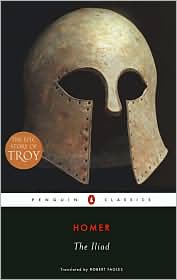
I think that this cover reflects that question. It's a fantastic choice for the cover of this masterpiece. Whereas most publishers have chosen stark pictures of Greek helms, or hoploi, or a panoply of empty, ghostlike armor, or others have chosen that famous statue of the spartan king, Leonidas, or still others have perhaps shown a painting or fresco of the legend of Achilles, the publisher here has chosen Robert Sargent's famous photo of the landing at Omaha beach, June 6, 1944, thus connecting the tumultous event of D-day in our modern era to the timeless themes embodied in Homer's great work.
Like the work of the Iliad, the stark black and white photo conveys a sense of fatedness and oppression from divine necessity. What is is and what will be will be. The gods themselves are merely slaves to the destructive fatedness of character in the Iliad and man is even more fated to endure "the will of Zeus moving toward its end." Events begun in wrath on Achilles' part work themselves out to the inevitable destruction of "so many sturdy souls hurled down to the house of death" such as Hector and Patroklus. Nor is there any justice in the slaughter of these men for they were "great fighters' souls" not cowards or evil men. Fate seems to grind down the good, the noble, the virtuous and the pure and there seems to be no escape from such horrible ruin. Hector himself acknowledges to Andromache that "one day mighty Ilium will fall" and Achilles states that "the same fate waits the coward and the brave." Courage, nobility and honor do not save a man from suffering the horrid ruin of being "hurled down to the house of death."
Similarly, Sargent's photo is framed by the steely cage of the Higgins boat, tomblike, funneling men onto the killing field of the sands of France. The colorless world of smoke and horror seems oppressive, fated, lifeless and terrifying. Nor does one have any assurance of surviving the hail of bullets from German pillboxes once he emerges from the relative security of the womb of the boat into the bloody world of war's reality. The young men who fought on that day undoubtedly had a sense of their own fate and the cruel jesting unfairness of it all.
Yet what more could they have done then their duty? They saw this moment as the beginning of the "Great Crusade, toward which we have striven these many months" as Eisenhower urged them. "The eyes of the world are upon you," Ike wrote, "The hopes and prayers of liberty-loving people everywhere march with you." No more could the young men butchered in those first few moments of terror shirk their duty then could Hector have remained behind the walls of the city. Hector claims that he cannot follow Andromache's command and remain in Troy for shame at facing "the women of Troy with their long robes trailing behind them" or the men who would mock him for his cowardice. The necessity of Honor drives Hector as it later would drive the young men on Omaha, Utah, Sword, Juno & Gold beach to give their own lives rather than shirk duty.
But more even than duty or honor what drives both Hector and the men at Normandy is the sense of love. Hector claims that he would sooner die than see Andromache "led off in chains, servant to some Greek woman" or see his little boy, Astyanax, thrown from the walls of the city (as later he would be). Love ultimately drives Hector to do the impossible task of defending a failing cause against overwhelming odds. Similarly the men at Normandy beach may have had different motives for joining the army, but in those moments before the gate dropped and the first waves dissolved in an hazy smear of blood, love must have been a motivating factor. Each man loved country, freedom, family, mothers, sisters, wives, children and each other. Driven by a love for the world and desire to stop the marauding hordes of darkness that threatened to engulf the fragility of human life and human civilization in a wave of Fascist nihilism, each man somehow found the courage to inch up that beach and reach the shingle. In a primordial way they struggled merely to survive; but beyond that animalian impulse they also wished to "bring about the destruction of the German war machine, the elimination of Nazi tyranny over the oppressed peoples of Europe, and security for (themselves) in a free world," just as Hector sought to preserve some vestige of human civilization and beauty for himself and those whom he loved.
Saint Paul once wrote to the Corinthians, "And now these three remain: faith, hope and love. But the greatest of these is love." Love seems to be the distinguishing mark of the free man. It is a deep seated power that transcends the acrid putridity of Treblinka and Auschwitz, the violent superfluity of Krystalnacht, and the tragic ruin of Hissarlik. Consequently it speaks of man's greatness who alone can, in the face of overwhelming odds, look beyond his world to a greater light and endure unimaginable pain for the "little low heavens" he sees around him. Ultimately, as in Sargent's photo, man seems to be heading toward a grey dismal land, only dimly seen through terrified eyes. But love, even in that last test of our heroism, allows us to stand against the barbarism that seeks to beat us down and say
My time has come! At last the gods have called me down to death. Well let me die - not without struggle, not without glory, no, but in some great clash of arms that even men to come will hear of down the years!
Now you tell me that both are equal in quality, talent, beauty and that both equally create an atmosphere of reverent and dignified prayer. All things are not equal and the switch from exhibit A to exhibit B (a switch very frequently seen and heard in modern churches) is not a lateral but a vertical downwards shift. But I suppose that if one conceives that there is no metaphysical world, or if one conceives that all images are equivocal and equally bullshit then why not have the Doobie Brothers or Led Zeppelin playing at your next Benediction ceremony? Advocates of the old forms of worship are sometimes cranks who simply hate change, but more often they have a valid point: images effect imagination, conception, the soul - lex orendi lex credendi. If the forms of worship or Bacchic, cheap, tawdry and shallow what they effect in the nous (mind/soul) will be of equal quality; an entire generation or two or three might grow thinking of Christ only as their non-threatening buddy and not as their leader, savior, guide, hope and salvation. But then, wait, that's already happened, hasn't it?
This is a video with the great "I've Seen All Good People" by Yes. Just thinking about the birth of Elanor, and traveling back from my faculty retreat up north for her birth here in MN.