Facile the descent to where no birds live; Night and day the dark gates of the Unchanged; But to recover the stair and ascend toward the sweet light, This is the work, this the labor. - Aeneid 6.124
Friday, October 5, 2007
On Mercantilism
Monday, September 24, 2007
In praise of garbage
Much of this might be dismissed as the work of the devil which only serves to corrupt our sensibilities, make us hedonistic bread heads, and lead us into a callous Americanistic boorishness not shared by our more elite neighbors on the other side of the swimming pool. True, true, true.
But think of it... where else on earth do people from so vast a geographical distance get together to share a love of Hummells?
I know, there's alot more that brings us together, but no one seems to give credit to this amazing American phenomenon of the production of garbage. No other country does it on so vast a scale. No other country seems to share so various and so similar tastes. And no other country enjoys the relative peace and amity that America enjoys. Even when we hate the opposition we don't actually go out and flay them.
In the Middle East to solve a problem means open carnage in the streets, murder, mayhem, yelling, screaming and riots. But then, the Middle East has never had a professional sports league like the Giants. Is there a connection? I think that indeed there is and if/when I write my book I will give a big hats off to whomever first said, "that'd sell to the American people."
Wednesday, September 5, 2007
Alexander Wilder and the Greek Gods
The worship of these subordinate beings constituted the idolatry charged upon the ancients, an imputation not deserved by the philosophers who recognized but one Supreme Being, and professed to understand the hyponia or under-meaning, by which angels, demons and heroes were to be regarded. Epicuras said, "The gods exist, but they are not what the [[hoi polloi]], or common multitude, supposed them to be. He is not an infidel or atheist who denies the existence of the gods whom the multitude worship, but he is such who fastens on these gods the opinions of the multitude."
Aristotle declares: "The divine essence pervades the whole world of nature; what are styled the gods are only the first principles. The myths and stories were devised to make the religious systems intelligible and attractive to the people, who otherwise would not give them any regard or veneration." Thus the stories of Jupiter, the siege of
~Alexander Wilder
What Aristotle seems to touch on is a fundamental reality of human existence; we perceive metaphysical realities first and foremost through artwork, images, forms. Philosophy and theology express metaphysical truth and make it intelligible, but myths and stories make metaphysical truth intelligible and attractive. Thus we find ourselves "relating" to a song or movie or story, though not to the doctrine of three persons in one god. The "gods", then, are these powers or manifestations of the One God that occur in our world and through us. We still today make heroes of our celebrities. Emulating them and admiring their enviable success, we tacitly wish that we too could be famous and svelt and successful. We still conjure the pagan gods as well each time we covet the luxuries of the shopping mall, or make a deity of alcohol and drugs, or over-romanticize sexual love through porn or adultery. The pagan gods and heroes are still very much with us b/c they are part of a fundamental longing in the human heart. By worshiping them we run the risk of becoming again their slaves and making them, as Augustine said, into demons. But by studying them and pondering what they really embodied, we not only come to understand the unique greatness of Christianity, we also come to know the metaphysical world and ourselves as well.
Monday, August 20, 2007
Beowulf the hero
When the Anglo-Saxons sharing this world view of inevitable ruin were converted to Christianity they must have seen in the person of Christ a savior who fit this view of heroism. Such an interpretation is born out by two examples, namely “The Dream of the Rood” which refers to Christ’s victory over death in terms of bravery in battle and entrance into the Lord’s mead hall.
That Son was victory-fast in that great venture,
Se sunu wæs sigorfæst on þam siðfate,
wunedon on wuldre, þa heora wealdend cwom,
The second example is a vignette concerning the conversion of King Edwin in “Bede’s Ecclesiastical History”, Bk II, Ch XIII. After the priest, Coifi, gives a speech supporting Christianity and calling for conversion, one unnamed theign casts his lot in favor of conversion and uses the famous image of a sparrow flying through a mead hall, saying,
"The present life of man, O king, seems to me, in comparison of that time which is unknown to us, like to the swift flight of a sparrow through the room wherein you sit at supper in winter, with your commanders and ministers, and a good fire in the midst, whilst the storms of rain and snow prevail abroad; the sparrow, I say, flying in at one door, and immediately out at another, whilst he is within, is safe from the wintry storm; but after a short space of fair weather, he immediately vanishes out of your sight, into the dark winter from which he had emerged. So this life of man appears for a short space, but of what went before, or what is to follow, we are utterly ignorant. If, therefore, this new doctrine contains something more certain, it seems justly to deserve to be followed."
The darkness surrounding the mead hall, with all its uncertainty and menace, is a parallel to Ragnarok, in the face of which every man is made weak. Beowulf proposes that facing this darkness is what makes a man heroic. Rather than crying out for something radically different than paganism it seems that the poet is actually encouraging his audience to embrace an image of heroism also exhibited in the heroism of Christ. As such, it tells a much more universal and human story.
Tuesday, August 14, 2007
Monday, August 13, 2007
On Eros
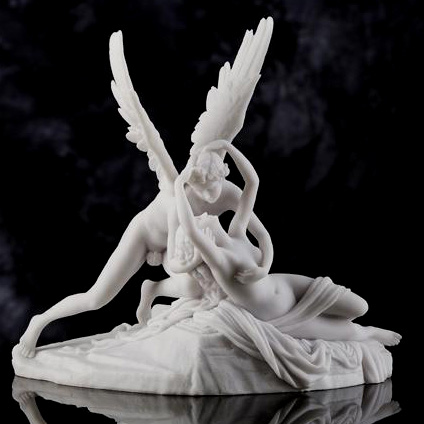
- Eros was not only erotic love and beauty but also the personification of the creative force, one of the primordial gods.
- The other version has Eros the god of romantic love, son of Aphrodite and Ares, and being a chaotic, mischievous force.
You just jumped right in there, dintcha?
First, we have to consider that no idea, including ideas about the divine, ever occurs in a vacuum. We have to look at the historical progression of ideas to get a sense of what we are dealing with in the modern world.
Yes, the ancients did see the force of Eros as positive and negative; but they saw all divine forces as such. Man was a pawn in the plan of the gods, subject to the whimsy that changed on a drachma. So Eros was both the beautiful force of attraction to the good, and it was the destructive force that played gin rummy on human lives. What were they talking about? Most probably they were describing that force that drives us to love this or that thing/person beyond our control. For the ancients, to disobey such a force caused ruin and, since life was short, one took what pleasure one could when one could. Carpe diem, said the Latins. Not everyone did this of course (Hector) but all reckoned that this was a force to have to deal with. Euripides’ “Bacchae” is really dealing with just this force of wild abandon and desire; ecstasy. I really believe that the ancients did see these forces as stemming from a central force or being, but they didn’t talk that way. Probably b/c humans must dissect in order to understand anything, so we break the power down to its constituent parts. Even Zeus himself was not the final force or power; he was merely the ruling Olympian god; law and order imposed on others (all of his sexual escapades are actually impositions of law, not eros gone willy nilly; they are rapes, not consensual powwows). This concept of various divisions of one force goes back to Neolithic (Stonehenge and Egyptians) times. Such gods were very real in that they really were thought to walk the earth but they bespoke of a dark and violent force to the world. Originally depicted as snakes, they later morph into animals and protean elemental forces. I don’t think that such a sense of terrifying snakiness has ever left us. We are still, as humans, quite pagan in our outlook on life. (so you can’t convert, you already are!) But history has added nuance to our paganism.
The first nuance was the change during Homer & later Plato’s time. Homer first starts to speak of the gods in a critical way. Not so much to poke holes in the whole polytheistic thing (I don’t think he was thinking that far ahead) but to show that these forces lent themselves to humor and tragedy. He was a radical in his era, but he also made a living by embodying the zeitgeist of the Ionian age. This same criticism is later picked up by the Athenians who see the gods not as gods external to us but as representations of forces within man. For Plato, the gods were a language for talking about those things we experience as humans. Nevertheless, the golden era philosophers seem to have believed that there really was a force of some sort to which man conformed (both physically and spiritually). This force is difficult to speak of directly so we speak of it through a mirror, or shield, which is polytheism. We anthropomorphize in order to understand. But in anthropomorphism a major change takes place. The snakiness disappears. No longer are the gods forces that control us, but they begin to become forces which we participate in (since they are manlike and not “Kadosh: otherness” as the Jews called them). Suddenly the gods become incarnate in man form and are thought to be understood not as beings that walked about the earth, but as forces which we control. No longer is Eros a destructive, whimsical force giving pleasure here or there, but becomes an expression of that longing which every man feels within him for some unknown beauty; the unknown Areopagite god. This unknown god is so beautiful that a man must control himself in order to see him, and sacrifice all else that he has for this richness. So a shift in teleology occurs; nuance is added to our pagan thought.
The next additional nuance comes from the merging of Jewish and Greek ideas. The Jews, who initially also saw the forces as serpents stemming from one serpent, began to conceive of the force as anthropomorphic; Yahweh was a man with hands, feet, breath, eyes, even a backside (which he shows to Moses). Moreover, he was a manlike being who loved his little creatures, instead of merely using them. This is a significant change. If the forces are within us, then the fact that the force loves us gives a teleology to the forces within us which is radically different than previous. This is why I love the mythology and religion of the Jews. God loved us, not only in a sexual way (as the Greek gods did) but in a deeply moving type of love that was beyond even eros. Eros becomes caught up in a greater love of self and other which is what Yahweh displays to his little shepherd idiots. We begin to get an insight through the Jewish faith into a being who loves on many levels; and thus we get an insight into the fact that our loves (whatever those mysterious movements in the soul are) have a greater telos than mere gain or pleasure. The Jews stressed family life as the greatest institution on earth. Man and woman were made to get married (not just to exchange bodily fluids) and within marriage sexual love was the highest expression of love (witness the book of Tobit wherein the demon seeks to block, not the marriage, but the sexual consummation of marriage). Thus for the Jews, women were honored above all else and the having of children was “arrows within your quiver.” Wealth became measured by how much one loved one’s god, one’s family and, by extension, one’s neighbors.
When the Jewish beliefs merged with the golden era Greek philosophy a new concept came into existence which again gave nuance to our paganism. The nuance was a merging of the Jewish concept of love & marriage (esp. as a symbol of God’s love) with the Greek idea of longing and self-control for a greater good. “No greater love hath a man than that he lay down his life for a friend.” In Christ we have the union of the concept of marriage and sex and birth with the concept of self-sacrifice, denial, suffering, resurrection. The Jewish aspect proclaims that “God so loved the world” and that Christ attended the wedding feast at Cana, and that “out of his side flowed blood and water.” The Greek aspect proclaims that “…he gave his only begotten son” and that Christ “suffered and died so that we might have life” and that on the third day he rose from the dead. The belief for men shifts in this nuance from being merely a concept to being an embodied individual; there really was a Christ, he really did bless marriage and friendship, he really did suffer and die and rise again. Thus our belief in the Incarnation changes our concept of ourselves. Not that if he could do it so can we (because that implies that success is merely a force of will) but rather that the focus of the divine force within us is to endure suffering and failure for the sake of the love of others not yet seen. Marriage and sex become a “total gift of self” (to borrow the words of JP2) and even Eros is subordinated to understanding, nobility & honor, and self sacrifice for the good of something greater. That’s one heck of a nuance.
The final nuance, IMO, is that given to the West by the Medievals. The code of chivalry exalts women to the status of quasi-divine creatures. I don’t think this is a new exaltation; I think that men have always had a tendency to do this. But the Medievals gave voice to what this experience is like and in the romances suggested that such a natural exaltation is symbolic of man’s longing for something greater than himself. The knights, ladies, monsters, love affairs, duels, and quests that populate the Medieval romances are themselves a landscape of the human heart wherein man learns how best to focus his own natural desires. Sure we can sympathize with another man on a cross, but my own desire for a woman, esp. one made unattainable by marriage to another, eats at me and conflicts with that image of self-sacrifice embodied by the figure of Christ. How can I be a good Christian when I so desire her? How can my natural drive to procreate with this divine-like being be reconciled with the purity and chastity which Christianity urges me to cultivate? This is the big question of the romances the answer to which gives the final nuance to our paganism. Lancelot’s desire for Guinevere never fades. In fact his perpetual desire for her destroys everything that he has ever believed in; ruins his wife, strips him of all honor, wrecks the court of Camelot, takes the life of Arthur, prevents Lancelot from achieving the Grail, and reduces him to a starving heap of a man. Yet he does not stop loving her. If she is the image of longing which Eros produces that does not bode well for any of us. When does Eros let us go? The answer, I think, is never. But what Lancelot does is remarkable. He chooses to apply himself to an honorable course of life. He chooses to enter the monastery when Guinevere enters the convent. He chooses to do penance for the love that has brought so many to ruin. This choice is the answer to those big questions of desire; we choose honor even if it makes us suffer and die. By doing so, we are not driven about by Eros but have a choice to remain constant to a way of life we know to be right. In so doing we become the greatest of chivalric persons.
Taken altogether, I don’t know if I answered your question. Bluntly, can you fall in love with the wrong person? Sure. Are you driven by love to have to act on that love? Absolutely not. Our “falling in love” comes and goes; Eros still shoots arrows. And in our blackest moments we all of us are pagans. But what the history of thought has shown us is that those black moments do not have to last. Ultimately, our sexual desire and, moreover, the desire of our heart (b/c the two are not entirely separable) will always be for different people. But we are free to choose that person who is right for us (I mean by “right” honorable, financially secure, emotionally stable, supportive of us, and attractive), commit to them, and remain faithful despite the tidal changes of the heart.
Eros is a force, like all the pagan gods, which, if worshipped like a god becomes a demon. He does not command us, we command him. And in the name of honor, self-sacrifice, goodness and happiness, in the name of Jesus Christ, we order him down to his proper place.
Hope this all helps.
Friday, August 10, 2007
The Lay of Gilligann
Thursday, August 2, 2007
Rewriting Dan Brown, revisited
Captain Awesome adds this addendum in the style of P.G.Wodehouse.
Also some linkage from another friend.
http://itre.cis.upenn.edu/~myl/languagelog/archives/000844.html
http://itre.cis.upenn.edu/%7Emyl/languagelog/archives/001628.html
http://itre.cis.upenn.edu/~myl/languagelog/archives/001631.html
Monday, July 23, 2007
Tristan & Isolde
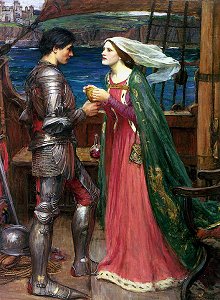
King Mark's address to the other chieftains, "Will you always be little men incapable of seeing what once was and may be again?"
Harry Potter
Verbum sapientibus
Tuesday, June 19, 2007
Michael Davis on Plato Nietzsche and Death
About the sage Nietzsche's Zarathustra has this to say:
His wisdom is: to wake in order to sleep well. And verily if life had no sense, and I had to choose nonsense, then I too would choose this the most sensible form of nonsense.
The contest between Plato and Nietzsche is, according to Nietzsche, a contest between the view that really makes sense of life and "the most sensible form of nonsense," that is, between truth and the most seductive form of error.
...saved fourteen Athenian youths and maidens from the dreaded Minotaur. ...Phaedo gives an enumeration of those present at Socrates' death, and we discover that fourteen youths are present. Like Theseus, Socrates will save these youths from a dreaded monster.The monster from which Socrates saves his Athenian youths is the dreaded fear of death; not just the cessation of life, but something more. The minotaur is that half man/half bull which breathes ice and devours flesh in the dark; something terrible and cold and inhuman in that maze of the afterlife which devours the mind with despair. As Davis points out, "human beings live better lives when they are not continually haunted by the knowledge of the necessity of their own deaths." Thus the story functions on the level of myth that gives hope to both interlocutors and future generations of readers.
Before we have some mass Cathar suicide ritual going on here, though, we have to recall that Plato himself is not present at the death; he is alive and trying to stay that way (to paraphrase Jack Gilford). So Plato is not suggesting that physical death ought to be pursued. Rather, the fear of death addresses "what Cebes calls 'the child in us who has such fears'". Davis notes that,
The mortal fear of death naturally gives rise to a longing for immortality as its cure. This longing is not a desire to be different from what we are; it is rather a desire to remain eternally what we already are. It is an attachment to ourselves.Everyone, from the slacker to the schoolgirl, from the professor to the pundit, abhors change and wants to be in control of the situation they know. No one wants to endure the suffering which death, in a most radical way, imposes. Thus we delude ourselves, surround ourselves with goodies, abuse each other, lord power over one another, and generally act like spoiled children. Such attachment to ourselves the Greeks called hubris, to which could be attributed every rotten excess of human crime and folly. In the Christian sense, pride (hubris) is the root of all sin (separation from God). Hubris is, essentially, an ingratitude for the goodness which we do not deserve. Thus, we have to grow up. Davis suggests that
Only knowledge of our own immortality can destroy the fears of that child in us and, in a rather radical way, force it to grow up.Those who refuse to grow up avoid facing their own immortality and seek to maximize pleasure. Yet such eternal pleasure is not really possible; "...the complete absence of pain would be possible only given the complete absence of pleasure," as Davis notes, "the natural desire to maximize pleasure, if pushed to its extreme, is a sort of death wish." Yet the same holds true for anyone who longs for an afterlife of eternal pleasure. Since pleasure and pain are yoked together in the individual self, to eradicate one or the other would also eradicate a self to register them. Davis suggests that
...common sense takes as its standard the soul, or life, as it is, and then attempts to imagine what would be the most satisfactory form of such a life. The result is an ideal life, which because it takes its bearings by the extreme... cannot be lived. The ideal verson of life is incompatible with life; it turns out to be a kind of death. This is the tragedy of common sense.Human life is, at root, tragic because we all long for something which would spell the end of us; we long for our own annihilation; oblivion;
a draught of vintage! that hath been
Cool'd a long age in the deep-delvèd earth
But as Keats noted, to long for such a thing spells our own forlorn doom. "While it is the case," Davis notes, "that the tragedy does not exist for a mollusk, it is also the case that a mollusk does not know that it is a mollusk. The human self seems to be constituted by the conflict between its desire to be what it is and its desire to be other than what it is." So at the very heart of philosophy, represented in Plato by Socrates, is an "awareness of the tragedy of common sense." If we indeed struggle under this crucifying tension of tragedy, why? from whence does it come? what is consciousness that it causes us to weep? and what is man that Thou dost care for him? mortal man that Thou dost love him?
For this reason it is of some importance that the whole question of immortality does not enter Socrates' argument as a means to overcome death. It enters as a means to overcome ignorance.Man must know who he is; gnothi seauton, as the Greeks urged, if he is ever to grow up. Otherwise we stumble about striking, mocking, spitting at, and crucifying one another. But knowing who we are is hindered by the hubristic self-interest that every person bears with them. Self-concern "gets in the way of our pursuit of wisdom... to see the world as it is and not through the lens of our self-interest requires neutralizing self-interest." And to see with such clarity makes one a better person.
So religion (and the "noble lie" of religion) is not such a lie after all but a perspective shift. Davis concludes,
By asserting the existence of a better life after death (even without absolute mathematical assurance of such existence - my own interpolation here) this life is made better. That is, by providing a vantage point from which to judge the goodness of life, the character of this life can be known more fully.
Monday, June 18, 2007
About the Desire for Power
~Galadriel
Tuesday, June 5, 2007
The Harmony of Apollo
Monday, June 4, 2007
On Arthurian Romance
So what is so enduring about a myth which seems to extol adultery? The whole of the Camelot court seems, as Theresa of Avila suggests, rife with knights and ladies not only incapable of controlling themselves but not even trying so to do. Why is the Arthurian legend so enduring?
It is not so, we know it, despite snow,
These infinites you postulate
Beyond the reach of breath.
Mass is but mother of sorrows loaned
The void that we might suffocate.
This longing accounts for the sense of dissatisfaction which the West endures; the “god-shaped hole” to borrow the words of Bono. It also accounts for the perpetual self-critique to which the West subjects itself. Why haven’t we achieved the Grail? What have we done wrong? Was it our fault? What could we do better? What might we change? What exactly is the Grail? “What is the Secret,” asks Willy Loman. These are questions that no Easterner has ever asked (not that Eastern philosophy at its best doesn’t ask profound question, just not these). The West is perpetually reinventing itself because it constantly seeks this elusive Grail of perfection. The Grail represents that vision of perfection which can be conceived through mathematics, theology, philosophy, art & music, yet which only the truly good man (Galahad) can accomplish. Strangely, in all the stories of the Grail Quest, Galahad’s accomplishment doesn’t involve a trophy (he gets no Stanley Cup to take home, no shining Oscar to put on the mantel) but only a knowledge of himself, a gnothi seauton, and a love of that beauty to which he joins himself. The Grail, then, is phi, Christ, the perfect jazz riff, the zone on the basketball court, the ecstatic moment during “Long-Distance Runaround”, the grace of Peggy Fleming, the fluidity of Tiger Woods’ putt, the elegance of Wedgewood China, the S-curve in the statue of Our Lady of Perpetual Help, the beauty and power of the Pastoral Symphony, et alia (oh, I’m not equating Christ to Wedgewood China; work with me, people!) Over and over again people in the West launch into the Grail Quest with hope springing eternal that this time we might achieve the quest, this time we might find the Questing Beast, this time we might discover Avalon. Camelot, the perfect society, exists in order to accomplish this very difficult, fragile, excellent task; Camelot exists in order to form a more perfect union, that “government of the people, by the people, for the people, shall not perish from the earth”, that “all men, yes, black men as well as white men, (should) be guaranteed the unalienable rights of life, liberty and the pursuit of happiness.” Inexorably wound up with the formation of Camelot is the engagement in the Grail Quest.
Why still, beset by enemies the heart upholds,
To hear within that abstract horde, grown cold,
Persistent rumbles of the Night she praised,
The flashes lighting wide the Western skies
And then
The long-locked thunder of the Cross?
Christianity infuses this vision of the Arthurian cycle, certainly, but is also owing to it for the marvelous concrete figure which the stories give to the concept of salvation. After Camelot is annihilated, the knights all dead or scattered, the court at Carlisle a blackened hulk, the women homeless, childless, or master-less, two things happen. First, Arthur, with his dying breath commits his sword, Excalibur, back to the Lady of the Lake. He thus fulfills the promise which eventually made him king and relinquishes the symbol of earthly power and intellect granted to him to complete his task of the Grail. To borrow Tolkien’s wording, he gives up the ring. Consequently, Arthur, like Galadriel, refuses the power of a god, diminishes into the West, and remains Arturus Magnus. Because of this last act of heroism on his part he is taken to the undying lands of Avalon by the spirits of the magical world of Faerie. Even Arthur, in his incompetence as king/husband/father and his failure to perceive his wife’s infidelity transpiring in his own court, redeems himself by a last valiant act of humanity.
Dedicatum cordi meo, Beth. Grazie, carissima bella.
Tuesday, May 29, 2007
Monday, May 21, 2007
Contact, Aquinas, Aristotle, and Faith
THERE is then a twofold sort of truth in things divine for the wise man to study: one that can be attained by rational enquiry, another that transcends all the industry of reason. … our cognitive faculty has different aptitudes for the knowledge of divine things. To the declaration therefore of the first sort of truth we must proceed by demonstrative reasons that may serve to convince the adversary. But because such reasons are not forthcoming for truth of the second sort, our aim ought not to be to convince the adversary by reasons, but to refute his reasonings against the truth … alleging the authority of Scripture confirmed from heaven by miracles.
As other sciences do not argue in proof of their principles, but argue from their principles to demonstrate other truths in these sciences: so this doctrine does not argue in proof of its principles, which are the articles of faith, but from them it goes on to prove something else…
Definition 1.
A point is that which has no part.
Definition 2.
A line is breadthless length.
Definition 3.
The ends of a line are points.
Etc.
If, on the other hand, there is an order & pattern one has to then ask whether that pattern repeats. Is it consistent? Is the pattern transferable from one thing to the next in the physical world? In what way does the pattern connect to something beyond this world? What does the pattern say about the patterner? Such inquiry leads not to being stymied but to true wisdom; as Aquinas notes,
...they are called 'wise' who put things in their right order and control them well.
Wednesday, May 16, 2007
Plato's Theory of Forms
There are two subdivisions, in the lower of which the soul uses the figures given by the former division as images; the enquiry can only be hypothetical, and instead of going upwards to a principle descends to the other end; in the higher of the two, the soul passes out of hypotheses, and goes up to a principle which is above hypotheses, making no use of images as in the former case, but proceeding only in and through the ideas themselves.
Socrates here is describing not so much a set doctrine but a relationship to the good which resembles something akin to love. When the soul first sets out to find the Good it examines the multiplicity of mathematical objects that govern the created world and hesitantly assumes certain principles on faith (such as that these mathematical objects are connected, that they are created by a Being that has reality, that there is an order to it all). Yet as the soul moves closer to loving the good it sees not multiplicity but unity and no longer questions the principles which initially led it to pursue the good. Discussing this idea Socrates says of mathematicians that
… although they make use of the visible forms and reason about them, they are thinking not of these, but of the ideals which they resemble; not of the figures which they draw, but of the absolute square and the absolute diameter, and so on --the forms which they draw or make, and which have shadows and reflections in water of their own, are converted by them into images, but they are really seeking to behold the things themselves, which can only be seen with the eye of the mind…
These Forms (the Neteru of the Egyptians) are not so much a thing or set of things to be attained but rather a relationship of harmonious union: the nomad soul drawn erotically toward the God, or conversely, the good intellect of God as it relates to His creations. Conceiving of them as terms or objects (i.e. goodness, truth, beauty, chairness or couchness) only limits them, as though to say that the closeness of lovers can be captured in a sentence or word or image. The minute one tries to define the Neteru one misconceives them and becomes like an outside voyeur attempting to comprehend the intimacy between lovers.
Plato’s consequent refusal to define the Forms seems understandable in this respect. Indeed the esoteric definitions of the Neteru become merely a guide to try and understand what can only be fully understood by direct experience on the part of the individual. The relationship of mathematical objects to Forms is one of unity increasing and multiplicity decreasing even as the soul ascends to love of the Good; the lover and the beloved are one. Descending from this, unity decreases and multiplicity increases until one diminishes to this specific math object governing this specific physical thing. Then descending into the realm of physical things, multiplicity (and consequent decrease in unity and infinity) increases again ending in the images we construct to comprehend those things. Yet all these multifarious objects are merely stepping stones, means to an end which is unity with the Good. As Socrates himself says:
…when I speak of the other division of the intelligible, you will understand me to speak of that other sort of knowledge which reason herself attains by the power of dialectic, using the hypotheses not as first principles, but only as hypotheses --that is to say, as steps and points of departure into a world which is above hypotheses, in order that she may soar beyond them to the first principle of the whole; and clinging to this and then to that which depends on this, by successive steps she descends again without the aid of any sensible object, from ideas, through ideas, and in ideas she ends.
But the discussion is not one of a philosophic doctrine as it is a discussion of the soul’s longing for oneness with the Good; this thing is God and is not God. Deus ubi est? In the discussion there is an implied unbroken chain of being back to the Good itself so that all things are drawn to the God and God becomes all in all. The soul reaches a point where it no longer hypothesizes whether it is loved, nor does it any longer need signs and wonders to prove that it loves the Good or that the Good reciprocates that love. It passes out of the realm of hypothesis into a realm of knowing “which is above hypothesis”; a realm in which the soul knows that it is loved.
Friday, May 4, 2007
The Naked and the Nude
For me, the naked and the nude
(By lexicographers construed
As synonyms that should express
The same deficiency of dress
Or shelter) stand as wide apart
As love from lies, or truth from art.
Lovers without reproach will gaze
On bodies naked and ablaze;
The Hippocratic eye will see
In nakedness, anatomy;
And naked shines the Goddess when
She mounts her lion among men.
The nude are bold, the nude are sly
To hold each treasonable eye.
While draping by a showman's trick
Their dishabille in rhetoric,
They grin a mock-religious grin
Of scorn at those of naked skin.
The naked, therefore, who compete
Against the nude may know defeat;
Yet when they both together tread
The briary pastures of the dead,
By Gorgons with long whips pursued,
How naked go the sometimes nude!
There be dragons!