Monday, June 4, 2007

On Arthurian Romance


Had a wonderful get together on Friday last with Dr. BS, Dr. BC, KevinD, MichealO, MichaelT, ChristopherS, Dr. ArturoH. Thanks, lads.


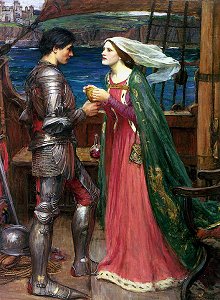
During the course of the confab at said gt, Dr BS raises the question of courtly love/Arthurian Romance/troubadors et alia. What is so great about these stories? Why do we want our young people to read them? Aren’t they, as Catherine of Sienna indicates and Cervantes hints at, extolling vice as virtue? Most of the stories seem centered around adultery and violence… what’s noble about that? Gottfried von Strassbourg, for instance, makes the life of adulterous romance out to be more noble than the life of honorable marriage; Cretien de Troyes lionizes (literally in one story) the adulterous man; even Goethe himself, though not directly praising adultery, praises the tragic life of, say Tristan and Isolde, as more ennobling and admirable than the desultory life of honorable marriage. Is that virtuous? Aren’t the stories warping to the mind as they did to Don Quixote until one goes and tilts with windmills?


Great query, Doc, and I pick up that gauntlet with gusto!


There is much here and I’ll try to attribute to those what gets it the proper acknowl. First one has to consider the historic context. The court of Eleanor of Aquitaine was certainly rife with adulterous peccadilloes (Ellie herself being somewhat, shall we say, less than faithful to her piggish hubbie, Hank Dos). So the point must go to the fact that there was plenty of “boinkin’" in the courts of Medieval France. The troubadours (those pop stars of the day) certainly contributed to the glissando of this activity; they knew where their bread was buttered, after all, and probably the moralizing troubadour didn’t last too long in his profession.


And yet, human nature being what it is, the profligate character of the courts was little different from our own wayward culture. There were those who did then and those who do now just as there were those who refrained from doing then and now. So the songs of the troubadours probably didn’t encourage licention any more or less than Whitney Houston or Britney Spears do today (which they do; the point being it wasn’t more then). But then, as now, the corpus of lit wasn’t confined only to the Whitneys and the Britneys of the day. Simultaneous with Gottfried, Cretien, and the troubadours, were many excellent composers of liturgical music, attesting to the fact that secular and sacred art lived in commune. Additionally among the secular artists, a prolific number of writers on the Arthurian cycle exist, numbering among them; the author of Pearl & Gawain and the Green Knight, the author of the Niebelungenlied, the Song of Roland, William of Malmesbury, Henry of Huntingdon, Geoffrey of MonMouth, Thomas of Britain and his great epic “Tristan”, not to mention Beroul and even Marie de France in Eleanor’s own court. Additionally there was Robert de Boron who treated the characters of Merlin and Perceval quite well. The German authors Eilhart von Oberge and Hartmann von Aue who reworked the stories of Tristan and Eric and Enid (it’s parallel). The prose poet of the French Tristan, Luce de Gat and the French “Perlesvaus” by an anonymous author also treat favorably the stories of tragic love. The Norse, the Dutch, even Hebrew has a “Melech Artu” which is a reworking of this legend and the Welsh have the “Mabinogion” and the “Culhwch and Olwen” stories as well as the Romances, “Owain”, “Geraint and Enid”, & “Peredur, son of Efrawg” and the Greeks have a “Presbys Hippotes”, “Priestly Horsemen” story. Later in history there is Malory, Ludovico Ariosto, and extending into our own generations, Tennyson, Pyle, White, even Steinbeck does a poor treatment of the story. Numerous musical compositions have been created by none other than Purcell, Handel, Wagner, and numerous others including Lerner & Loewe (for what its worth). One of the most popular masses composed during the Renaissance was the “Missa L’homme armee”, the man at arms mass, and churches throughout Europe abound with knightly imagery. Plays, artwork, poetry have been constructed based on the Arthurian cycle in a list too long to name here. J.R.R. Tolkien himself, when considering what subject matter might give frame to his vision, seriously considered reworking the Arthurian cycle. The imagery of the Arthurian cycle permeates today our pop culture, our advertising industry, our current vision of politics, religion, and how to live life. It is, I would argue, the most dominant paradigm the West possesses.


So what is so enduring about a myth which seems to extol adultery? The whole of the Camelot court seems, as Theresa of Avila suggests, rife with knights and ladies not only incapable of controlling themselves but not even trying so to do. Why is the Arthurian legend so enduring?


Primarily, the Arthurian Romance ennobles man’s general tendency toward violence. Historically, the stories channeled the violent tendencies of a dominant warrior class which ruled Europe at the time. Dr. BernardC points out that the Middle Ages consisted of a warrior class holding the land over a large population of peasant/serfs. This class of men were professionally trained killers who frequently practiced their arts on the local serfs. Atrocities were known to happen. The Arthurian stories suggest that such action is base and ignoble. The true knight protects the weak and only fights those who are his equals. This suggestion, which became pervasive due to the treatment of the theme, has far-reaching consequences. Our current idea of the warrior is one who limits his energy only to release it in a torrent of violence upon those who are evil. Indeed the very concept of combating evil seems to have emerged through the Arthurian cycle. Our vision of religion as a battle takes its theme from this (witness the Saint Michael character and the exercises of St Ignatius of Loyola). Our vision of justice owes much to this as well and hence our civil and political thought; bad men need to be fought; moral relativism (an Eastern concept) is itself a lie which undermines the good man. Arthurian Romance created in the West the vision that struggle, violence, and combat were not random perennial events which the poor man must suffer (as the Greeks thought; life was war with occasional peace), but the major activity of the good man on this earth.


Further, the Arthurian Romance elevated the vision of woman. Setting aside for a moment the stories of adultery, women in the romances are continually depicted as noble, worth honoring, beautiful and the basis of every court (this goes back as far as the proto-Arthurian romance of “Beowulf” in the character of Wealtheow). It was one of the maxims of Arthurian chivalry that a man honors a woman, even an adulterous woman. The claim that Guinevere was an adulteress (though true) was only spoken of openly by the bastard churl, Mordred. Even the weak and bumbling Gawain, who refuses to defend the pyre of Guinevere because of the death of his brothers, will not openly speak of her affair. Women, even adulterous women, are to be honored and their reputation preserved. Moreover, women are perpetually the source of knightly action. Whether the knight set out on the quest to honor his mistress, or to serve his queen, or to protect his wife, or even to be with his lover, he was always motivated by some woman somewhere. Homosexual love never occurs in the Arthurian legends and motivations due to greed, revenge, hubris, desire for more camels or cows or the lust to conquer are non-existent. All motivations in Arthurian Romance involve a woman; Mark’s jealousy of Tristan begins due to Isolde (though some claim that he also has intentions on Tristan as Saul might have had for David), Launcelot’s madness occurs because of the tension between Guinevere and Elaine, Merlin’s imprisonment is due to his love for Elaine the enchantress (not the same Elaine but a girl synonymous with the Lady of the Lake). This honoring of women is simultaneous with the amazing and odd rise of the cult of Mary throughout Europe. This cult in the Church has its origins in England but spread throughout all of Christendom. Thus we even now refer to Mary as “Mother of the Church” the “Virgin of Virgins” the “Star of the Sea” and other noble epithetic titles. Our vision of women as important to society comes from the Arthurian legends; our love of romance, our sense of chivalry toward women (and thus the counter, rampant feminism and the current misogyny of our culture) and even women’s suffrage are all beholden to these cycles (there has been no feminist movement in the Middle East, after all).


Third, the Arthurian Romances ennobled the vision of society and government through the stories of Camelot and the Grail Quest. In the writings of those authors who treat these particular themes with gravity Camelot becomes the paragon of human society; the subordinating of individual human desires in order to graft together divergent powers and interests and create a working community capable of greatness. Interestingly enough, the Camelot story is inseparable from the Grail Quest; what can the well-formed society achieve? Finding the Grail, of course! Ever since the Arthurian stories, our society in the West has sought exactly this. We seek in our politics, our art, our commercialism, our daily activity, the Grail; that “ever-receding Ausonian shore” as Virgil put it when describing Rome. All our longings hint at something beyond this world consisting of happiness, greatness, completion. As my father, Dr Rollin Lasseter, puts it in one of his poems,

It is not so, we know it, despite snow,
These infinites you postulate
Beyond the reach of breath.
Mass is but mother of sorrows loaned
The void that we might suffocate.


This longing accounts for the sense of dissatisfaction which the West endures; the “god-shaped hole” to borrow the words of Bono. It also accounts for the perpetual self-critique to which the West subjects itself. Why haven’t we achieved the Grail? What have we done wrong? Was it our fault? What could we do better? What might we change? What exactly is the Grail? “What is the Secret,” asks Willy Loman. These are questions that no Easterner has ever asked (not that Eastern philosophy at its best doesn’t ask profound question, just not these). The West is perpetually reinventing itself because it constantly seeks this elusive Grail of perfection. The Grail represents that vision of perfection which can be conceived through mathematics, theology, philosophy, art & music, yet which only the truly good man (Galahad) can accomplish. Strangely, in all the stories of the Grail Quest, Galahad’s accomplishment doesn’t involve a trophy (he gets no Stanley Cup to take home, no shining Oscar to put on the mantel) but only a knowledge of himself, a gnothi seauton, and a love of that beauty to which he joins himself. The Grail, then, is phi, Christ, the perfect jazz riff, the zone on the basketball court, the ecstatic moment during “Long-Distance Runaround”, the grace of Peggy Fleming, the fluidity of Tiger Woods’ putt, the elegance of Wedgewood China, the S-curve in the statue of Our Lady of Perpetual Help, the beauty and power of the Pastoral Symphony, et alia (oh, I’m not equating Christ to Wedgewood China; work with me, people!) Over and over again people in the West launch into the Grail Quest with hope springing eternal that this time we might achieve the quest, this time we might find the Questing Beast, this time we might discover Avalon. Camelot, the perfect society, exists in order to accomplish this very difficult, fragile, excellent task; Camelot exists in order to form a more perfect union, that “government of the people, by the people, for the people, shall not perish from the earth”, that “all men, yes, black men as well as white men, (should) be guaranteed the unalienable rights of life, liberty and the pursuit of happiness.” Inexorably wound up with the formation of Camelot is the engagement in the Grail Quest.


Unfortunately for all humanity, also wound up with the formation of Camelot is the Affair of Lancelot and Guinevere. It is in this context that the existence of adultery in the Arthurian cycles really becomes comprehensible. Maugre those troubadours and poets who merely used adultery to entertain and titillate, adultery was in the cycles the one major source of all ruination. Tristan & Isolde fall to ruin only when they finally consummate there implacable love for each other. Elaine commits suicide only when Lancelot returns to adultery with Guinevere (a prefigurement of the later Camelot ruin). Merlin is ruined by adultery as is Uther Pendragon as is Gawain as is Arthur himself (whose adulterous/incestuous affair with his half-sister, Morgana le Fay, becomes the proximate cause of Camelot’s destruction). Adultery is not simply the fun, frivolous flaunting of Christian principles, it evades those principles in order to undermine the very root of human existence. What the adulterous complications in the Arthurian cycle point out is that fundamentally every human being is deeply flawed, and thus deeply in need of redemption. All humans struggle with the fomes (as Thomas called them); those powerful tugs on the human heart that seek to lead us toward things lesser than God. These fomes Augustine called “the gods” (and indeed he was probably more accurate than he thought since most of the Greeks and Romans thought of them as such, too); powers that when worshipped as gods become demons. We see these powers in our own culture; sex, violence, power, rebellion, sex, revenge, sloth, money, avarice, sex, sex, and sex. Indeed of these powers the most powerful, the unbridled sexual urge, Venus or Aphrodite or Astarte or Ishtar, causes ruin more often than any other. Failure in this realm leads to drug use, self-abuse, avarice, power grabbing, viciousness and all the other maladies of Pandora’s box (no pun intended there, no way…). Man seeks beauty, and is drawn, inexplicably, erotically toward beauty. But when that beauty is thwarted we fall to the worst forms of bestiality and vice ever conceived. So the adultery in the Arthurian stories becomes metaphor of this failed attraction toward that which is most loved and most unattainable. It embodies a tension in man between what he desires and what he knows he ought to desire. God, after all, is already married. Who are we to love Him? Who are we to presume that the Queen would look kindly upon us in our pathetic lowliness and bumbling incompetence? And when we don’t gain that ecstasy of heaven and settle for second best (the mistress, the job, fame) what disaster do we reek on ourselves and others? We end, as Lancelot does, running around the Grail Chapel, weeping because we cannot find the door in. Pathetic. Miserable. Imminently human. Thus the Grail/Camelot/Affair story embodies what we in the West see as The Human Story; misery, pain, longing for love, ruining things by our ineptitude, and seemingly unable to stop it all.


Yet the Arthurian Cycle doesn’t quit there. Perhaps this is the greatest element of the stories in the West. Greeks saw life as tragedy and ruin. The East sees things as destiny and karma. The Arthurian Cycle suggests that there is a form of redemption even after our failure. We still believe in goodness despite suffering blow upon blow upon blow. As my father writes in one of his poems,

Why still, beset by enemies the heart upholds,
To hear within that abstract horde, grown cold,
Persistent rumbles of the Night she praised,
The flashes lighting wide the Western skies
And then
The long-locked thunder of the Cross?

Christianity infuses this vision of the Arthurian cycle, certainly, but is also owing to it for the marvelous concrete figure which the stories give to the concept of salvation. After Camelot is annihilated, the knights all dead or scattered, the court at Carlisle a blackened hulk, the women homeless, childless, or master-less, two things happen. First, Arthur, with his dying breath commits his sword, Excalibur, back to the Lady of the Lake. He thus fulfills the promise which eventually made him king and relinquishes the symbol of earthly power and intellect granted to him to complete his task of the Grail. To borrow Tolkien’s wording, he gives up the ring. Consequently, Arthur, like Galadriel, refuses the power of a god, diminishes into the West, and remains Arturus Magnus. Because of this last act of heroism on his part he is taken to the undying lands of Avalon by the spirits of the magical world of Faerie. Even Arthur, in his incompetence as king/husband/father and his failure to perceive his wife’s infidelity transpiring in his own court, redeems himself by a last valiant act of humanity.


Second, both Lancelot and Guinevere, realizing too late the severe consequence of their ill-conceived affair, try to make amends for what they have done. She first enters a convent and denies Lancelot all access to her person. It is agony for her, but she knows it is necessary if she is to find any modicum of happiness. At last, sick and delirious from starvation she calls him one last time, tells him that she no longer loves him but loves Arthur, the “love of her girlhood” and then dies. He, driven to grief by her loss, enters a monastery where he finishes his days in acts of penitence, charity and prayer, “weeping out his last days” as Malory puts it. The ending of these two great figures reminds me of Sebastian Flyte, dying miserably on the steps of the monastery in “Brideshead Revisited.” Yet there is some salvation for these broken and wayward figures. Even losers can find redemption. As Kierkegaard put it, we “work out our salvation in fear and trembling.” I don’t think this is an encomium of such a life as the ideal, as Goethe might have it, but rather a recognition that in our worst moments as humans there might yet be some glimmer of hope. Hope seems, then, a distinctly Western ideal. Westerners do not habitually throw themselves on their swords, barring the ever honorable Romans; hari-kari is not our way. Rather, the underdog, the Rocky (be he III, IV, or MCM), the William Holden, the Cinderella Man, the Shane, becomes our model. Though tragic in its own right, the story of Lancelot and Guinevere (and its parallels in Tristan & Isolde, et alia) is really a story of redemption. Every man fails, inevitably; Finnsburgh burns, Beowulf dies, Peter betrays Christ, Frodo refuses the quest. What a man does with that failure afterwards determines his character as a churl or as a Chevalier au Lion.

Dedicatum cordi meo, Beth. Grazie, carissima bella.

Monday, May 21, 2007

Contact, Aquinas, Aristotle, and Faith

My lovely partner in the conspiracy and I saw the movie “Contact” the other night with Jodie Foster and Matthew McConaughey (yes I know it came out in 1997 and I’m behind the times; so what?). It was a fairly decent movie. Jodie Foster was excellent to watch, as usual, John Hurt was creepy, James Woods, Tom Skerritt, and William Fichtner all gave solid performances. The movie had some hokey things to it; beginning the movie with the young Jodie Foster character and showing elements from her childhood seemed a bit superfluous; the early sex scene between Foster and McConaughey was unnecessary and, though I know Hollywood knows no other way to show love, ruined the romantic tension later in the flick; the treatment of religious zealotry was absurd (Christian suicide bombers? Um, how many of those are there?), but overall these things could be ignored. What was intriguing about the movie was its central theme of faith versus skepticism.

The story was written by Carl Sagan, leading astronomer, physicist, atheist, so I doubt he was so generous to religion as the director, Robert Zemeckis, seems to have been in the movie. But the addition of the character of Palmer Joss, played by McConaughey, seems to have really put the zip into the story. Jodie Foster plays Ellie Arroway, a young (gorgeous, they’re always gorgeous) scientist working on SETI, the search for extra-terrestrial intelligence, after her father died. She is skeptical about religious belief and faith, preferring to look at the world as a “scientist” who sees only those things which can be empirically proven and thinking that religion is a form of mass self-delusion. The McConaughey character, however, challenges these assumptions with some pretty powerful refutations. Instead of philosophizing her to death he says “did you love your father? Prove it!” That seems a pretty powerful argument. Well, anyway, a message from intelligent lifeforms is received on earth, they build a big machine to travel through a wormhole, Ellie goes through the wormhole and sees another world (several other worlds, actually) and makes contact with other intelligences in the universe. She is overcome by the experience and weeps for the beauty of it. Unfortunately, when she returns, no one seems to believe her as she apparently never seemed to have left this world despite her protestations that she was gone for eighteen hours. All she can do is plead with others to accept the vision she has been given on faith. Thus Ellie is suddenly put in the position of being the religious visionary whom no one believes. Only McConaughey, out of love for her, believes her story.

Whether Sagan wanted to create a story about religious experience, or whether he wanted to create a scientific alternative to religious experience is unclear. But the idea that generations of people have mass-deluded themselves in order to escape being so alone is an interesting take on the religious experience. Even more interesting is that the McConaughey character refuses to accept this facile explanation of the mystic vision, partly because it is the belief of the majority of the race and partly because he simply knows, without doubt, that God is.

Here for me was the interesting point; there are two ways of looking at creation. Either one sees order & pattern, or one sees no order or pattern; either providence or chaos. If chaos, then the chaos cannot be limited only to some areas but must extend to all areas. Language, thought, emotions, experience, all of it is mere meaningless chaos. But if this is the case then even discussion about the issue is impossible and one can never find out if the truth is chaos or order. Aquinas speaks to this in the Summa Contra Gentiles;

THERE is then a twofold sort of truth in things divine for the wise man to study: one that can be attained by rational enquiry, another that transcends all the industry of reason. … our cognitive faculty has different aptitudes for the knowledge of divine things. To the declaration therefore of the first sort of truth we must proceed by demonstrative reasons that may serve to convince the adversary. But because such reasons are not forthcoming for truth of the second sort, our aim ought not to be to convince the adversary by reasons, but to refute his reasonings against the truth … alleging the authority of Scripture confirmed from heaven by miracles.


The Being we call “God” is order itself. To deny God is to deny order, pattern, reasoning and discussion itself. Thus, no amount of reasoning can succeed in persuading. Rather a transcendent from of truth, a metatruth has to take place in which the individual accepts certain fundamental principles such as “reason and argument are about something and lead to something.” Aquinas addresses this in his Summa Thelogica introduction when he says;

As other sciences do not argue in proof of their principles, but argue from their principles to demonstrate other truths in these sciences: so this doctrine does not argue in proof of its principles, which are the articles of faith, but from them it goes on to prove something else…

Thus mathematics does not begin by arguing whether a “one” or a “two” exist; nor does it argue whether addition and subtraction are valid procedures. Euclid himself begins his Elements with certain definitions:

Definition 1.
A point is that which has no part.
Definition 2.
A line is breadthless length.
Definition 3.
The ends of a line are points.
Etc.
Were he to prove whether “point” is a valid concept, or “partness” is indeterminate, or were he to excurse upon what the “that” is the Elements would never see completion. Every system of thought assumes some basic principles and proceeds from those principles to “demonstrate other truths in these sciences.” Thus to deny that there is an order & pattern, to deny that there is an orderer & patterner, a “kinoun akineton” as Aristotle calls it in the Metaphysics, is to completely end the conversation; emasculating oneself and preventing any success in discovering whether any of this yackity-yack connects to something real.

If, on the other hand, there is an order & pattern one has to then ask whether that pattern repeats. Is it consistent? Is the pattern transferable from one thing to the next in the physical world? In what way does the pattern connect to something beyond this world? What does the pattern say about the patterner? Such inquiry leads not to being stymied but to true wisdom; as Aquinas notes,
...they are called 'wise' who put things in their right order and control them well.
Wisdom consists in taking that first foolish step and accepting on faith that which cannot be immediately proven empirically; an experience, a relationship, The Forms (ala Plato), or the Neteru (ala the Egyptians). One accepts on faith that these things are, and then one can see them. The Psalm says “the fool in his heart has said ‘there is no God.’” This isn’t in reference to some cosmic fool wandering around in some Nietzschean state of denial, but rather to the fact that denial of such existence makes one foolish, incapable of seeing the Neteru.

As truth is a correspondence to reality, one seeks not truth but the reality to which it corresponds. But one cannot find that reality if one has previously denied its existence. Thus to really comprehend truth, acceptance of what seems outrageous, impossible, ludicrous to the rational mind, this very thing becomes necessary. With such acceptance one gains the wisdom that transcends reason. With denial one remains only a rational fool.

Wednesday, May 16, 2007

Plato's Theory of Forms

The idea of the Forms, the eidoi in Greek, is perhaps one of the most hotly debated ideas in the corpus of Plato’s work. Plato himself never seems to have concretely defined what he meant in his theory of Forms and the doctrine most often is interpreted as some attempt to account of the multiplicity of the created world. But in this passage in the Republic Bk VI Socrates seems to intimate that he is not setting down so much a doctrine of philosophic thought as a description of a relationship, or proportion. Describing the intelligible section of the divided line he says:

There are two subdivisions, in the lower of which the soul
uses the figures given by the former division as images; the enquiry can only be hypothetical, and instead of going upwards to a principle descends to the other end; in the higher of the two, the soul passes out of hypotheses, and goes up to a principle which is above hypotheses, making no use of images as in the former case, but proceeding only in and through the ideas themselves.

Socrates here is describing not so much a set doctrine but a relationship to the good which resembles something akin to love. When the soul first sets out to find the Good it examines the multiplicity of mathematical objects that govern the created world and hesitantly assumes certain principles on faith (such as that these mathematical objects are connected, that they are created by a Being that has reality, that there is an order to it all). Yet as the soul moves closer to loving the good it sees not multiplicity but unity and no longer questions the principles which initially led it to pursue the good. Discussing this idea Socrates says of mathematicians that


… although they make use of the visible forms and reason about them, they are thinking not of these, but of the ideals which they resemble; not of the figures which they draw, but of the absolute square and the absolute diameter, and so on --the forms which they draw or make, and which have shadows and reflections in water of their own, are converted by them into images, but they are really seeking to behold the things themselves, which can only be seen with the eye of the mind

These Forms (the Neteru of the Egyptians) are not so much a thing or set of things to be attained but rather a relationship of harmonious union: the nomad soul drawn erotically toward the God, or conversely, the good intellect of God as it relates to His creations. Conceiving of them as terms or objects (i.e. goodness, truth, beauty, chairness or couchness) only limits them, as though to say that the closeness of lovers can be captured in a sentence or word or image. The minute one tries to define the Neteru one misconceives them and becomes like an outside voyeur attempting to comprehend the intimacy between lovers.

Plato’s consequent refusal to define the Forms seems understandable in this respect. Indeed the esoteric definitions of the Neteru become merely a guide to try and understand what can only be fully understood by direct experience on the part of the individual. The relationship of mathematical objects to Forms is one of unity increasing and multiplicity decreasing even as the soul ascends to love of the Good; the lover and the beloved are one. Descending from this, unity decreases and multiplicity increases until one diminishes to this specific math object governing this specific physical thing. Then descending into the realm of physical things, multiplicity (and consequent decrease in unity and infinity) increases again ending in the images we construct to comprehend those things. Yet all these multifarious objects are merely stepping stones, means to an end which is unity with the Good. As Socrates himself says:

…when I speak of the other division of the intelligible, you
will understand me to speak of that other sort of knowledge which reason herself attains by the power of dialectic, using the hypotheses not as first principles, but only as hypotheses --that is to say, as steps and points of departure into a world which is above hypotheses, in order that she may soar beyond them to the first principle of the whole; and clinging to this and then to that which depends on this, by successive steps she descends again without the aid of any sensible object, from ideas, through ideas, and in ideas she ends.

But the discussion is not one of a philosophic doctrine as it is a discussion of the soul’s longing for oneness with the Good; this thing is God and is not God. Deus ubi est? In the discussion there is an implied unbroken chain of being back to the Good itself so that all things are drawn to the God and God becomes all in all. The soul reaches a point where it no longer hypothesizes whether it is loved, nor does it any longer need signs and wonders to prove that it loves the Good or that the Good reciprocates that love. It passes out of the realm of hypothesis into a realm of knowing “which is above hypothesis”; a realm in which the soul knows that it is loved.

Friday, May 4, 2007

The Naked and the Nude

~ by Robert Graves

For me, the naked and the nude
(By lexicographers construed
As synonyms that should express
The same deficiency of dress
Or shelter) stand as wide apart
As love from lies, or truth from art.

Lovers without reproach will gaze
On bodies naked and ablaze;
The Hippocratic eye will see
In nakedness, anatomy;
And naked shines the Goddess when
She mounts her lion among men.

The nude are bold, the nude are sly
To hold each treasonable eye.
While draping by a showman's trick
Their dishabille in rhetoric,
They grin a mock-religious grin
Of scorn at those of naked skin.

The naked, therefore, who compete
Against the nude may know defeat;
Yet when they both together tread
The briary pastures of the dead,
By Gorgons with long whips pursued,
How naked go the sometimes nude!

Sunday, March 18, 2007

the 300


I must admit I was a bit disappointed in "The 300". Indeed, it comes from the graphic novel of Frank Miller, so perhaps the writing wasn't going to be so good and the exaggeration of evil vs. good was going to be heightened, but still... First, the movie is loosely based on the events of 480 in which 300 Spartans held off the massive army of Xerxes, king of Persia.

In its depiction of this event there are many things that were good. First, The visual style was wonderful; the movie is shot on a lot and the backgrounds and sets digitally painted in giving the whole picture a dreamlike atmosphere that resembles the graphic novel. Video ramping and color wash are employed to heighten the action sequences. Costume design and armory, though not authentic, are certainly a wonder to behold. Further, seeing a depiction of how ancient warfare might have been was quite exciting. There are few movies that actually depict this type of warfare (more's the pity) and for some time I've wanted a "opening 15 minutes of Private Ryan" that concerns itself with ancient warfare. This is pretty close. The historical inaccuracies aside, the fight scenes and the graphic nature of the battle contribute to the depiction of the horror and glory that was ancient warfare. Additionally, the epic struggle between obviously good men and definitively evil forces was certainly stirring. The Spartan men and women are beautiful physically and spiritually. They are noble, rugged, and ripped with muscles (even the lead feminine star,
Lena Heady). Xerxes and the Persians are monstrous, orc-like, covered with piercing and warped in body and mind. They are obviously tortured, inhuman creatures about whom no one can have an illusion about their badness. Finally, the overall spectacle was impressive. If one goes to see a movie for spectacle, this would be it. It is nonstop, overwhelming, seductive spectacle of the most glamorous kind; the type Saint Augustine used to say was the pride of the arena.

And therein lies my discontent. I care less about the historical inaccuracies, nude scenes, graphic violence or even bad acting and story plot than I do about the spectacle element. Certainly I'm in agreement with Victor Hanson that the leonization of Leonidas and the 300 is a time honore tradition dating back to Herodotus. What the Spartans did at Thermoplyae was impressive and should give great encouragement to anyone else fighting in a conflict that seems unwinnable. Moreover, the movie has hints of a Western vs. Muslim conflict wherein the Spartans are the Westerners and the Persians are the Muslims ("submission" becoming the ubiquitous word from the mouths of the Persians seems no little coincidence). It’s quite encouraging to think that anything out of Hollywood might suggest such a theme.

Nevertheless, I don’t know if it does. The acting in the movie is not great; once or twice Gerard Butler sounds more like Sean Connery than Leonidas. There are many unnecessary scenes (like a video ramped sex scene? Why?) and some downright silly historical inaccuracies; such as a rhinoceros and elephants at Thermoplyae. Please. But the thing that gets me most is that the Persians are unsubtle inhuman monstrosities not of mind but of body. They are orcs, not men. Like Peter Jackson’s rendition of the Lord of the Rings, this rendition of the truly monstrous philosophy of submission which infected the Persian empire saps the power of this philosophy completely from the characters. They are orcs and act with orcish natures. As such they are no more threatening than a lion or a bear or a shark. Were they men they would be far more threatening because the possibility of other men being infected with the same mental disease would be far greater. The opposition which Leonidas and his men would be facing would not just be the physical struggle of bronze on bronze but the mental struggle that what they had to offer as a free people was ridiculous, miniscule, transient, futile.

This flaw in the movie is most pronounced in the character of Ephialtes. Historically, Ephialtes of Trachis was a man who chose to betray the Spartans for a reason unknown to history. Greed? Lust? Revenge? Or did he just see the future in which the massive empire which enjoyed plumbing, mail service, secure government, medicine, possibilities of wealth, and advanced culture would dominate the backwater slums of the Greeks? What was freedom (a concept feared by the Spartans as they owned one of the largest slave populations in Greece at the time) compared to this physical luxury and advancement? Surely the fleetingness of giving obeisance to a god-king was a small price to pay for being able to enjoy the greatest of modern inventions? Greeks were fools to resist the coming age. The movie depicts Ephialtes as a misshapen beast who betrays the Spartans because Leonidas, quite understandably, rejects him as a warrior. The misshapen Ephialtes then turns to the fleshpots of Xerxes and the promise of physical pleasure. His motives are so simple and mundane as to be almost laughable. The name Ephialtes means "nightmare" and the real nightmare is not that one man will give in to his passions but that the promise of freedom will seem paltry compared to what the simplicity of submission has to offer.

This oversimplification seems a terrible disservice both to history and to the present situation. If the movie seeks to lionize the historical event it does a poor job through its abridgement of the characters and their motives. If the movie seeks to tell an inspiring story to modern viewers it fails through its oversimplification. Our current enemies are men, not ogres. Their seemingly pristine message of submission is highly attractive compared to the tangled and exhausting mental journey necessary for autonomous men. Their viciousness and callous murders seem more horrific because of the human greatness which they deny. If they were a hurricane, or a shark, or a bear they would not be so terrifying. But like Leonidas facing the actual Persian hordes, the West faces an enemy that operates with human cunning, human complexity and human sorrow. The movie fails to show this complexity. There are no moments when one feels sorrow for Leonidas, affection for his wife and son, understanding for his enemies. There are no moments of tension in the movie or uncertainty about the situation. There are no moments of crisis when the possibility of total failure becomes a reality.

And as such, the spectacle of the whole thing disturbs me. Is this what the West stands for? Is this what is put forth as being attractive? Is this what encourages young men in the West today? 300 still reigns at the box office and perhaps it might effect some sort of dim recognition of honor and glory in the minds of its audience. I only hope that, under cover of the aspis of spectacle, a hidden, somewhat insidious enemy doesn’t creep in to the gates.

Friday, January 5, 2007

On The Bacchae and Man's Search for Meaning


All education is a search for reality, that which is, the “I Am that I Am”. We know reality through truth, that is, we don’t actually have in our heads the real thing but a perception corresponding to greater or lesser degree to the real thing. This perception is called truth. Our perceptions, then, are either closely correspondent to reality and therefore “true” or not related to reality and therefore “false”. A true perception, or correspondence, is itself an image, form, idea, statement which best embodies reality. Acquisition of such perception is a form of knowledge similar to enlightenment which the Greeks called “Episteme”. It is a knowledge of reality through the patina of truth. Such knowledge doesn’t simply sit in our heads, though, but prompts to, like gods, create new things; we employ knowledge in order to create.
Our creation takes two forms called by the Greeks Techne and Poiesis. Techne is technical proficiency with the tools and formulas of a trade; knowing one’s materials and being able to employ them dexterously. So for example one might be technically proficient in playing the piano, hitting all the right notes with the right emphasis at the right times. Any student of any discipline, from auto maintenance to sculpture, drama, music seeks first to become technically proficient at their craft. But techne alone is insufficient.
Poiesis, the other form of creation, is poetical, or artistic creation, what the Romans called “ars” and it is a transformation and continuation of the world. Poiesis doesn’t simply follow the rules of creation but rather exhibits a depth of thought, originality, profundity which changes the way one perceives the world and more closely resembles the essential reality of the thing examined. So just as playing the piano by the rules very well is techne, playing the piano and inventing new tunes, methods, interpretations is poiesis. The one is an excellent student of piano at Juilliard, the other is Art Tatum or Glenn Gould or Van Cliburne or Lyle Mays or Rick Wakeman.
All poetic creation is based on and includes technical knowledge of a subject, but not all technical proficiency is poetic creation. When we create, then, we might create something exactly as the instructions dictate, write an essay just as we are told, play every note on the trumpet, and still not achieve true poetical creation. We remain carbon copiers and not artists.
To understand a work of art and to become ourselves artists we have to ask questions of the works we perceive. What is the artist expressing? What is the reality he seeks to convey? What is the nature of art? Why do humans create art? What does it mean to be human? How is art an embodiment of the truth? Where do I fit into this great pattern of reality? Merely asking the question leads to greater understanding even if no immediate answer emerges. Any work of art attempts to embody some answer to these questions and thus to embody truth with accuracy and thoroughness. It states some truth about “how things are.” One’s understanding of the artwork, then, ought not be related to one’s preference or agreement with the artwork; not “I like this” or “I don’t like this” but rather an attempt to comprehend what is being said and then a verdict about how well it has been said and how accurate it is. Comprehension of art, and indeed of the world, is a reception based on analysis, not an imposition of will based on how we want things to be.
This, at last, brings us to the Bacchae. The Bacchae examines the nature of the created world and suggests that there are two powers that be; one masculine and one feminine. The masculine power consists of order, light, law, the conscious and self-assured imposition of the will over the world. This power is best represented by the king, Pentheus and has a parallel representative in the god Apollo who, although not appearing in the play, seems to lurk in the background. Yet for all its apparent strength, this power is essentially sterile and intolerant of life in its insistence on conformity and rules. Pentheus does not ask the questions which might sustain him and make him see the world as it is rather than as he wants it to be. He is an excellent technician, but a lousy artist.
The feminine force, however, is not necessarily embodied in Bacchus, though he is the most closely associated with it. Rather, Bacchus, or Dionysus, is a postulant of whatever that force is that through the green fuse drives our age. He speaks of Bacchus, the god, as another person, yet manifests the persona of the god during various stages of the play. He speaks of the Bacchants as a force or power to be reckoned with, but not as his force or power. He allows himself to be jailed, but than bursts from the jail seemingly under his own power. The feminine force is, itself, a force of chaos, darkness, anarchy, and that all-consuming subconscious power of intuition and dreams. Bacchus is not that power, but he represents it and the Bacchants, themselves seemingly more in tune with the power than Bacchus himself, keep their distance from him and operate independent of his will. Before one condemns this second force as lawless we have to consider the fact that this force is fertile where the other is barren; it allows for life where the other paves over life; it allows possibility where the other abides only within the restrictions of dogmatism.
In challenging this power, Pentheus is torn asunder. The power consumes and annihilates him, spreading his blood over the earth to make it fertile. What, then, was the king’s error? He refused to engage in asking the questions necessary for life; who am I? Where am I going? What is reality and my place in reality? This failure to move from techne to poiesis seems epidemic amongst the whole ruling house of Thebes. Pentheus refuses to entertain the existence of divinity in his midst; Cadmus, his father, only late in life begins asking questions, himself having abdicated his position as ruler; Ino and Agave give in entirely to the power of Bacchus and are driven mad as Bacchants. All of them suffer because of their familial penchant for obedience to the rules.
Ultimately, though, rules cannot be jettisoned for the sake of some Woodstockian abandonment to madness and wine. Such, after all, is the route of Ino and Agave who, at the end of the work are just as miserable as Pentheus and are changed into dragons for all their trouble. So what is the solution to the problem of masculine and feminine force? It seems that Euripides is hinting at a solution in the position of kingship. Pentheus is a bad king because he seeks not to govern but to dictate. He imposes law on the lawlessness of the world rather than seeking to discern the right and proper course of action. A king, ideally, doesn’t see the world as he wants, but tries to discern his place in the world and, by consequence, the place of his city in the world. Thus he is artist, or poet, attempting to find The Word by which to embody reality in truth for himself and his city. Pentheus’ refusal to ask the questions necessary for life leads him to prurient interest in the subject and ultimately to his demise. Similarly Cadmus’ abdication of his throne, and Agave’s abdication of the “throne” of her own household for the hippy pleasures of the fields leads them both to a lawlessness and lack of control, a madness, which terminates in their becoming one with the spirallic pattern of the created world (the serpent). They do not ask the questions a king must ask, but seek the joys of freedom without control and are thus unable to escape the dictatorship of the natural world.
Man, Euripides suggests, is neither masculine force nor feminine force, but rather the representative or conduit of both; he is a marriage between the two. He submits to reality and governs and recreates the natural world through the force of poetry under the control of technical ability. King must both govern and inspire; control and discern. And thus the role of man in the universe is not to be the dictatorial lout who will not listen to others, nor the foppish libertine who, like Homer’s Paris, has not the exercise of his own will, but somewhere in medias res of these two powers.
Aristotle suggested that virtue consists of the mean between two extremes, and indeed Euripides seems to suggest a similar theme. The proper course for man is between planting and harvesting, between life and death, between governance and obedience, between masculine and feminine, between heaven and earth; crucified in submission to the powers of reality, yet triumphing through such obedience to death, even death on a cross.

Wednesday, December 13, 2006

Achilles and the devastation of rage


Personal responsibility. A man is responsible to friends, parents, siblings, the whole human race. What Achilles’ pride blinds him to is how vital this responsibility is and how his actions can cause so much devastation in the lives of others. Man is a sorrowful beast – to learn about this sorrow in a personal way is a painful, terrifying business but vital if we are to see the world as it is and not as we want it to be; bent to our inexorable will. To experience sorrow leads to greater knowledge of ourselves and all humanity.
Yet the sorrow never goes away. There is no “happily ever after” for those who eat the bread of this earth; such poor wretches as we are, scuttling between heaven and earth. Rather, an adult, a man, carries always with him the sorrow, knowledge, pain over his own mortality and his ability to destroy and the inevitable, miserable Ragnarok of all things beautiful. This weight of sorrow is a teacher which reveals reality to the initiate and gives him an insight into who he is. Such insight is not available yet to self-centered immature whelps, lost in their own innocence. It is a knowledge both somber and liberating.
Achilles’ rage clears the way for this mature realization; burns away all obstacles, leaf, flower, tree, from the landscape of his soul such that all the pretty, bucolic Eden of youth is eternally lost; the whims, illusions, pretences and luxury of pettiness to which young people are prone. Once the rage burns itself out, Achilles stands in that fire-blasted terrain, barren of tree or grass or living thing, amidst the devastation caused by his own hand and the unearthly, inhuman silence in which no birds sing and there realizes his own capacity for violence and his own utter aloneness. And he weeps.

Wednesday, November 29, 2006

Humanae Vitae

Ever have days that you just get a little irate over seeing things too clearly?

Contraception, why not? I reread Humanae Vitae today and thought about that question raised by Paul VI. Why oughtn’t one to engage in artificial contraception? Yet the answer to me seems so very obvious that it becomes a source of frustration.

Look, either human actions do or don’t represent spiritual actions.

  • If they don’t then there is no purpose or point to our action and we are no more than highly evolved apes; the whole of man’s spiritual happiness and nobility of existence being thrown out with one negative.
  • If human actions do represent spiritual actions then either they do or they don’t have specific consequences on the spiritual level.
  • If they don’t then all actions are whimsical bits of relativism, without consequence and one might as well murder and rape from the world all that one desires rather than suffer the slings and arrows of outrageous fortune.
  • If they do then marriage either does or doesn’t have a spiritual dimension.
  • If it doesn’t then marriage is the one, unique action, materialistic and relative.
  • If it does than marriage either is or isn’t ordered according to natural law.
  • If it isn’t then one must deny that this most fundamental action of our human existence is connected to the natural law which governs every other aspect of our humanity.
  • If it is connected to natural law than natural either does or doesn’t dictate that marriage is twofold; procreative and unitive.
  • If it isn’t twofold (solely procreative or solely unitive) then we deny one aspect of natural law and the marriage act either has no purpose (again, unique among human endeavors) or it becomes nothing more than a unitive or a procreative activity.
  • If solely unitive, the unity eventually fades with nothing to show for such unity (as pleasure and happiness in another person will fade without some project to work on together).
  • If solely procreative, neglect of one’s spouse eventually kills the love and happiness the two share and makes an object of one or the other person.
  • If, then, marriage is unitive & procreative it either does or doesn’t reflect the spiritual reality of unity and procreation.
  • If it doesn’t reflect this reality what then would it reflect? One is left denying the spiritual aspect or seeking some better spiritual aspect for this action to reflect.
  • If it does reflect this aspect then the greatest example of unity and procreation is the unity of Christ and the Church which unites God with the individual soul and produces the fruits, or children, of such union in loving acts of charity.

So either one denies the spiritual aspect of man altogether, or else one denies that this act (of all human acts) has relevance in the spiritual realm, or else one denies that this act reflects this reality of unity and procreation, or one relents and says that indeed marriage does reflect the union of Christ and His Church.

Then, any act that actively denies or prevents one or other aspect of the twofold nature of marriage denies the twofold nature of the union of God and man.

Contraception, why not?

  • If contraception then one either does or doesn’t deny one aspect of the marriage life.
  • If one doesn’t, then the very purpose of contraception is undermined, or redefined by a lie.
  • If one does deny one aspect then doesn’t one have then to justify by denying other realities; namely that there are other realities, or that there is natural law, or that there is a purpose to human action, or that this act corresponds with this reality, or that there is a twofold meaning to the marriage act, or that there must not be any artificial barrier between God and man?
  • And if there is a barrier raised between God and man and the subsequent denial of other realities, a denial necessary to justify the action of contraception, what then becomes of human life? What happens when the artificial barrier fails and the natural course of things occurs as God planned and a little bambino or bambina emerges into the world? Isn’t it a mistake? Isn’t it unplanned? Isn’t it out of one’s control? Shouldn’t one destroy it and keep only those little ones that one judges are worthy of life?

Seems that this is a one way ticket to making gods of ourselves.

Isn’t that obvious?

Tuesday, November 14, 2006

Rewriting Dan Brown

A friend recently sent me a funny article critiquing the syntax of that master of modern literature, Dan Brown. All theological argument aside about the veracity or blasphemy or what have you of the work da "Vinci Code", his writing stinks! So, I took it upon myself to rewrite him. Here are some samples, please feel free to offer your own rewrite:

Assignment: Rewrite Dan Brown’s opening paragraph.

Dan Brown (original): Renowned curator Jacques Saunière staggered through the vaulted archway of the museum's Grand Gallery. He lunged for the nearest painting he could see, a Caravaggio. Grabbing the gilded frame, the seventy-six-year-old man heaved the masterpiece toward himself until it tore from the wall and Saunière collapsed backward in a heap beneath the canvas.

S.E. Hinton: As I stepped out into the shadowy recesses of the gloomy gallery from the brightness of the lobby, I lurched, like some animal, desperately toward the Caravaggio, covered in gold and massive; now my only hope for triggering the alarm and bringing salvation. The canvas tore from the wall with a ripping sound and the twang of snapping twine. The last I remembered as I lay in a heap, the cold, clean tiles pressing against my cheek, was the sound of the resonating alarm and the slow, sonorous approach of my pursuer’s footsteps. Then only blackness.

Hemingway: Darkness. A hallway. The curator moving as men move, men who know death like a lover or a charging bull running in the streets of Barcelona, their ominous hoof tread close behind and the sweat and the terror fast approaching through a whiskey-clouded haze, though now it was fear, not the sweet burning residual alcohol in the throat. Jacques Saunière, seventy-six years old, still capable of fear, knowing what fear was, fearing the unmanliness that it would bring, knowing he could not stop it, clawed with ancient and papery hands at the nearest trifle. There. On the wall. Something like a Caravaggio, or a Monet. With his last strength he exerts all and chances all in a gamble that the silent alarm will bring help or perhaps that the relentless pursuer (no bull this, but a man, dark and menacing) might halt and turn aside at the veracity of the act, or perhaps the heavy frame might come down swiftly on his old head killing this aged curator right out, his last defiant act like a man dying at his own hands and not reduced to womanish weeping and pleading for his own life at the hands of a merciless stranger.

Faulkner: Saunière had loved the Caravaggio. Loved it like a child knowing (in that way that only a long life spent in intimate thought and conversation unhindered by the trivialities of a world in chaos that rushes by without heeding the beauty and immensity of artwork) that one day (though perhaps not this day, “please Lord let it not be this one,” he might say in a moment of agony and they were many at this age) he would leave it (despite all the pills and the exercise and the eating of his creamy purified yogurt new bought from the local health store in the desperate attempt to stave off the years of excess, the gin and the women and the hard living, nights up poring over manuscripts, and the back-breaking strain of living, not just living, but surviving, enduring, unvanquished) or it would leave him (for all that is beautiful suffers at the hands of delineating time which gnaws always at the back of the mind until “Jack!” he might hear “Jack!” the sound of mother at the top of the stairs on that most desperate day “Jack!” calling to him as she struggled to rise up from the ground “Jack!” and he, as if in some dream, running, weeping and running up the stairs, three at a time only to arrive too late and that most beautiful thing in his world, though he could tell no one; how could he? A six-year old boy and his mother collapsing at the top of the stairs; expiring at last from the face of the planet). Now was the time. Now. It would give its life for him, this Caravaggio. It would protect him from the barbarian onslaught, the incessant footfall of strangers, standing in the shadows watching, always watching with a menace and hatred which he, even at seventy six could not comprehend any more than at the age of six. He yanked and pulled at the frame but it would not come free. Dammit! Why now? How often had he had to readjust the frame after a field trip of young, foolish-eyed students had bustled through and (though never touching the picture) had dislocated it through their cattle-like stampede. He needed it to come free; to give its life; to trigger the alarm; that he might live, might escape the footfall he had dreaded ever since that day that she had collapsed at the top of the stairs; coming closer, always coming closer; so that now, at the age of seventy six his hands still shook with a fear and terror of the darkness pervasive like that of a six year old child. He pulled again. There was a twanging noise and the curator let out one sharp, rabbit-like shriek.

Melville: Call me Jacques. Having eluded the pursuit of a stranger –don’t ask me how- I came here at last to this cocoon of sanctity; this womb of happiness which, for so long as if in some dream or nightmare (call it what you will) I had spent so many happy hours alone; utterly alone. Now the womb was invaded; the cocoon broke open and I, pursued as if by some dark fury down cavernous corridors, come at last to my Megiddo. Whence then to run? The looming effigy of that hideous stranger, the whiteness of which I detested more than my own cuticles, threatened even from fifteen feet away. My eyes burned with horror that indeed his immensity, not physically, mind you, but the immensity that some strange characters in the drama of the world, evil men and chaotic, exude by their very ability to escape the ebb and flow of the natural law, might come down upon me, penetrate this womb of joy I had so long known, crush me within its pale marble confines and finally snuff out the life I had lived as curator and caretaker of this place. No. It would not be. I would stab at him from Hell’s heart. For hate’s sake I would spit my last breath at him. With eager, shivering hand, as though in some somnambulant excursus, hindered only by an inarticulate reticence for preserving that thing which constitutes beauty in our world, I reached for the nearest work of art; a Caravaggio, it would happen to be, in the grand, cosmic irony of the universe. This! This would be the weapon. To set off the alarm. To crush his spectral whiteness, blot out his terrifying purity, pierce his inner heart that beat with a whiteness of its own. The snap, then the groan of the wood, then my own piercing shriek as the wood fell onto my aged head, and I? I knew no more. 

Dante:

Midway along the path of this life’s journey
I woke to find myself too swiftly pursued
Down vaulted shadowy archaic archway,


My terror now increased, now lost, now renewed.
And I, renowned curator, Jacques Sauniere,
With the last remaining manly strength embued


Clasped the Caravaggio frame cutaway,
- Chiaroscuro, Sanctus Petrus nailed prostrate -
The fast approaching stranger's hand to stay


Or perhaps the silent 'larm to activate
And then alarm amongst the watching guard
Spread.  My fears not only to corroborate


But the murd'rous pursuers pursuit retard.
Three quarters and one steps up a path so steep,
My life's sweet pilgrim ascent now stumbling hard,


With no smooth path my footing then could not keep -

The masterpiece toward myself I tore
And collapsed beneath it in a lifeless heap,

A curator to care now nevermore.

Homer:
Sing, Brown, the terror of Sauniere,
Murderous, doomed that took him down to the house of death.
Begin, Brown, of how he staggered through vaulted archways
Breathless as a wild deer hunted by hounds
Turning now this way, now that, escaping the snares
While the beaters strike the bushes and the horns ring out,
So too did Sauniere, seventy six years of age, run
Through the hallowed halls of the great Grand Gallery
Until he lunged at last on a looming painting
Caravaggio, grapes, a young boy shadowy
Painted on the canvas and surrounded by the heavy gilt frame
A frame which no two men of our day could lift,
But he lifted it easily. It tore from the wall
And the sinews snapped, and the wood groaned forth,
Until it fell to the floor biting the cruel dirt.

Monday, November 13, 2006

Back in the Saddle

A new post, and not about politics (yet). Let's talk instead about sex. (the two of the three things my grandma always said should never be discussed at the dinner table, the third being religion).
"Heartache occurs" ought to be the new bumper sticker. Relationships run afoul of all sorts of things, from sex, to money problems, to differences in opinion. But such ought not to be the way. Indeed, heartache between people is a sign of fallen nature, not of intrinsic evil of the opposite sex and all of us, prone to heartache throughout our lives, must not fall into the trap of thinking of the opposite sex as the source of the problem. To even engage in language that talks of men as stupid, or women as whores, men as worthless, or women as evil, is to encourage a generalization that is neither helpful nor realistic. Some men are stupid and worthless. Some women are evil and act like whores. Perhaps even many men and women are such, but the fact that they exist ought to prompt us to govern more closely our own hearts and involvements.
Eros, the Greeks said, was the most driving form of love. Not the sordid, physical attractions we all experience, either, but this intense longing for the beautiful; a longing which could not find easy solution. We are human, therefore we have heartache, for our very individuality creates a separation from others, from the beautiful, from God himself. Sexuality is a physical expression of this intense longing, but eros is far stronger than just the physical. This is why when we give ourselves physically to another we always are dealing with a religious act; the physical expression is a surrender of self to the other with the trust that they will remain faithful and desirous of our friendship; fellow sojourners on a road towards the good. Thus heartache is intensified by any physical contact with another person should that relationship go sour.
But how we are told we ought to view relationships is that man and woman are one flesh. Marriage is a vow to honor that oneness and seek unity even at the cost of self-sacrifice and endurance of pain. Love finds its greatest expression in the oneness between man and woman working together to seek the good, and until we can give ourselves in a sworn relationship we ought to very carefully avoid the natural bond that develops through physical relationships however much those relationships are based on real love. Above all else, married life must be a friendship; relying on each other, and entrusting to each other mutual respect and admiration.
When seeking a partner for life one must ask "How worthy am I of love? Have I made myself noble and honest, honorable and knowledgeable, beautiful and interesting?" Then in the other we look to see if this person is a friend; trustworthy; honest; strong in their ideas yet able to forgive; seeking the good yet able to laugh; and finally, attractive. But above all else, honor. How a man talks about women to other women, to other men, to himself is vital to how he will treat women. A man without honor, discourteous, crude, betrays in himself an ability for cruelty which the man of honor could never allow himself to engage in. A man who speaks kindly to women, treats them like human beings, avoids wrecking himself through substance abuse and porn, is a man who can be trusted with greater responsibilities that require self-discipline. Find a man who treats you well and you will have a friend for life. Similarly, the myth of the "dirty woman" has to be abandoned. Men are naturally drawn to the dark and dangerous women who flatter them and play with their emotions. But such women are not women of honor and they can betray and wound a man or drive him to the brink of despair. Find a woman who is beautiful but whose beauty is in holding herself to a code of honor with men, other women, and herself. Such honor in people is rare, but very valuable if we hope to avoid the thousand natural shocks which flesh is heir to.
Heartache is a reality of life, and never fully goes away while in this world (and I can't speak for the next, though I hope...), but the heartache that occurs between man and woman is a sadness that is best minimalized by our own courtesy and pursuit of honor.

Thursday, November 2, 2006

My true face.

Here's a candid shot of me snapped by a friend of mine:


I'm getting a bit pudgy around the middle, I think.

Friday, October 27, 2006

Troy redux

It occurred to me that we are living in Troy again. Not that we have the high walls or the Scaean gates, or that we are located on the plain of Ilium, rather that the situation in which we currently find ourselves with respect to the terrorist enemy is much like the Trojans facing the Achaeans. How much Homer understood. The ancients held that the true character of a man was known only in defeat. This doctrine of heroism in the face of immanent annihilation was best expressed by the Anglo-Saxons in their great works of poetry “Beowulf” and “Maldon.” But I’m convinced that Homer saw it too and incorporated into the theme of his work. Hector, besieged by barbarous and murderous men who seek only the ruination of his city, fights to protect all that he holds dear; wife, son, civilization itself. All around him he sees his army composed of cowards and mercenaries. And his defeat is assured when Achilles, the young savage now bent on revenge, enters again into the fray. We fight an enemy whose cultural memory extends far into the past. Hilaire Belloc notes this in his great work on Muhammadanism in the larger context of “Great Heresies.” Islam, he notes, has suffered a decline for almost 400 years. Technically behind the West they have retained their tribal sense and historical memory of injuries done them many years ago. Belloc points to one date in particular, that of 1683. The Muslim empire had swept through the north of Africa, up through Spain and over the Pyrenees into France. Corsairs from the Barbary coast had established forts on the south of Ireland. Ottomans in the East had surged around the fortress of Constantinople and up to the very walls of Vienna. Though the Spanish kings drove out the Moors after 200 years of Reconquista (in 1492, no less; freeing up the cash which Isabella could give to Columbus so he could “do something”), the East was under constant threat. Islam’s stated goal was to wipe out the infidel and conquer all of Christendom; enslaving the children, killing the men, making concubines of the women. In 1683, the Viennese were facing a three month siege which they knew they could not break. No help was in sight and the end seemed imminent. But the king of Poland (God bless him) raised an army, marched south, and drove the Muslims away from Vienna. Not soon after the Muslim Empire suffered a long and humiliating decline. Thus the memory of that battle burns in the imagination like a firebrand. The date? September 11, 1683. Belloc suggests that Islam will undoubtedly rise again. The barbarism, cruelty, and unremitting violence of the Achaeans will not soon leave our shores of Ilium. The nuke will detonate, the EMP will send us back to a colonial era culture, the murders and assassinations will increase. What then? Are we to be Paris and immerse ourselves in oblivious self-indulgence? Are we to be like Agamemnon and become merciless ourselves? Are we to be Achilles and seek only glory for our own name? Or are we to emulate Hector, who, knowing that he will die, seeks to fight to the last drop of his blood to protect civilization, his beloved wife, and the dear little Astyanax who eagerly awaits his daddy’s return home?

About Richard Scarry's best Word Book Ever


Last night the Happy family was reading Richard Scarry's Best Word Book Ever (revised edition) and as the little ones (buggy-boo, booky-bear, and sweetpea) listened to their mother read, Mr. Happy noticed that the revised edition had "new" gender-neutral words. No longer was the bear a "mailman" but was now a letter carrier. No more pigs were "firemen", but were now a porcine crew of fire fighters. Nor was the fox a "policeman" but was instead a police officer. Aside from the rather pedantic question of whether policemen who were not officers could still be called police officer, Mr. Happy noticed something a bit odd about our culture and its declining masculinity. sure sure sure, the language is more inclusive and women can become police officers just as much as men. In fact there are some excellent women very suited to the job. But I can't help but wonder, in our society where young men no longer seem to know what it means to be a man; have we eradicated the imagery of the messenger, the protector, the savior as manly jobs when we call them "mail carrier", "police officer", "fire fighter"? No longer are they men, manly men, noble, worthy of emulation by little boys. Now they are gender inclusive roles open to both parties. Yet there's something natural in little boys that longs to grow up and be a man; a messenger, a protector, a savior. They want to be the ones who "kick the bad guy in the shin" or "sock him in the nose": they want to "shoot the zombies" at the house of their wierdo neighbors, or "fight the bad guys" while wearing a mask and a sheet or towel around their neck. It's a little thing, I know, and you might say "Abe, lighten up. It's just a book about pigs and cats..." But the Chinese used to have a torture called death by a thousand cuts whereing the victim would get a little cut here, a little cut there, by a very sharp razor until he was pouring blood, his body went into shock, and he died. If the first cut is the deepest, ought we not try to stop it first? I'll ask my local mail carrier, or maybe I'll just consult my three year old while he's in the role of "shooter man".

Tuesday, October 17, 2006

Culture, tragedy, maturity, and other fine things

Cultured. From the original Latin word cultus; meaning to be tilled, ready for planting, receptive to the seed. The cultured man is the civilized man. He is the man who is receptive to understanding who, as Simone Weill points out, is able to listen, the religious man. But being ready for the seed, being receptive to the word, involves a certain amount of violence; churning the earth, tearing out the weeds and roots, breaking the stones. Tillage is not a task for the weak and always some damage to the “natural” environment must occur. Thus tragedy teaches one to be cultured. Hector, the defender of Troy, experiences one tragedy after another over the course of nine years of violence. He is faced with ultimate ruin and pain. He even fails and runs from Achilles. But at the end he realizes what is important and stands his ground. The suffering of violence and loss, that tragic element of life presents to us a moment of crisis wherein all illusions are stripped away and we have to face with unblinking eyes the harsh reality of the world. No more can we respond with laughter to everything. No more can we adopt a careless attitude of irresponsibility. No more can we remain oblivious to our own poor decisions and the suffering of others which those decisions create. In that moment of crisis we are presented a choice; either to reject what has happened to us, to lay down and die, do nothing to stop the inevitable, join with despair and become a monster, or else to accept our own weakness and still fight on for that which we have, in happier times, seen to be good and noble and beautiful whether it be our cause, or our beloved, or our little ones. Acceptance is, in this instance, not simply a que cera cera moment but rather a submission to the plow which makes us more receptive, more open to the commonality we share, more adept at being listeners. It instills in us, as it does eventually in Achilles, a sense of the commonality of human suffering. We cannot remain in that happy childhood world of oblivion where no consequence exists for our hateful words and actions, our neglect and self-indulgence, our laziness and failure to help those in need. Rather, we gain a sense of our helplessness, our smallness, our need for redemption; we hunger for the seed; we thirst for righteousness, yet realize that we cannot gain righteousness by our own good works because we have become a curse to our friends and loved ones and have suffered deeds which men talk about in hushed voices. Only then can we never inflict pain inadvertently. Only then are we ready for the planting; cultured and civilized. Only then are we ready to see the real comedy of God’s mercy and rejoice at the escape from death offered in the resurrection; to rise on that day, to look at the movement of the stars and heavens, and realize that death has no sting.

Wednesday, October 4, 2006

An exchange on Plato

This is an excellent email exchange I had today with a recent grad. Aren't our alums great?
Mr. Lasseter – I hope that everything is going well at Providence this year. In a Humanities class that I am taking this quarter ... we are reading several different texts, among which are Plato’s Apology and Crito. I was wondering what you thought about the following question – is it unreasonable to suppose that regarding his trial, Socrates is actually trying to provoke the jury rather than defend his case? In supporting a negative answer to this question, I am in an overwhelming minority.
Also, most of the members of the class seem to view Socrates as arrogant, pompous, and annoying. (Although many also admitted having no previous exposure to him.) I, on the other hand, found many things he says hilarious, especially when he suggests that as an alternate punishment to the death penalty, he should receive free meals. If you have a few minutes, I was wondering what your view would be on these two separate issues – the class brings back a lot of memories of the Republic. (I think when I mentioned in passing that I had studied it in high school, the prof’s response was, “The whole thing? The whole entire thing?!”)
Thanks,KO
Dear KO,
Good to hear from you. I chuckled at the account of the reading of Plato. Yes, I’ve many times before heard the rather unoriginal and uninspiring reading of Plato that makes such a claim about Socrates. I’ve also heard that Socrates meant none of what he said in the Republic and was just making it all up to toy with his audience. I’ve heard that his philosophizing was intentionally done to throw other people off the right track, to disrupt the society, to seduce his interlocutors. I’ve heard that he was a socialist, a feminist, a Straussian. There are numerous readings out there of Socrates, one more ludicrous than the next. As Socrates himself might suggest, let’s look at the mode of reading itself and judge whether it makes sense.
Socrates, having contempt for his judges and knowing that theirs was a kangaroo court intentionally eggs them on. Is it reasonable that he have contempt for all his judges? The text itself shows that he has contempt for some, but honors others. Why? B/c some were honorable men and others contemptible. The jury was actually split rather ½ and 1/2. Thus he’d have a hard time ticking off the honorable men, and wouldn’t have to do much to tick off the dishonorable. So is it reasonable that he would spend his time saying things to make the dishonorable men issue a more severe sentence or is it more likely that he’d say something which would both show his contempt for the dishonorable and also bear a message to the honorable? That sort of ambiguity holds with Socrates’ (and Plato’s) knack for ambiguous speech. So perhaps his egging on the court is more complex than the one-dimensional read of “trying to provoke the jury” for a more severe sentence.
Regardless, to what end would he be provoking them were he to do so? That they might kill him? Why, that he be an example to others? To really piss them off? To defy them recklessly? Is Socrates in love with death? Is there any evidence anywhere else in the texts that Socrates wanted to die? The answer is, no. There is no other evidence. Moreover there is contrary evidence that he enjoyed life, wanted to live, and found suicide (or self-destructive behavior) to be ignoble. Thus to throw away his life in order to spite the jury seems ridiculous. To throw away his life to make a point doesn’t seem to fit either as he would be more effective being alive and able to speak + he didn’t want to die. What seems most likely, then, is that what he is saying provokes the jury not b/c of Socrates but b/c of the jury. In other words, when Socrates says that he ought to be put up by the state, he means it. When he says that he is the most beneficial asset to the state, he means it. When he says that they ought to reward him for his work, he means it. The other texts confirm that Socrates really does think the philosopher to be the best and noblest benefit of the state (a view reiterated by the Church in their support of contemplatives). Does he not know that such words will piss off half the jury? Of course he does. He even says so when he expresses surprise that so many had voted for him. So what he says is said b/c it is true, and truth provokes the ignoble men on the jury. Socrates doesn’t say these things in order to provoke, but he says them b/c they are true and they provoke.
The real thing to consider, though, is not whether he’s arrogant or provocative or what have you… that’s all irrelevant and counterproductive to a real understanding of these great works. What Plato is saying (and he, after all, is the authority we should consider even more than Socrates) is that good men need to speak the truth, hold fast to the truth even when that truth threatens their life and provokes bad men. Socrates knows his interlocutors will be enraged by his words b/c he knows their character and their characteristic response to the truth. But though he does not desire death Socrates is willing to accept death rather than sacrifice the truth. That’s a far more productive read of the work and it allows one to see some of the truly funny sections of Socrates’ humor to which you allude. The biggest drawback to reading the Apology either as a lesson in arrogance or else as a cynical attempt to prod the jury is that both impart to the character of Socrates a hardness of heart incapable of making jokes or enjoying beauty. Thus the reader (about whom such criticism is actually addressed), suffers the same mercenary tendencies he imputes to Socrates. It’s not that Socrates is mercenary enough to provoke his jury it’s that the reader making such a claim doesn’t possess the cleanness of heart necessary to take a joke.
I wouldn’t sweat too much the stupidity of your fellow students. I remember once having a girl tell me she didn’t like Dante b/c she didn’t believe in Hell. As though her personal beliefs mattered squat in the understanding of great literature.
Anyway, hope this helps.
Must toddle along.
WjLasseter

Tuesday, September 5, 2006

Article by Katherine Kersten

Great article, again, by Katherine Kersten. I am reminded both of the old Anglo-Saxon insistence on remaining stalwart even in defeat. At the Battle of Maldon, immortalized in a mere fragment of poetry, the idea is expressed beautifully by Brythwold, the Saxon. Surveying the corpses of his brothers and father and seeing the imminent destruction of the Saxons by the raiding Vikings he says:
“Thought must be the harder, heart the keenerSpirit shall be more - as our might lessens.”
The Saxons contributed this vision to the Western world, as Tolkien points out in a great essay on Beowulf. Nowhere else exists such a substantial resistance to the power of despair in the face of defeat.
Beowulf, an Anglo-Saxon poem which we teach in the 9th grade, also expresses the sentiment. Faced with inevitable death at the hands of the troll, Grendel, many of the Danes have succumbed to despair, abandoned Christianity and begun worshipping again the dark, bloodthirsty pagan gods. One such despairing man is Unferth whose despair has led him vicious attacks against nobility in others, envy of the courageous, and eventual murder of the king’s sons entrusted to his care. Beowulf defies Unferth, defeats Grendel and Grendel’s ugly mother. Even in his old age, enfeebled and weary, when other men thought of retirement by the fireside, Beowulf faces a dragon that threatens his country. He defeats the dragon, but only at the cost of his own life. As he lies dying he passes on the reign of kingship to the youth, Wiglaf, the only man who has remained by his side when others have fled.

"I would fain bestow on son of mine/this gear of war, were given me now/that any heir should after me come/of my proper blood. This people I ruled/fifty winters. No folk-king was there,/none at all, of the neighboring clans/who war would wage me with 'warriors'-friends'1/and threat me with horrors. At home I bided/what fate might come, and I cared for mine own;/feuds I sought not, nor falsely swore/ever on oath. For all these things,/though fatally wounded, fain am I!/From the Ruler-of-Man no wrath shall seize me,/when life from my frame must flee
away…

This refusal to give in to the despairing vision of a hopeless future populated with cowardly citizens seems to embody that Anglo-Saxon toughness.
Tolkien adopts this theme in his great work of the Lord of the Rings and gives the theme a more Christian element. Frodo, as he stands on the cracks of Mount Orodruin, is unable to throw the ring into the fire. He refuses to complete the task given him and ultimately fails in the spiritual fight set forth for him. I have come.
"But I do not choose now to do what I came to do. I will not do this deed. The Ring is mine."
He despairs, and takes action (the wrong action) to stave off that despair. It takes a struggle with Gollum, who defeats Frodo and bites off the finger with the ring, to complete the quest by stumbling and falling into the fire with the ring clutched in his hand. Tolkien saw that in the Christian vision everyone fails. There is no such thing as a successful Christian. Not that Christians can’t have good jobs, good families, happiness in life, but rather that the struggle, the Great Struggle in which Christians find themselves is a struggle which no amount of pulling ourselves up by our bootstraps can win. We will ultimately fail. Christianity, Tolkien witnessed, proclaims that such failure is possible to endure and live through.
The young men on Lynch’s soccer team certainly faced no physical trolls, dragons or fiery chasms, but they faced that fiery chasm of the heart/mind of which Hopkins says:
O the mind, mind has mountains; cliffs of fall
Frightful, sheer, no-man-fathomed. Hold them cheap
May who ne’er hung there.
If, then, the young men on that team suffering those defeats and still pursuing excellence learned any lesson it was that defeat is possible, indeed, inevitable, and yet surmountable. To quote one last less literary though no less valuable source, Thomas Wayne who says to young Bruce,
“Why do we fall, Bruce? To learn to pick ourselves up again.”

There be dragons!