Had a wonderful get together on Friday last with Dr. BS, Dr. BC, KevinD, MichealO, MichaelT, ChristopherS, Dr. ArturoH. Thanks, lads.
During the course of the confab at said gt, Dr BS raises the question of courtly love/Arthurian Romance/troubadors et alia. What is so great about these stories? Why do we want our young people to read them? Aren’t they, as Catherine of Sienna indicates and Cervantes hints at, extolling vice as virtue? Most of the stories seem centered around adultery and violence… what’s noble about that? Gottfried von Strassbourg, for instance, makes the life of adulterous romance out to be more noble than the life of honorable marriage; Cretien de Troyes lionizes (literally in one story) the adulterous man; even Goethe himself, though not directly praising adultery, praises the tragic life of, say Tristan and Isolde, as more ennobling and admirable than the desultory life of honorable marriage. Is that virtuous? Aren’t the stories warping to the mind as they did to Don Quixote until one goes and tilts with windmills?
Great query, Doc, and I pick up that gauntlet with gusto!
There is much here and I’ll try to attribute to those what gets it the proper acknowl. First one has to consider the historic context. The court of Eleanor of Aquitaine was certainly rife with adulterous peccadilloes (Ellie herself being somewhat, shall we say, less than faithful to her piggish hubbie, Hank Dos). So the point must go to the fact that there was plenty of “boinkin’" in the courts of Medieval France. The troubadours (those pop stars of the day) certainly contributed to the glissando of this activity; they knew where their bread was buttered, after all, and probably the moralizing troubadour didn’t last too long in his profession. 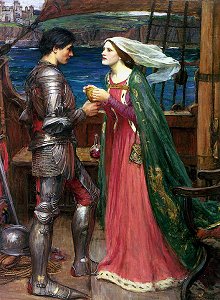
And yet, human nature being what it is, the profligate character of the courts was little different from our own wayward culture. There were those who did then and those who do now just as there were those who refrained from doing then and now. So the songs of the troubadours probably didn’t encourage licention any more or less than Whitney Houston or Britney Spears do today (which they do; the point being it wasn’t more then). But then, as now, the corpus of lit wasn’t confined only to the Whitneys and the Britneys of the day. Simultaneous with Gottfried, Cretien, and the troubadours, were many excellent composers of liturgical music, attesting to the fact that secular and sacred art lived in commune. Additionally among the secular artists, a prolific number of writers on the Arthurian cycle exist, numbering among them; the author of Pearl & Gawain and the Green Knight, the author of the Niebelungenlied, the Song of Roland, William of Malmesbury, Henry of Huntingdon, Geoffrey of MonMouth, Thomas of Britain and his great epic “Tristan”, not to mention Beroul and even Marie de France in Eleanor’s own court. Additionally there was Robert de Boron who treated the characters of Merlin and Perceval quite well. The German authors Eilhart von Oberge and Hartmann von Aue who reworked the stories of Tristan and Eric and Enid (it’s parallel). The prose poet of the French Tristan, Luce de Gat and the French “Perlesvaus” by an anonymous author also treat favorably the stories of tragic love. The Norse, the Dutch, even Hebrew has a “Melech Artu” which is a reworking of this legend and the Welsh have the “Mabinogion” and the “Culhwch and Olwen” stories as well as the Romances, “Owain”, “Geraint and Enid”, & “Peredur, son of Efrawg” and the Greeks have a “Presbys Hippotes”, “Priestly Horsemen” story. Later in history there is Malory, Ludovico Ariosto, and extending into our own generations, Tennyson, Pyle, White, even Steinbeck does a poor treatment of the story. Numerous musical compositions have been created by none other than Purcell, Handel, Wagner, and numerous others including Lerner & Loewe (for what its worth). One of the most popular masses composed during the Renaissance was the “Missa L’homme armee”, the man at arms mass, and churches throughout Europe abound with knightly imagery. Plays, artwork, poetry have been constructed based on the Arthurian cycle in a list too long to name here. J.R.R. Tolkien himself, when considering what subject matter might give frame to his vision, seriously considered reworking the Arthurian cycle. The imagery of the Arthurian cycle permeates today our pop culture, our advertising industry, our current vision of politics, religion, and how to live life. It is, I would argue, the most dominant paradigm the West possesses.
So what is so enduring about a myth which seems to extol adultery? The whole of the Camelot court seems, as Theresa of Avila suggests, rife with knights and ladies not only incapable of controlling themselves but not even trying so to do. Why is the Arthurian legend so enduring?

Primarily, the Arthurian Romance ennobles man’s general tendency toward violence. Historically, the stories channeled the violent tendencies of a dominant warrior class which ruled Europe at the time. Dr. BernardC points out that the Middle Ages consisted of a warrior class holding the land over a large population of peasant/serfs. This class of men were professionally trained killers who frequently practiced their arts on the local serfs. Atrocities were known to happen. The Arthurian stories suggest that such action is base and ignoble. The true knight protects the weak and only fights those who are his equals. This suggestion, which became pervasive due to the treatment of the theme, has far-reaching consequences. Our current idea of the warrior is one who limits his energy only to release it in a torrent of violence upon those who are evil. Indeed the very concept of combating evil seems to have emerged through the Arthurian cycle. Our vision of religion as a battle takes its theme from this (witness the Saint Michael character and the exercises of St Ignatius of Loyola). Our vision of justice owes much to this as well and hence our civil and political thought; bad men need to be fought; moral relativism (an Eastern concept) is itself a lie which undermines the good man. Arthurian Romance created in the West the vision that struggle, violence, and combat were not random perennial events which the poor man must suffer (as the Greeks thought; life was war with occasional peace), but the major activity of the good man on this earth.
Further, the Arthurian Romance elevated the vision of woman. Setting aside for a moment the stories of adultery, women in the romances are continually depicted as noble, worth honoring, beautiful and the basis of every court (this goes back as far as the proto-Arthurian romance of “Beowulf” in the character of Wealtheow). It was one of the maxims of Arthurian chivalry that a man honors a woman, even an adulterous woman. The claim that Guinevere was an adulteress (though true) was only spoken of openly by the bastard churl, Mordred. Even the weak and bumbling Gawain, who refuses to defend the pyre of Guinevere because of the death of his brothers, will not openly speak of her affair. Women, even adulterous women, are to be honored and their reputation preserved. Moreover, women are perpetually the source of knightly action. Whether the knight set out on the quest to honor his mistress, or to serve his queen, or to protect his wife, or even to be with his lover, he was always motivated by some woman somewhere. Homosexual love never occurs in the Arthurian legends and motivations due to greed, revenge, hubris, desire for more camels or cows or the lust to conquer are non-existent. All motivations in Arthurian Romance involve a woman; Mark’s jealousy of Tristan begins due to Isolde (though some claim that he also has intentions on Tristan as Saul might have had for David), Launcelot’s madness occurs because of the tension between Guinevere and Elaine, Merlin’s imprisonment is due to his love for Elaine the enchantress (not the same Elaine but a girl synonymous with the Lady of the Lake). This honoring of women is simultaneous with the amazing and odd rise of the cult of Mary throughout Europe. This cult in the Church has its origins in England but spread throughout all of Christendom. Thus we even now refer to Mary as “Mother of the Church” the “Virgin of Virgins” the “Star of the Sea” and other noble epithetic titles. Our vision of women as important to society comes from the Arthurian legends; our love of romance, our sense of chivalry toward women (and thus the counter, rampant feminism and the current misogyny of our culture) and even women’s suffrage are all beholden to these cycles (there has been no feminist movement in the Middle East, after all).
Third, the Arthurian Romances ennobled the vision of society and government through the stories of Camelot and the Grail Quest. In the writings of those authors who treat these particular themes with gravity Camelot becomes the paragon of human society; the subordinating of individual human desires in order to graft together divergent powers and interests and create a working community capable of greatness. Interestingly enough, the Camelot story is inseparable from the Grail Quest; what can the well-formed society achieve? Finding the Grail, of course! Ever since the Arthurian stories, our society in the West has sought exactly this. We seek in our politics, our art, our commercialism, our daily activity, the Grail; that “ever-receding Ausonian shore” as Virgil put it when describing Rome. All our longings hint at something beyond this world consisting of happiness, greatness, completion. As my father, Dr Rollin Lasseter, puts it in one of his poems, 
It is not so, we know it, despite snow,
These infinites you postulate
Beyond the reach of breath.
Mass is but mother of sorrows loaned
The void that we might suffocate.
This longing accounts for the sense of dissatisfaction which the West endures; the “god-shaped hole” to borrow the words of Bono. It also accounts for the perpetual self-critique to which the West subjects itself. Why haven’t we achieved the Grail? What have we done wrong? Was it our fault? What could we do better? What might we change? What exactly is the Grail? “What is the Secret,” asks Willy Loman. These are questions that no Easterner has ever asked (not that Eastern philosophy at its best doesn’t ask profound question, just not these). The West is perpetually reinventing itself because it constantly seeks this elusive Grail of perfection. The Grail represents that vision of perfection which can be conceived through mathematics, theology, philosophy, art & music, yet which only the truly good man (Galahad) can accomplish. Strangely, in all the stories of the Grail Quest, Galahad’s accomplishment doesn’t involve a trophy (he gets no Stanley Cup to take home, no shining Oscar to put on the mantel) but only a knowledge of himself, a gnothi seauton, and a love of that beauty to which he joins himself. The Grail, then, is phi, Christ, the perfect jazz riff, the zone on the basketball court, the ecstatic moment during “Long-Distance Runaround”, the grace of Peggy Fleming, the fluidity of Tiger Woods’ putt, the elegance of Wedgewood China, the S-curve in the statue of Our Lady of Perpetual Help, the beauty and power of the Pastoral Symphony, et alia (oh, I’m not equating Christ to Wedgewood China; work with me, people!) Over and over again people in the West launch into the Grail Quest with hope springing eternal that this time we might achieve the quest, this time we might find the Questing Beast, this time we might discover Avalon. Camelot, the perfect society, exists in order to accomplish this very difficult, fragile, excellent task; Camelot exists in order to form a more perfect union, that “government of the people, by the people, for the people, shall not perish from the earth”, that “all men, yes, black men as well as white men, (should) be guaranteed the unalienable rights of life, liberty and the pursuit of happiness.” Inexorably wound up with the formation of Camelot is the engagement in the Grail Quest.
It is not so, we know it, despite snow,
These infinites you postulate
Beyond the reach of breath.
Mass is but mother of sorrows loaned
The void that we might suffocate.
This longing accounts for the sense of dissatisfaction which the West endures; the “god-shaped hole” to borrow the words of Bono. It also accounts for the perpetual self-critique to which the West subjects itself. Why haven’t we achieved the Grail? What have we done wrong? Was it our fault? What could we do better? What might we change? What exactly is the Grail? “What is the Secret,” asks Willy Loman. These are questions that no Easterner has ever asked (not that Eastern philosophy at its best doesn’t ask profound question, just not these). The West is perpetually reinventing itself because it constantly seeks this elusive Grail of perfection. The Grail represents that vision of perfection which can be conceived through mathematics, theology, philosophy, art & music, yet which only the truly good man (Galahad) can accomplish. Strangely, in all the stories of the Grail Quest, Galahad’s accomplishment doesn’t involve a trophy (he gets no Stanley Cup to take home, no shining Oscar to put on the mantel) but only a knowledge of himself, a gnothi seauton, and a love of that beauty to which he joins himself. The Grail, then, is phi, Christ, the perfect jazz riff, the zone on the basketball court, the ecstatic moment during “Long-Distance Runaround”, the grace of Peggy Fleming, the fluidity of Tiger Woods’ putt, the elegance of Wedgewood China, the S-curve in the statue of Our Lady of Perpetual Help, the beauty and power of the Pastoral Symphony, et alia (oh, I’m not equating Christ to Wedgewood China; work with me, people!) Over and over again people in the West launch into the Grail Quest with hope springing eternal that this time we might achieve the quest, this time we might find the Questing Beast, this time we might discover Avalon. Camelot, the perfect society, exists in order to accomplish this very difficult, fragile, excellent task; Camelot exists in order to form a more perfect union, that “government of the people, by the people, for the people, shall not perish from the earth”, that “all men, yes, black men as well as white men, (should) be guaranteed the unalienable rights of life, liberty and the pursuit of happiness.” Inexorably wound up with the formation of Camelot is the engagement in the Grail Quest.
Unfortunately for all humanity, also wound up with the formation of Camelot is the Affair of Lancelot and Guinevere. It is in this context that the existence of adultery in the Arthurian cycles really becomes comprehensible. Maugre those troubadours and poets who merely used adultery to entertain and titillate, adultery was in the cycles the one major source of all ruination. Tristan & Isolde fall to ruin only when they finally consummate there implacable love for each other. Elaine commits suicide only when Lancelot returns to adultery with Guinevere (a prefigurement of the later Camelot ruin). Merlin is ruined by adultery as is Uther Pendragon as is Gawain as is Arthur himself (whose adulterous/incestuous affair with his half-sister, Morgana le Fay, becomes the proximate cause of Camelot’s destruction). Adultery is not simply the fun, frivolous flaunting of Christian principles, it evades those principles in order to undermine the very root of human existence. What the adulterous complications in the Arthurian cycle point out is that fundamentally every human being is deeply flawed, and thus deeply in need of redemption. All humans struggle with the fomes (as Thomas called them); those powerful tugs on the human heart that seek to lead us toward things lesser than God. These fomes Augustine called “the gods” (and indeed he was probably more accurate than he thought since most of the Greeks and Romans thought of them as such, too); powers that when worshipped as gods become demons. We see these powers in our own culture; sex, violence, power, rebellion, sex, revenge, sloth, money, avarice, sex, sex, and sex. Indeed of these powers the most powerful, the unbridled sexual urge, Venus or Aphrodite or Astarte or Ishtar, causes ruin more often than any other. Failure in this realm leads to drug use, self-abuse, avarice, power grabbing, viciousness and all the other maladies of Pandora’s box (no pun intended there, no way…). Man seeks beauty, and is drawn, inexplicably, erotically toward beauty. But when that beauty is thwarted we fall to the worst forms of bestiality and vice ever conceived. So the adultery in the Arthurian stories becomes metaphor of this failed attraction toward that which is most loved and most unattainable. It embodies a tension in man between what he desires and what he knows he ought to desire. God, after all, is already married. Who are we to love Him? Who are we to presume that the Queen would look kindly upon us in our pathetic lowliness and bumbling incompetence? And when we don’t gain that ecstasy of heaven and settle for second best (the mistress, the job, fame) what disaster do we reek on ourselves and others? We end, as Lancelot does, running around the Grail Chapel, weeping because we cannot find the door in. Pathetic. Miserable. Imminently human. Thus the Grail/Camelot/Affair story embodies what we in the West see as The Human Story; misery, pain, longing for love, ruining things by our ineptitude, and seemingly unable to stop it all. 
Yet the Arthurian Cycle doesn’t quit there. Perhaps this is the greatest element of the stories in the West. Greeks saw life as tragedy and ruin. The East sees things as destiny and karma. The Arthurian Cycle suggests that there is a form of redemption even after our failure. We still believe in goodness despite suffering blow upon blow upon blow. As my father writes in one of his poems,
Why still, beset by enemies the heart upholds,
To hear within that abstract horde, grown cold,
Persistent rumbles of the Night she praised,
The flashes lighting wide the Western skies
And then
The long-locked thunder of the Cross?
Christianity infuses this vision of the Arthurian cycle, certainly, but is also owing to it for the marvelous concrete figure which the stories give to the concept of salvation. After Camelot is annihilated, the knights all dead or scattered, the court at Carlisle a blackened hulk, the women homeless, childless, or master-less, two things happen. First, Arthur, with his dying breath commits his sword, Excalibur, back to the Lady of the Lake. He thus fulfills the promise which eventually made him king and relinquishes the symbol of earthly power and intellect granted to him to complete his task of the Grail. To borrow Tolkien’s wording, he gives up the ring. Consequently, Arthur, like Galadriel, refuses the power of a god, diminishes into the West, and remains Arturus Magnus. Because of this last act of heroism on his part he is taken to the undying lands of Avalon by the spirits of the magical world of Faerie. Even Arthur, in his incompetence as king/husband/father and his failure to perceive his wife’s infidelity transpiring in his own court, redeems himself by a last valiant act of humanity.
Why still, beset by enemies the heart upholds,
To hear within that abstract horde, grown cold,
Persistent rumbles of the Night she praised,
The flashes lighting wide the Western skies
And then
The long-locked thunder of the Cross?
Christianity infuses this vision of the Arthurian cycle, certainly, but is also owing to it for the marvelous concrete figure which the stories give to the concept of salvation. After Camelot is annihilated, the knights all dead or scattered, the court at Carlisle a blackened hulk, the women homeless, childless, or master-less, two things happen. First, Arthur, with his dying breath commits his sword, Excalibur, back to the Lady of the Lake. He thus fulfills the promise which eventually made him king and relinquishes the symbol of earthly power and intellect granted to him to complete his task of the Grail. To borrow Tolkien’s wording, he gives up the ring. Consequently, Arthur, like Galadriel, refuses the power of a god, diminishes into the West, and remains Arturus Magnus. Because of this last act of heroism on his part he is taken to the undying lands of Avalon by the spirits of the magical world of Faerie. Even Arthur, in his incompetence as king/husband/father and his failure to perceive his wife’s infidelity transpiring in his own court, redeems himself by a last valiant act of humanity.
Second, both Lancelot and Guinevere, realizing too late the severe consequence of their ill-conceived affair, try to make amends for what they have done. She first enters a convent and denies Lancelot all access to her person. It is agony for her, but she knows it is necessary if she is to find any modicum of happiness. At last, sick and delirious from starvation she calls him one last time, tells him that she no longer loves him but loves Arthur, the “love of her girlhood” and then dies. He, driven to grief by her loss, enters a monastery where he finishes his days in acts of penitence, charity and prayer, “weeping out his last days” as Malory puts it. The ending of these two great figures reminds me of Sebastian Flyte, dying miserably on the steps of the monastery in “Brideshead Revisited.” Yet there is some salvation for these broken and wayward figures. Even losers can find redemption. As Kierkegaard put it, we “work out our salvation in fear and trembling.” I don’t think this is an encomium of such a life as the ideal, as Goethe might have it, but rather a recognition that in our worst moments as humans there might yet be some glimmer of hope. Hope seems, then, a distinctly Western ideal. Westerners do not habitually throw themselves on their swords, barring the ever honorable Romans; hari-kari is not our way. Rather, the underdog, the Rocky (be he III, IV, or MCM), the William Holden, the Cinderella Man, the Shane, becomes our model. Though tragic in its own right, the story of Lancelot and Guinevere (and its parallels in Tristan & Isolde, et alia) is really a story of redemption. Every man fails, inevitably; Finnsburgh burns, Beowulf dies, Peter betrays Christ, Frodo refuses the quest. What a man does with that failure afterwards determines his character as a churl or as a Chevalier au Lion. 
Dedicatum cordi meo, Beth. Grazie, carissima bella.
Dedicatum cordi meo, Beth. Grazie, carissima bella.